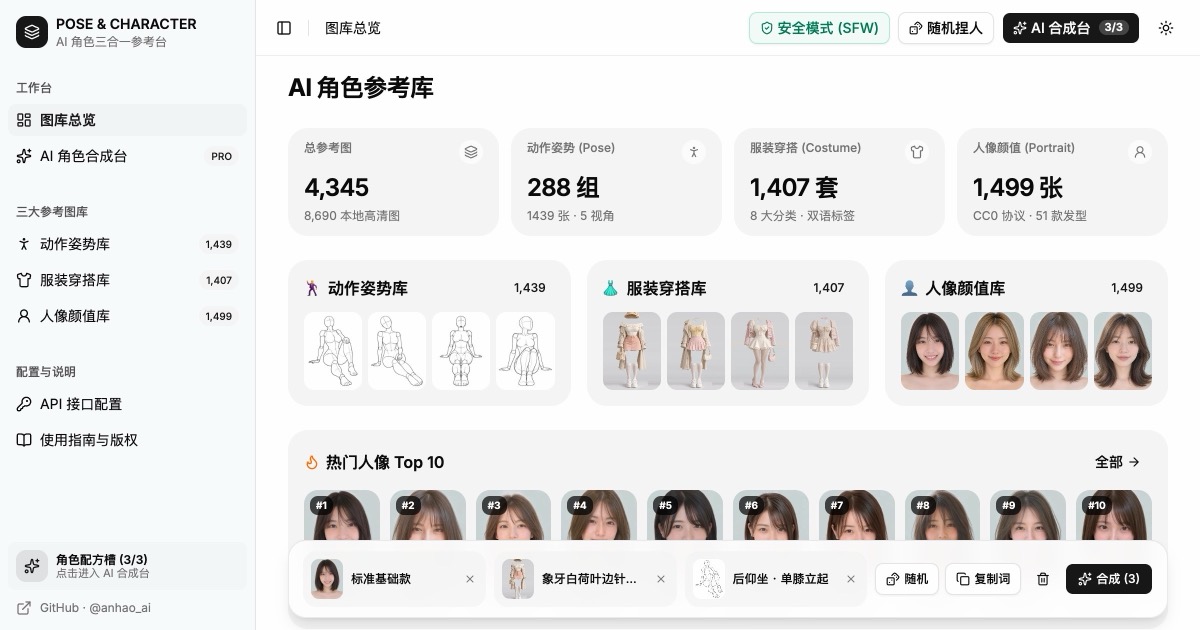
AI POSE Gallery Zh
Chinese localized AI character reference gallery and studio
A static web gallery and studio merges pose, costume, and portrait references with optional ComfyUI nodes and multiple cloud image APIs.
696 open-source projects in AI & Machine Learning, compared by GitHub stars, license and self-hosting.
Chinese localized AI character reference gallery and studio
A static web gallery and studio merges pose, costume, and portrait references with optional ComfyUI nodes and multiple cloud image APIs.

Open-source AI answer engine with a generative UI
Morphic is an AI-powered search engine that returns grounded, cited answers rendered as rich inline components. It supports multiple model and search providers and can be run locally with Docker Compose.

SoftVC VITS singing voice conversion with realtime use
This fork of so-vits-svc adds realtime voice conversion, a GUI, and a unified CLI. Models align with so-vits-svc 4.0 v1 branch compatibility.

Multimodal database and vector store for AI workloads
Deep Lake stores, versions, and queries AI data including embeddings and media, with vector search and training-time streaming from your own cloud.

Local-first microVM runtime for untrusted workloads
Microsandbox runs agents, user code, and automation inside hardware-isolated microVMs with CLI and SDKs, locally or on managed cloud.

Fast online machine learning with contextual bandits
Vowpal Wabbit is an online learning system for reinforcement, supervised, and interactive problems with hashing, reductions, and a flexible text feature format.

Open-source datacenter-scale distributed generative AI inference stack
Dynamo coordinates vLLM, SGLang, and TensorRT-LLM across many GPUs and nodes. It adds routing, disaggregated prefill and decode, KV cache management, and autoscaling without replacing those engines.
PyTorch k-bit quantization for large language models
bitsandbytes reduces GPU memory for LLM training and inference via 8-bit optimizers, LLM.int8() inference, and QLoRA 4-bit training modules.
Multi-user hub for shared Jupyter notebook servers
JupyterHub runs a central hub that spawns and proxies separate Jupyter notebook environments for many signed-in users. Project Jupyter built it for classrooms, teams, and research groups.

Browser sidebar and UI for local AI models
Page Assist is an open-source browser extension with a sidebar and full-page web UI for local AI models. It connects to OpenAI-compatible endpoints such as Ollama from any webpage.

Self-hosted multi-device AI agent and workspace hub
Yao Agents centralizes agents and workspaces across desktop, mobile, browser, and API. A task board tracks work while agents run on your own machines.

Local-first open-source desktop AI design and prototyping tool
Open CoDesign turns prompts into prototypes, slides or PDFs on your machine with BYOK models and optional ChatGPT subscription sign-in.

Open-source browser API for AI agents and web automation
Steel is an open-source browser API that runs managed Chrome sessions for AI agents and apps. It handles sessions, proxies and stealth, and works with Puppeteer, Playwright or Selenium.

Local-first multi-agent desktop team for macOS and Windows
Orkas is a desktop app where a Commander agent plans work, coordinates specialist agents, and connects Claude Code, Codex, and other CLI agents. Data stays on your machine by default.
Multilingual Python natural language processing toolkit
Stanza provides neural NLP pipelines for 60+ languages—tokenization, tagging, parsing, NER—and a Python wrapper for Stanford CoreNLP.

Python framework for LLM input and output guards
Guardrails helps Python applications validate and shape large language model inputs and outputs. It combines risk validators with utilities to produce structured data from model responses.
Programmable safety controls for LLM and agent apps
NeMo Guardrails is an open-source Python library that applies configurable input, output, and tool-call checks to conversational apps, RAG pipelines, and agents.

Open-source agent skills and vibe workflow platform
Refly compiles business workflows into versioned agent skills you run in its workspace or export as APIs and webhooks. Skills are meant as reusable infrastructure rather than one-off prompts.

Open-source OpenTelemetry-based observability for LLM applications
OpenLLMetry is a set of OpenTelemetry extensions and a Traceloop SDK that trace LLM applications, including LLM provider and vector database calls, and send standard telemetry to existing observability tools.

Go language bindings for OpenCV computer vision
GoCV wraps OpenCV 4 for Go programs, covering capture, image processing, DNN, CUDA, OpenVINO, and contrib modules. It targets Linux, macOS, Windows, and Docker, with Android support in progress.

Offline web toolkit for TensorFlow training runs
Web-based suite for inspecting scalars, graphs, images, and other summaries written from TensorFlow training jobs.

LLM and RAG conversational analytics and Text-to-SQL
SQLBot answers natural-language data questions, generates SQL with RAG, and returns charts. It offers workspace isolation, fine permissions, and embed options.

Open AI search and vector serving platform
Vespa queries and ranks vectors, tensors, text, and structured data at serving time. It targets search, recommendations, personalization, and RAG with sub-100ms latency at large scale.

Open-source actor platform for running and scaling agent workloads
Rivet Actors are long-lived processes with in-memory state, SQLite storage, WebSockets and scheduling, one per agent, user or session. Data lives in object storage; the control plane is self-hosted or managed
 Bolt.new
 Claude Cowork