
TensorFlow
End-to-end machine learning platform and tooling ecosystem
TensorFlow is a machine learning platform with Python and C++ APIs, optional GPU packages, and companion libraries for data, training, deployment, and visualization.
PyTorch k-bit quantization for large language models
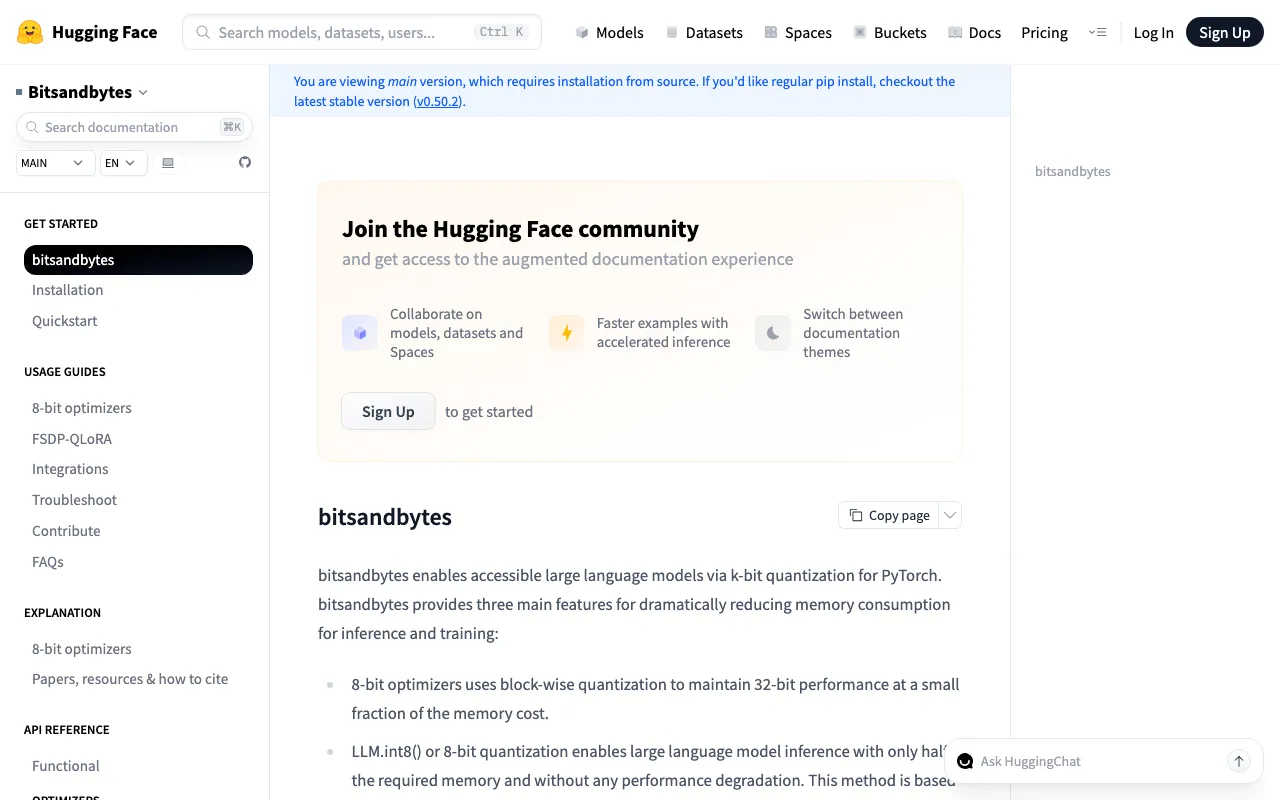
bitsandbytes reduces GPU memory for LLM training and inference via 8-bit optimizers, LLM.int8() inference, and QLoRA 4-bit training modules.
bitsandbytes is a PyTorch library that makes large language models more accessible through k-bit quantization. It provides three main capabilities: block-wise 8-bit optimizers that cut optimizer memory while targeting 32-bit behavior, LLM.int8() inference that halves memory via vector-wise 8-bit quantization with 16-bit outlier handling, and QLoRA 4-bit training that quantizes weights and adds trainable low-rank adapters.
Developers use bitsandbytes.nn.Linear8bitLt and Linear4bit layers plus optimizers in bitsandbytes.optim. Documentation is integrated with Hugging Face Transformers, Diffusers, and PEFT ecosystems.
Platform support spans Linux and Windows on x86-64 and arm64, plus macOS 14+ on Apple Silicon, with NVIDIA CUDA, AMD ROCm-style GPUs, Intel XPU, Intel Gaudi HPU, and Metal MPS backends documented in the requirements matrix. Python 3.10+ is required; current branch notes may differ from latest stable releases.
Some accelerator combinations are partially supported or lack optimized 8-bit optimizer paths, as noted in the compatibility table. The project is MIT licensed and cites academic work behind QLoRA, LLM.int8(), and 8-bit optimizers.
End-to-end machine learning platform and tooling ecosystem
TensorFlow is a machine learning platform with Python and C++ APIs, optional GPU packages, and companion libraries for data, training, deployment, and visualization.

Run open AI models locally or in the cloud
Ollama runs open language models such as Gemma, Qwen, DeepSeek and gpt-oss on macOS, Windows and Linux, locally or in the cloud. It offers a CLI, a REST API, and Python and JavaScript libraries.

Shared model definitions for multimodal ML workloads
Transformers is a Python library that defines pretrained text, vision, audio, and multimodal models once in PyTorch for shared inference and training across the ecosystem.

LLM inference engine in C/C++ for local and cloud hardware
llama.cpp runs large language models and multimodal models locally or in the cloud with minimal setup. It includes a CLI, an OpenAI-compatible server with a built-in chat app, and a C library API.

General-purpose speech recognition and translation model
Whisper is a speech recognition model trained on diverse audio. It supports multilingual transcription, speech-to-English translation, and language identification via Python or the command line.

High-throughput, memory-efficient inference and serving engine for LLMs
vLLM is a library and server for running and serving large language models. It uses PagedAttention and continuous batching for throughput, offers an OpenAI-compatible API, and runs on many GPU, CPU and accelerator types.