
Argo Workflows
Kubernetes-native container workflow engine
Argo Workflows orchestrates parallel container jobs on Kubernetes using custom resources. Each step is a container, arranged as sequential tasks or DAG dependencies.
Open-source datacenter-scale distributed generative AI inference stack
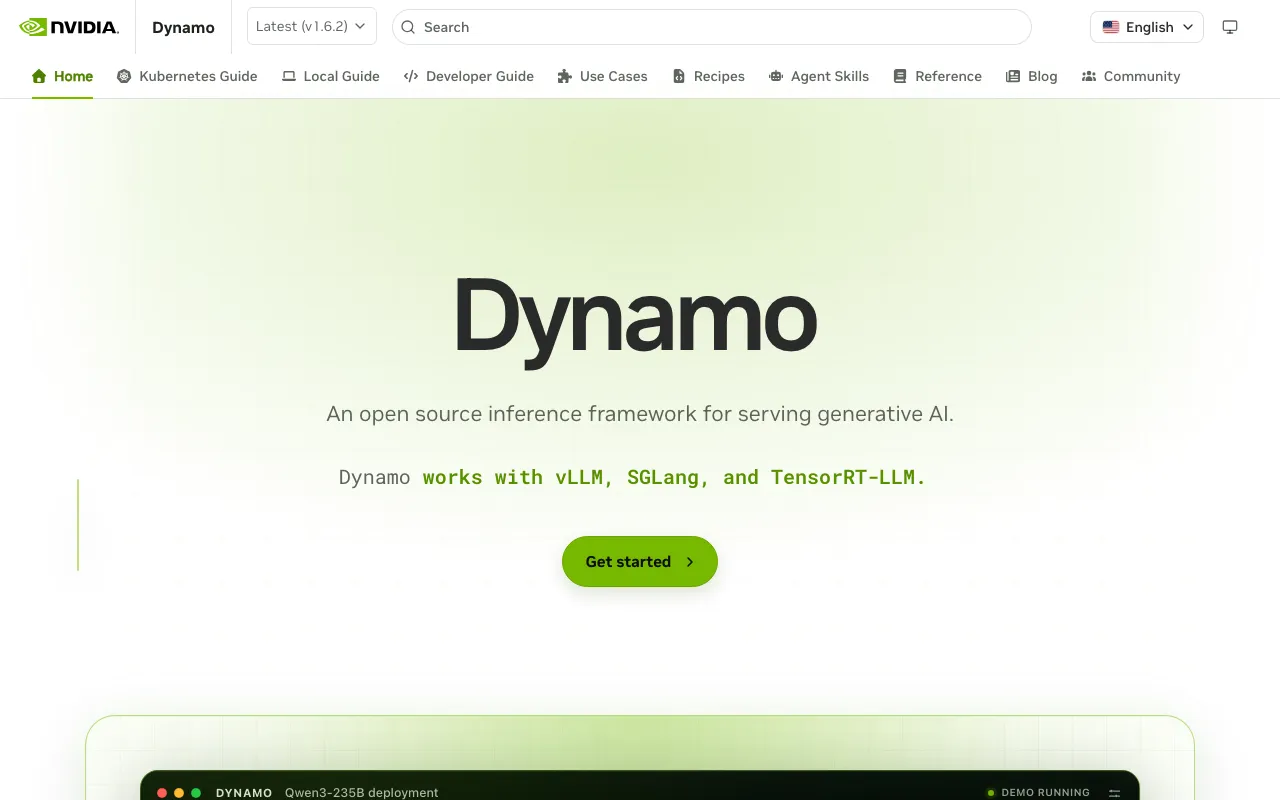
Dynamo coordinates vLLM, SGLang, and TensorRT-LLM across many GPUs and nodes. It adds routing, disaggregated prefill and decode, KV cache management, and autoscaling without replacing those engines.
Dynamo is an open inference framework for serving generative AI. It sits above popular inference engines and turns a cluster of GPUs into a coordinated system for LLM, reasoning, multimodal, and video generation workloads.
The stack combines disaggregated serving, KV-aware routing, multi-tier KV caching, and automatic scaling to raise throughput and cut latency. A frontend can expose an OpenAI-compatible API while a router selects workers based on load and cache overlap. Prefill and decode can run in separate, independently scaled GPU pools.
Dynamo works with vLLM, SGLang, and TensorRT-LLM and supports NVIDIA and AMD GPUs and Intel XPUs. You can deploy on Kubernetes, Slurm, or locally, and adopt individual components such as the frontend, router, planner, or cache manager as needs grow.
For production clusters, the platform can be installed and deployed from manifests, with pre-built recipes for common models. Local and container quick starts are documented, along with a Kubernetes Gateway API inference extension for KV-aware routing inside standard gateway setups.
Kubernetes-native container workflow engine
Argo Workflows orchestrates parallel container jobs on Kubernetes using custom resources. Each step is a container, arranged as sequential tasks or DAG dependencies.
Unified orchestration layer for AI compute across GPU clouds and clusters
Open-source control plane for provisioning GPU compute and running training and inference on GPU clouds, Kubernetes, Slurm, VMs, or bare-metal clusters. Supports NVIDIA, AMD, Google TPU, and Tenstorrent accelerators.

End-to-end machine learning platform and tooling ecosystem
TensorFlow is a machine learning platform with Python and C++ APIs, optional GPU packages, and companion libraries for data, training, deployment, and visualization.

Run open AI models locally or in the cloud
Ollama runs open language models such as Gemma, Qwen, DeepSeek and gpt-oss on macOS, Windows and Linux, locally or in the cloud. It offers a CLI, a REST API, and Python and JavaScript libraries.

Shared model definitions for multimodal ML workloads
Transformers is a Python library that defines pretrained text, vision, audio, and multimodal models once in PyTorch for shared inference and training across the ecosystem.

LLM inference engine in C/C++ for local and cloud hardware
llama.cpp runs large language models and multimodal models locally or in the cloud with minimal setup. It includes a CLI, an OpenAI-compatible server with a built-in chat app, and a C library API.