
TensorFlow
End-to-end machine learning platform and tooling ecosystem
TensorFlow is a machine learning platform with Python and C++ APIs, optional GPU packages, and companion libraries for data, training, deployment, and visualization.
Multilingual Python natural language processing toolkit
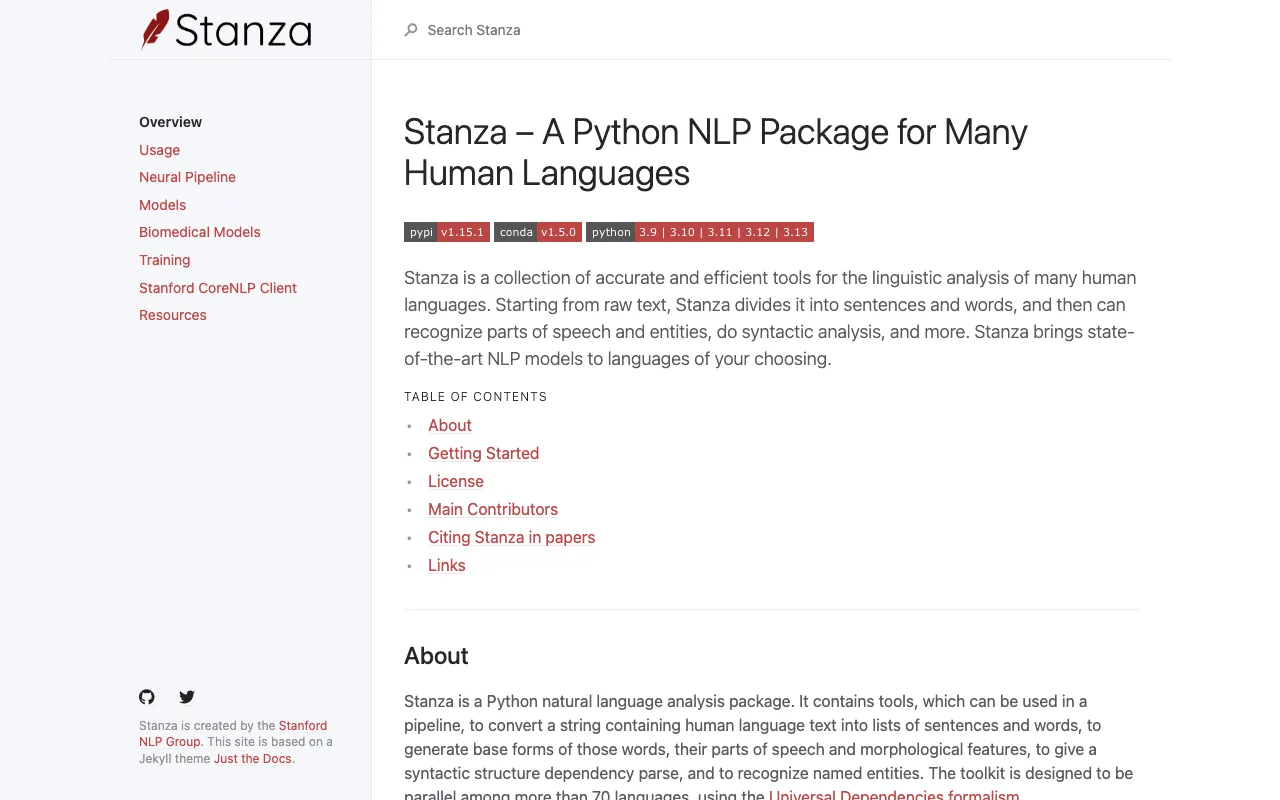
Stanza provides neural NLP pipelines for 60+ languages—tokenization, tagging, parsing, NER—and a Python wrapper for Stanford CoreNLP.
Stanza is the Stanford NLP Group’s Python library for linguistic analysis across many human languages. From raw text it can segment sentences and words, expand multi-word tokens, lemmatize, tag parts of speech and morphology, parse dependencies under Universal Dependencies, and recognize named entities. Pretrained models cover Universal Dependencies treebanks and NER for widely spoken languages, with additional biomedical and clinical English packages for literature and clinical notes.
The native pipeline is implemented in PyTorch and can run faster on GPU hardware. Modules are designed for batching: concatenating documents separated by blank lines improves throughput compared with processing one sentence per loop. You install via pip or conda, download language models, and run a Pipeline in Python; CoreNLP Java features require a separate CoreNLP download and CORENLP_HOME configuration.
Beyond the neural stack, Stanza includes an official Python client for the Java Stanford CoreNLP software, exposing constituency parsing, coreference, Semgrex, and related tools when CoreNLP is present. Training custom tokenizer, tagger, lemmatizer, parser, or NER models uses CoNLL-U or BIOES data from a source checkout rather than the high-level Pipeline API alone.
Documentation covers installation, getting started, biomedical models, FAQs, interactive Colab notebooks, and examples for calling CoreNLP through Python.
End-to-end machine learning platform and tooling ecosystem
TensorFlow is a machine learning platform with Python and C++ APIs, optional GPU packages, and companion libraries for data, training, deployment, and visualization.

Run open AI models locally or in the cloud
Ollama runs open language models such as Gemma, Qwen, DeepSeek and gpt-oss on macOS, Windows and Linux, locally or in the cloud. It offers a CLI, a REST API, and Python and JavaScript libraries.

Shared model definitions for multimodal ML workloads
Transformers is a Python library that defines pretrained text, vision, audio, and multimodal models once in PyTorch for shared inference and training across the ecosystem.

LLM inference engine in C/C++ for local and cloud hardware
llama.cpp runs large language models and multimodal models locally or in the cloud with minimal setup. It includes a CLI, an OpenAI-compatible server with a built-in chat app, and a C library API.

General-purpose speech recognition and translation model
Whisper is a speech recognition model trained on diverse audio. It supports multilingual transcription, speech-to-English translation, and language identification via Python or the command line.

High-throughput, memory-efficient inference and serving engine for LLMs
vLLM is a library and server for running and serving large language models. It uses PagedAttention and continuous batching for throughput, offers an OpenAI-compatible API, and runs on many GPU, CPU and accelerator types.