FreeDomain
Free domain registration with DNS learning resources
DigitalPlat FreeDomain lets people register free domains under several extensions, point custom nameservers at a DNS provider, and follow guides from setup through deployment.
Multi-user hub for shared Jupyter notebook servers
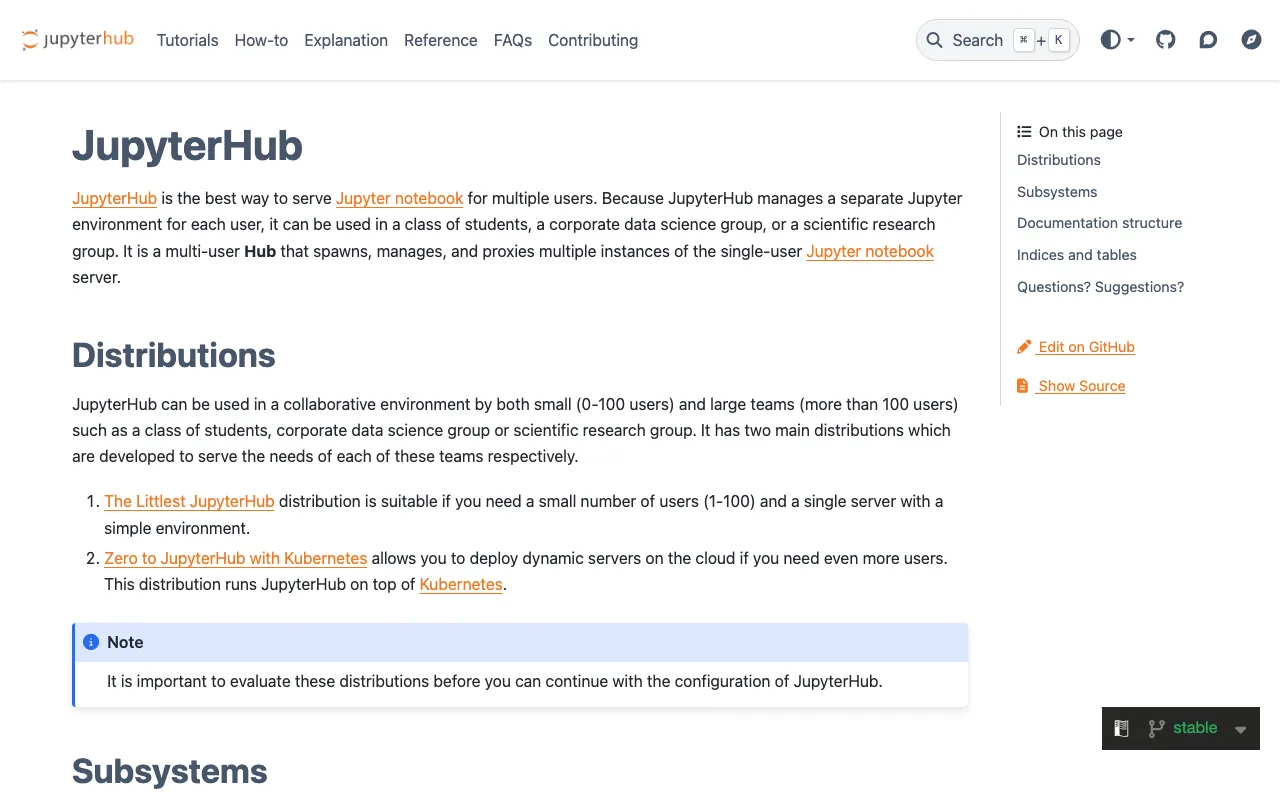
JupyterHub runs a central hub that spawns and proxies separate Jupyter notebook environments for many signed-in users. Project Jupyter built it for classrooms, teams, and research groups.
JupyterHub is a multi-user server that creates a hub process to spawn, manage, and proxy many single-user Jupyter notebook servers. The hub handles login, starts notebook servers on demand, and routes traffic through a configurable HTTP proxy so each user gets an isolated environment.
Operation centers on three parts: the hub (a Tornado process), an HTTP proxy, and multiple single-user notebook servers. After the hub starts the proxy, it forwards requests, authenticates users, and tells the proxy which URL prefixes belong to each running server. An administration REST API is available for managing the hub and its users.
Authenticators and spawners are pluggable. Defaults include PAM for login and local process spawners, but deployments can swap in other options. Distributions such as The Littlest JupyterHub target smaller teams on one server, while Zero to JupyterHub with Kubernetes targets larger cloud deployments on Kubernetes.
You can install with conda or pip, run the hub with the jupyterhub command, and visit it in a browser to sign in. Official support targets Linux and Unix systems; Docker images on quay.io provide a baseline hub container that still needs custom authenticator or spawner configuration. For Windows, documentation suggests running the hub inside Docker or a Linux VM.
Free domain registration with DNS learning resources
DigitalPlat FreeDomain lets people register free domains under several extensions, point custom nameservers at a DNS provider, and follow guides from setup through deployment.

End-to-end machine learning platform and tooling ecosystem
TensorFlow is a machine learning platform with Python and C++ APIs, optional GPU packages, and companion libraries for data, training, deployment, and visualization.

Run open AI models locally or in the cloud
Ollama runs open language models such as Gemma, Qwen, DeepSeek and gpt-oss on macOS, Windows and Linux, locally or in the cloud. It offers a CLI, a REST API, and Python and JavaScript libraries.

Shared model definitions for multimodal ML workloads
Transformers is a Python library that defines pretrained text, vision, audio, and multimodal models once in PyTorch for shared inference and training across the ecosystem.

LLM inference engine in C/C++ for local and cloud hardware
llama.cpp runs large language models and multimodal models locally or in the cloud with minimal setup. It includes a CLI, an OpenAI-compatible server with a built-in chat app, and a C library API.

General-purpose speech recognition and translation model
Whisper is a speech recognition model trained on diverse audio. It supports multilingual transcription, speech-to-English translation, and language identification via Python or the command line.