
PrivateGPT
Local API layer for private RAG and agent apps
PrivateGPT is an open API that sits above any OpenAI-compatible inference server. It adds ingestion, retrieval with citations, tools, MCP, databases, and a workbench UI for demos.
Programmable safety controls for LLM and agent apps
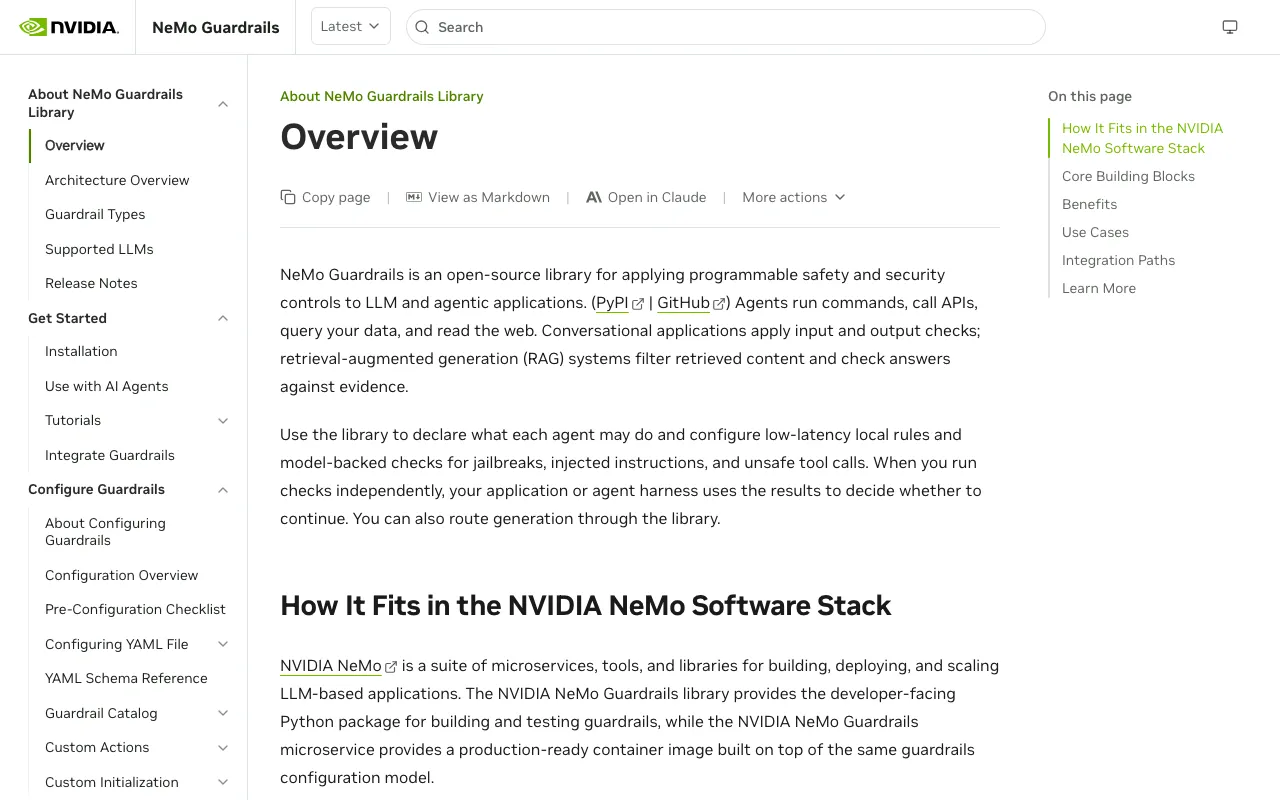
NeMo Guardrails is an open-source Python library that applies configurable input, output, and tool-call checks to conversational apps, RAG pipelines, and agents.
NeMo Guardrails lets teams declare what agents and chat applications may do through policy configuration, mixing fast local rules with model-backed checks for jailbreaks, injected instructions, and unsafe tool use. Agents that run commands, call APIs, query data, and read the web can be gated at prompts, responses, retrieved content, and tool boundaries.
You define rails, models, and prompts in configuration files, then run the library inside your Python process or deploy it as a standalone server. Check mode keeps your application in control of LLM and tool execution while sending relevant payloads to the library for verdicts; proxy mode routes generation through the library so input and output rails run on the traffic path.
Supported patterns include conversational moderation, RAG grounding and sensitive-data handling, tool-call and tool-result validation, regex and CEL rules, LLM self-checks, third-party moderation APIs, and hooks for coding agents. Integrations span the Python SDK, a Checks API, a gateway server, and a hooks server.
The library is Apache 2.0 licensed and designed to run with your choice of local detectors or hosted inference endpoints. Configurations can align with the separate NeMo Guardrails microservice so policies can move between local development and production deployment.
NVIDIA-NeMo Guardrails doesn't name these products itself, but its own description shows it does the same job.
Local API layer for private RAG and agent apps
PrivateGPT is an open API that sits above any OpenAI-compatible inference server. It adds ingestion, retrieval with citations, tools, MCP, databases, and a workbench UI for demos.
Reference stack for running AI agents in NVIDIA OpenShell sandboxes
Open-source reference stack that runs supported AI agents (OpenClaw, Hermes, LangChain Deep Agents Code) inside NVIDIA OpenShell sandboxes, with guided onboarding, managed inference, network policy and lifecycle commands through a CLI.

Python framework for LLM input and output guards
Guardrails helps Python applications validate and shape large language model inputs and outputs. It combines risk validators with utilities to produce structured data from model responses.

Open-source plugin-based agent harness from DeepSeek
DeepSeek Harness is an open-source agent harness built on an everything-is-a-plugin architecture powered by Cordis. It offers a web UI, desktop app, and extensible plugins for daily work, coding, and automation.

Self-improving open-source AI agent with memory, skills and messaging gateway
Open-source AI agent from Nous Research that keeps persistent memory, creates skills from experience, and runs from a terminal, desktop app or messaging platforms with any model provider.

Web scrape crawl and search infrastructure for AI agents
Firecrawl turns websites into LLM-ready markdown and structured data via API, CLI, and MCP. It supports scrape, crawl, map, batch jobs, optional cloud scale, and self-hosted server deployment.
 Anthropic Claude
 ChatGPT