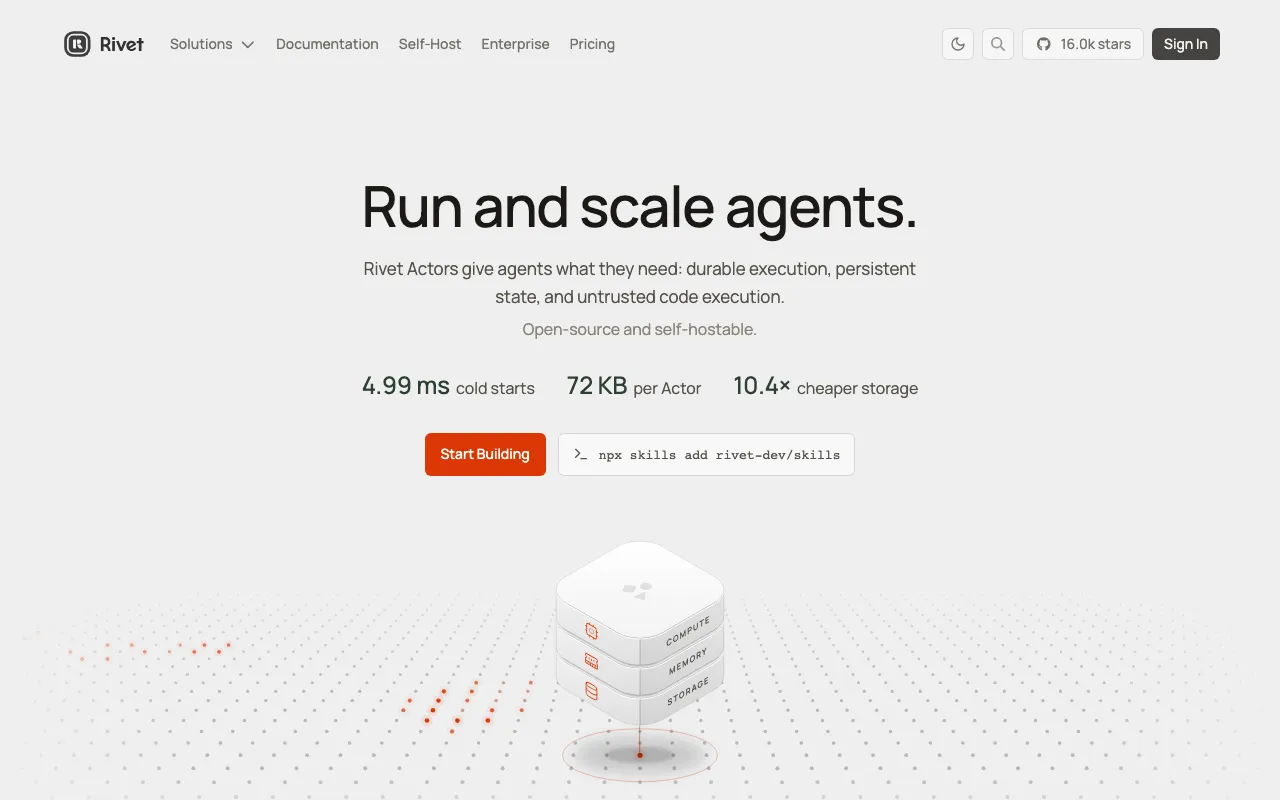
Rivet Actors are long-lived processes with in-memory state, SQLite storage, WebSockets and scheduling, one per agent, user or session. Data lives in object storage; the control plane is self-hosted or managed
Overview
Rivet is an orchestrator built around Actors: long-lived processes that hold in-memory state, a SQLite database, WebSocket connections and scheduling. You can create one Actor per agent, user, session or tenant. Actors share a Node.js, Bun or Rust process instead of each booting its own container or VM, so a single server can hold very large numbers of them. The project reports a 4.99 ms p99 cold start and 72 KB of memory per Actor.
All Actor data is stored in object storage such as Amazon S3, Google Cloud Storage, Azure Blob Storage, or S3-compatible stores like MinIO and Cloudflare R2. Per-Actor SQLite is served at SSD-like latency, and idle Actors hibernate and wake on the next request with their state intact. There is no separate database or message bus to run. A local filesystem backend is available for trying it on one machine.
Built-in features include fault tolerance (Actors are rescheduled onto other nodes if a node fails), HTTP and WebSocket networking, end-to-end typed clients, React hooks, cron and scheduling, Actor-to-Actor calls, scoped JWTs, and OpenTelemetry output. Optional libraries on top of Actors cover durable agents, workflows, and agentOS, a lightweight sandbox for running code that agents write. A preview feature deploys a backend per user for AI-generated apps.
The control plane is a Rust binary that schedules, routes and persists Actors. You can self-host it with Docker Compose, Kubernetes, a VM or bare metal, or on platforms such as Hetzner, AWS ECS, Railway and Render. Rivet Cloud offers managed dedicated clusters on AWS or GCP. A BYOC option runs the control plane in your own VPC, managed by Rivet. SDKs are available for TypeScript, Rust, and experimental Python and Swift clients.
Key features
- Long-lived Actors with in-memory state
- Per-Actor SQLite backed by object storage
- Hibernation when idle, wake on demand
- HTTP and WebSocket networking
- Cron and scheduling
- Fault tolerance with automatic rescheduling
- Typed clients and React hooks
- OpenTelemetry traces, metrics and logs
Use cases
- Durable multiplayer AI agents
- Multi-step workflows that replay after a crash
- Running code generated by AI agents
- Collaborative editing with one Actor per document
- Self-hosted alternative to Durable Objects



 Anthropic Claude
 ChatGPT