REA
MCP and CLI reverse-engineering toolkit for agents
REA connects coding agents and terminals to local analysis tools for binaries, Electron apps, websites, .NET, and Android targets. Setup registers MCP access and investigation skills via npm.

Local-first microVM runtime for untrusted workloads
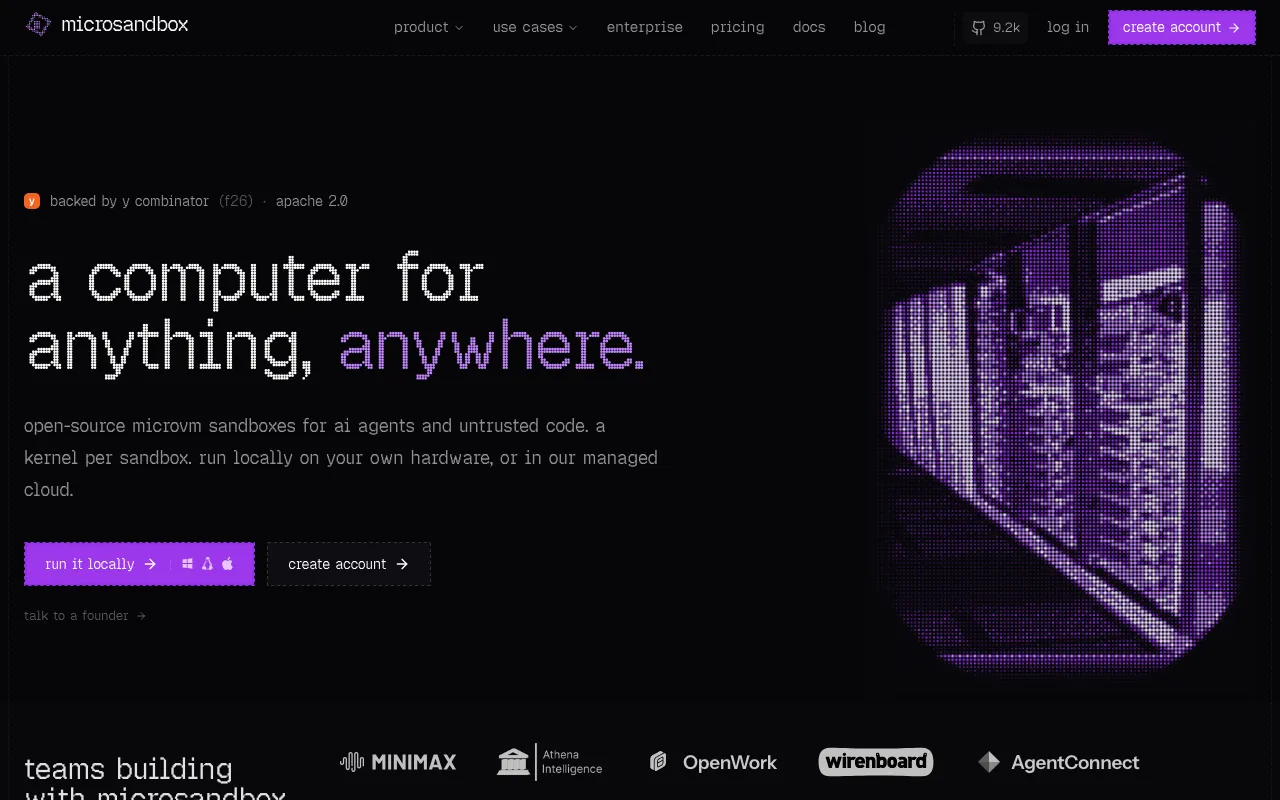
Microsandbox runs agents, user code, and automation inside hardware-isolated microVMs with CLI and SDKs, locally or on managed cloud.
Microsandbox is an open-source runtime for executing untrusted workloads—AI agents, plugins, CI jobs, scrapers, and similar tasks—inside fast microVMs that each have their own kernel boundary, unlike ordinary containers that share a host kernel. It targets local-first use with optional managed cloud deployment using the same SDK.
The msb CLI manages sandboxes, snapshots, images, and volumes. SDKs for Rust, TypeScript, Python, Go, and Ruby let applications call Sandbox.builder(...).create() to boot a microVM as a child process without separate infrastructure. Requirements noted in the source include Apple Silicon on macOS, KVM on Linux, and WHP on Windows; the project labels itself beta with possible breaking changes.
Agent Skills and an MCP server teach coding agents to control sandbox lifecycle, commands, filesystem access, volumes, and monitoring. Guides cover Docker inside a sandbox, Playwright, browser-use agents, GitHub Actions runners, and warm worker snapshots.
Managed Microsandbox Cloud offers orgs, SSO, audit logs, and quotas while the Apache-licensed runtime can be evaluated for bring-your-own-cloud deployments.
MCP and CLI reverse-engineering toolkit for agents
REA connects coding agents and terminals to local analysis tools for binaries, Electron apps, websites, .NET, and Android targets. Setup registers MCP access and investigation skills via npm.

End-to-end machine learning platform and tooling ecosystem
TensorFlow is a machine learning platform with Python and C++ APIs, optional GPU packages, and companion libraries for data, training, deployment, and visualization.

Run open AI models locally or in the cloud
Ollama runs open language models such as Gemma, Qwen, DeepSeek and gpt-oss on macOS, Windows and Linux, locally or in the cloud. It offers a CLI, a REST API, and Python and JavaScript libraries.

Shared model definitions for multimodal ML workloads
Transformers is a Python library that defines pretrained text, vision, audio, and multimodal models once in PyTorch for shared inference and training across the ecosystem.

LLM inference engine in C/C++ for local and cloud hardware
llama.cpp runs large language models and multimodal models locally or in the cloud with minimal setup. It includes a CLI, an OpenAI-compatible server with a built-in chat app, and a C library API.

General-purpose speech recognition and translation model
Whisper is a speech recognition model trained on diverse audio. It supports multilingual transcription, speech-to-English translation, and language identification via Python or the command line.