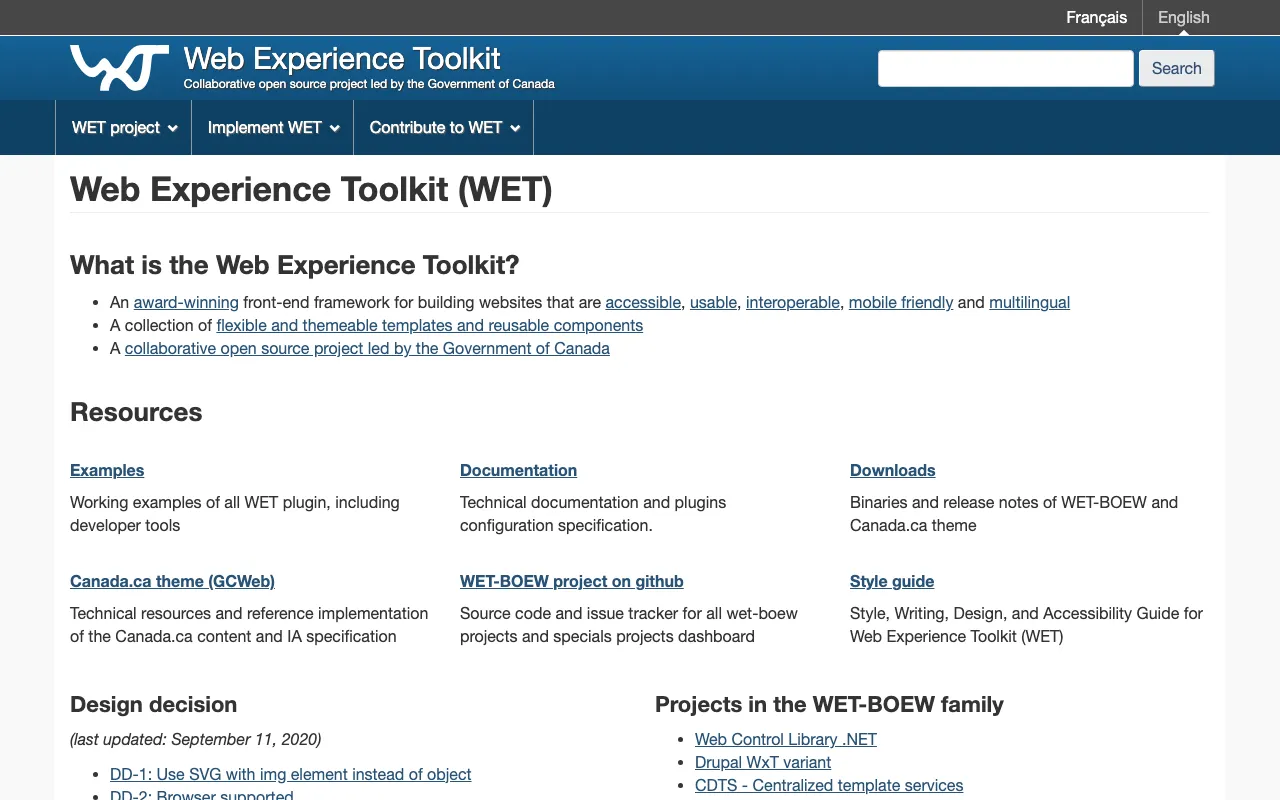
The Web Experience Toolkit is an open front-end framework and component library for sites that must be accessible, mobile-friendly, and multilingual.
Overview
The Web Experience Toolkit, often called WET-BOEW, helps teams build websites that meet accessibility, usability, interoperability, responsive mobile, and multilingual requirements. It is led as a collaborative open-source effort by the Government of Canada and ships flexible templates, plugins, and reusable widgets.
Components target modern HTML with progressive enhancement, polyfills where needed, and conformance goals such as WCAG 2.0 level AA cited on the project site, along with WAI-ARIA usage and assistive-technology testing through community working groups. The framework supports many browsers including Edge, Firefox, Chrome, Safari, and Opera, with responsive layouts and touchscreen-oriented patterns.
Internationalization covers dozens of languages, including right-to-left scripts listed in project documentation. Themes are customizable, with multiple theme packages including a Canada.ca reference implementation. Integrations and variants are documented for Drupal, WordPress, PHP, SSI, Java/Maven, and in-development SharePoint and DotNetNuke adapters.
Resources include working examples, technical documentation, downloadable releases, a public GitHub issue tracker, and contribution review processes combining automated and manual checks. Related family projects cover centralized templates, Drupal WxT, .NET controls, and WCAG review tooling.
Key features
- Reusable web components and plugins
- WCAG-oriented accessibility patterns
- Responsive mobile-first layouts
- 34-language localization support
- Themeable templates
- HTML5 progressive enhancement
- CMS framework integrations
- Working example documentation
Use cases
- Government and public sector websites
- Accessible multilingual publishing
- Consistent federal web branding
- Component-based institutional sites


 Ionic Enterprise