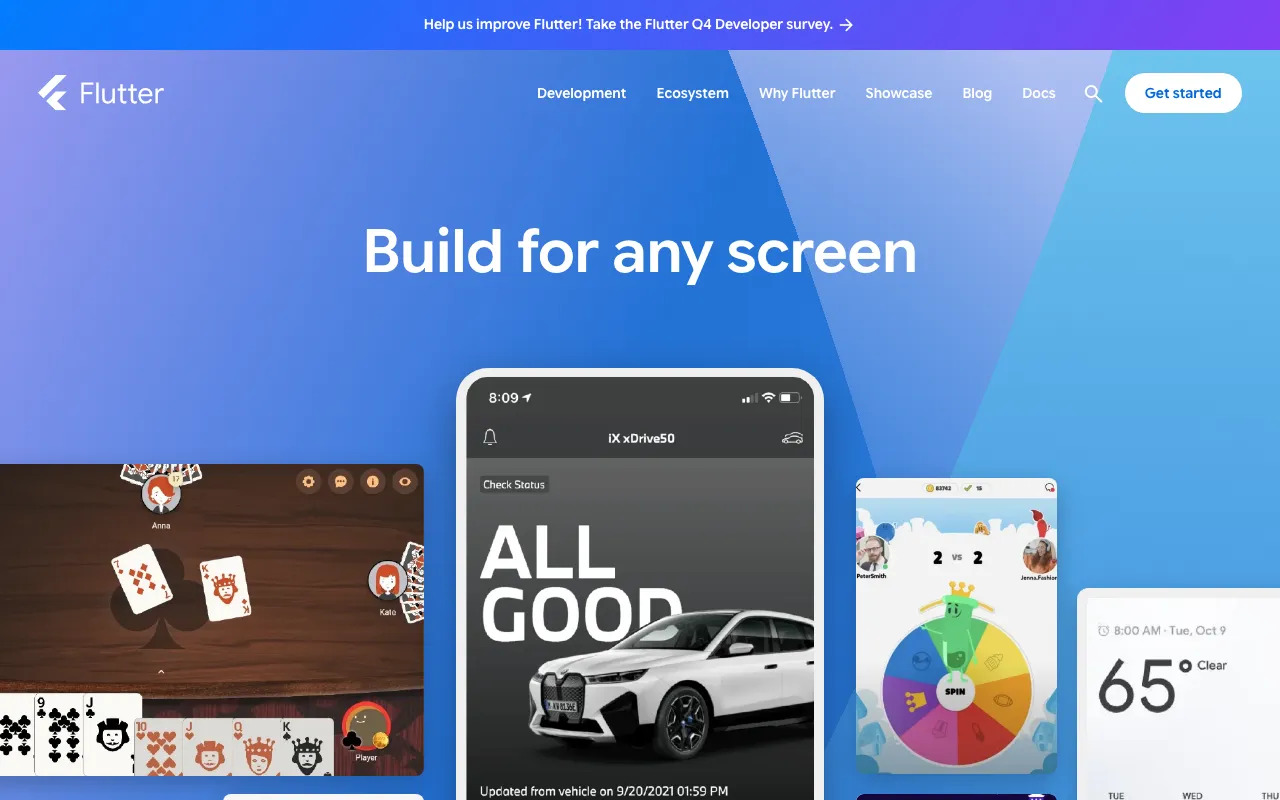
Flutter is an SDK for building user experiences for mobile, web, and desktop from a single codebase. It uses the Dart language and compiles to native machine code or web targets.
Overview
Flutter is an open-source SDK for crafting user interfaces that can target mobile, web, and desktop from one shared codebase. It is designed to work alongside existing code and supports organizations shipping apps across several platforms without maintaining wholly separate client projects.
Rendering uses hardware-accelerated 2D graphics through libraries such as Skia and Impeller, with a layered architecture that exposes compositing for graphics, video, text, and controls. Widget sets cover Material and Cupertino styles, and teams can customize or add visual components for platform-specific design goals.
Dart powers Flutter applications and compiles to ARM machine code on iOS and Android, JavaScript or WebAssembly on the web, and Intel x64 or ARM on desktop targets. Stateful hot reload lets developers change code and see updates in a running app without a full restart or loss of state.
The tooling integrates with common editors such as Visual Studio Code and IntelliJ or Android Studio, exposes FFI and platform APIs for calling native code, and draws on a large package ecosystem on pub.dev. Documentation and the project site describe deployment to mobile, web, desktop, and embedded devices from the same project.
Key features
- Single codebase for multiple platforms
- Dart with native and web compilation
- Stateful hot reload during development
- Material and Cupertino widget libraries
- Skia and Impeller graphics rendering
- Editor plugins for VS Code and Android Studio
- FFI and platform native API access
- Package ecosystem on pub.dev
Use cases
- Cross-platform mobile client applications
- Web and desktop apps from one project
- Embedded device user interfaces
Does the same job as
Flutter doesn't name these products itself, but its own description shows it does the same job.

 Ionic Enterprise