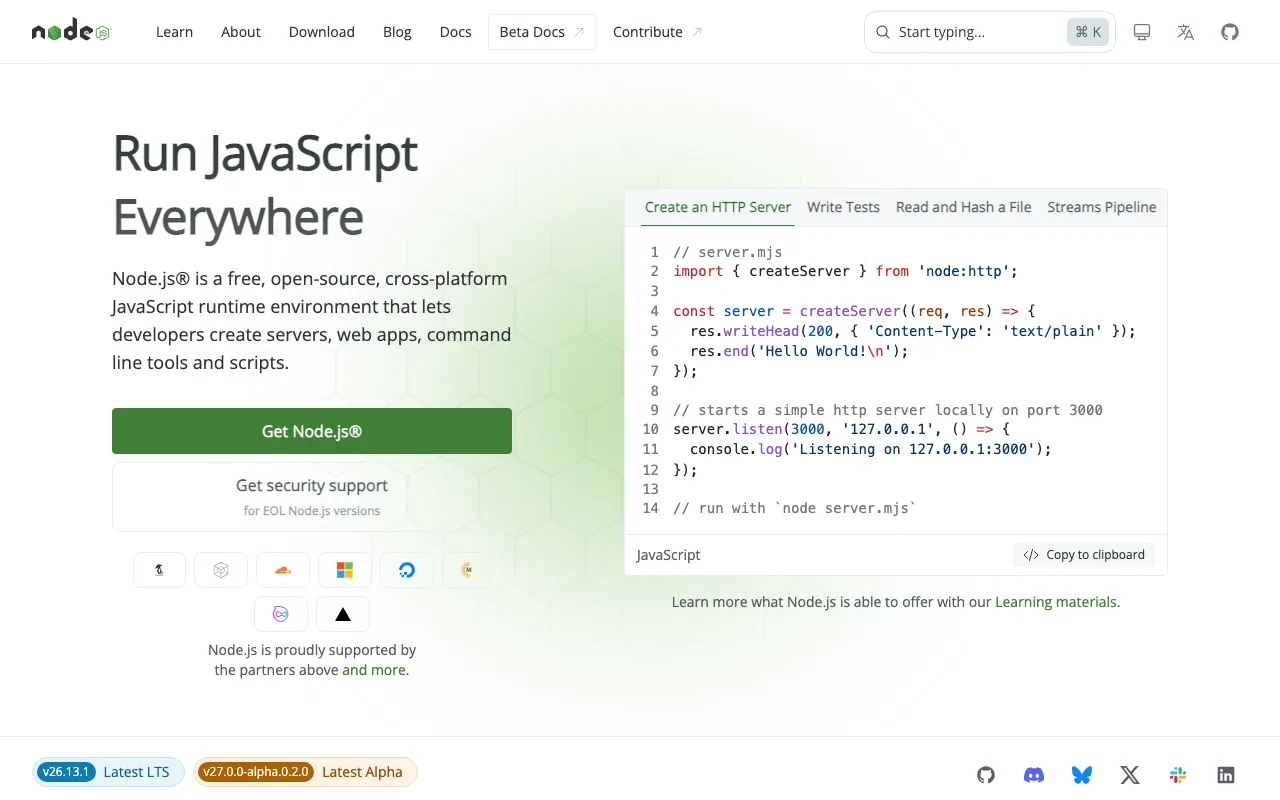
Node.js is an open-source, cross-platform JavaScript runtime. It lets developers create servers, web apps, command line tools, and scripts.
Overview
Node.js provides a JavaScript runtime environment that runs outside the browser. The project is supported under an open governance model with backing from the OpenJS Foundation.
Release lines include development and long-term support tracks with semantic versioning. Distributions offer binaries, installers, and source tarballs, plus API documentation for each release.
The runtime ships built-in modules for HTTP servers, file I/O, cryptography, streams, and worker threads. Examples on the project site illustrate creating servers, running tests, hashing files, piping streams, and using threads.
Node.js targets developers who want one language for networked services, tooling, and scripting across supported desktop operating systems.
Key features
- Cross-platform JavaScript execution
- HTTP server and networking APIs
- Streams and file I/O modules
- Built-in test runner support
- Worker threads for parallel work
- Cryptographic hashing utilities
- Long-term support release lines
- Binary and installer downloads
Use cases
- Building HTTP servers and web apps
- Command-line tools and scripts
- File processing and streaming pipelines
- Running JavaScript tests in Node
- Multithreaded JavaScript workloads




 Ionic Enterprise


