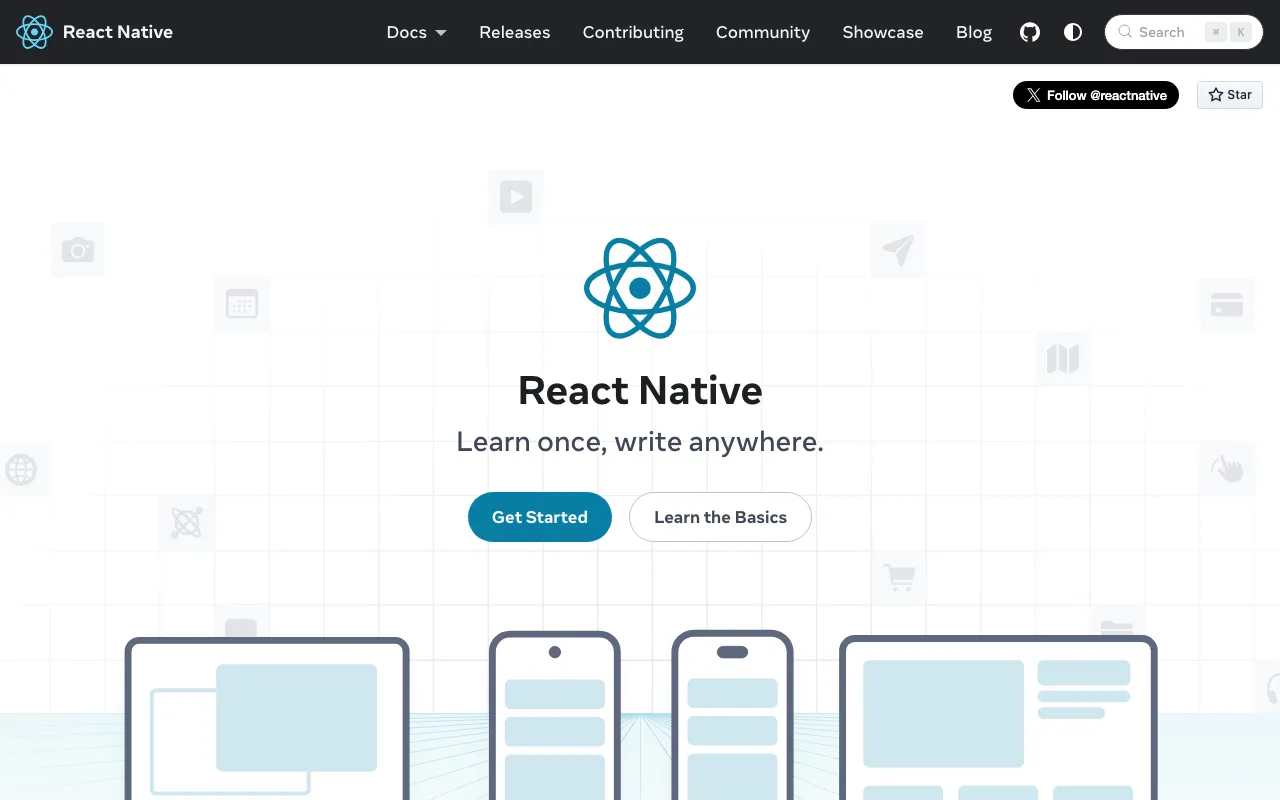
React Native lets developers build Android and iOS interfaces with React components rendered through native platform APIs. JavaScript changes can refresh quickly during development.
Overview
React Native targets teams who want declarative React patterns while still calling each operating system's native UI and services. Core primitives such as views, text, and images map to platform widgets so gestures, accessibility, and text scaling follow OS conventions.
Applications are authored primarily in JavaScript or TypeScript and packaged for mobile stores like other native apps. Fast Refresh applies many JavaScript edits without rebuilding the entire native binary, shortening iteration loops while UI logic evolves.
New projects often start through the Expo framework, which supplies file-based routing, a standard set of native modules, and tooling for production workflows. Teams with specialized needs can adopt React Native without a framework and wire navigation, dependencies, and platform APIs themselves.
Documentation on the project website covers getting started, core components, native modules, debugging, upgrades, and architecture notes. Integration guides explain embedding React Native screens inside existing native applications incrementally.
Key features
- React component model on mobile
- Native platform UI rendering
- Android and iOS targets
- Fast Refresh for JavaScript edits
- Expo framework integration path
- Native module extension points
- Incremental adoption in existing apps
- Shared React hooks and Suspense patterns
Use cases
- Shipping cross-platform consumer mobile apps
- Reusing React skills on iOS and Android
- Prototyping mobile UI with fast reload
- Adding React screens to legacy native codebases




 Ionic Enterprise


