qmetrics.net

LoopBack

TypeScript Node.js framework for OpenAPI-driven APIs

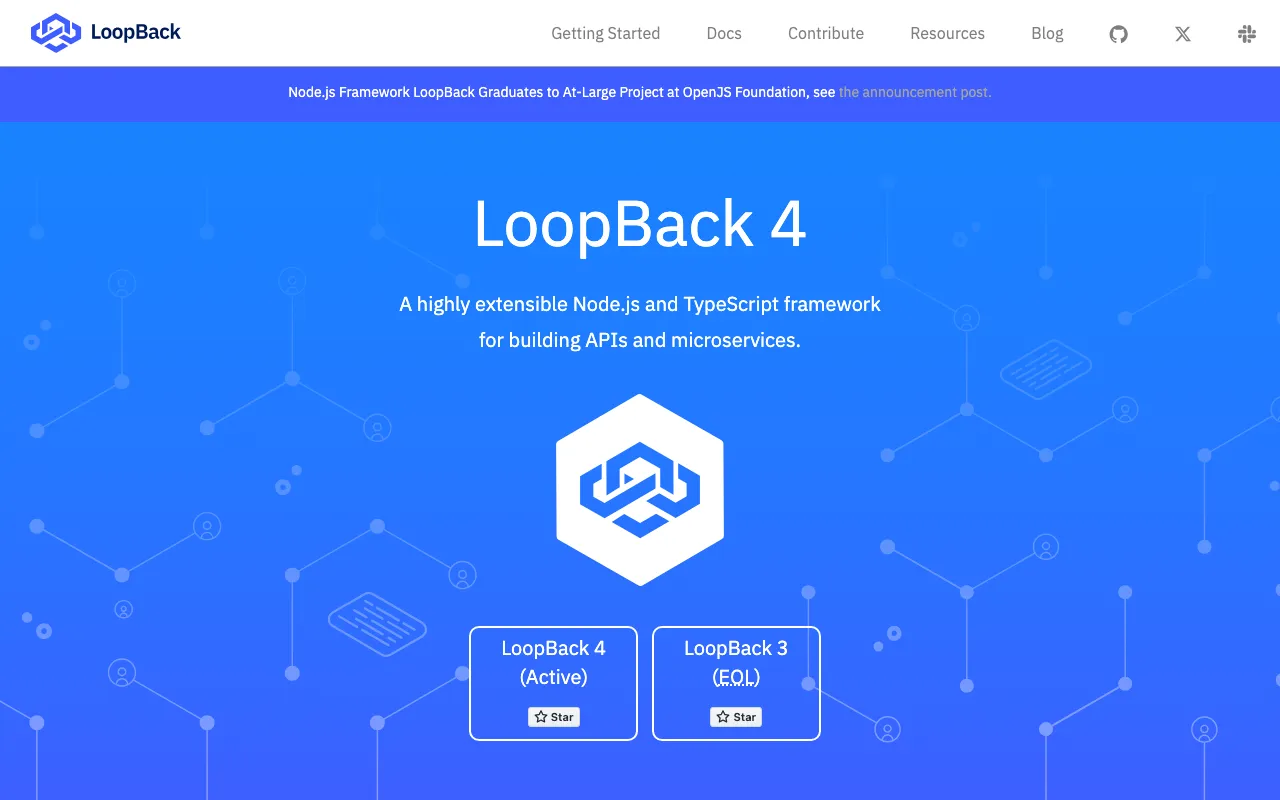
LoopBack screenshot

LoopBack is a Node.js and TypeScript framework for building REST APIs and microservices. It centers on OpenAPI for defining data and endpoints.

Overview

LoopBack helps teams create API applications that tie into complex backends and integrations. The stack is aimed at modern Node.js development with a TypeScript-oriented core and an extensible programming model.

You can scaffold APIs from OpenAPI definitions and generate working endpoints without maintaining generated code by hand. Dependency injection, components, mixins, and repositories are part of how you extend behavior. GraphQL interfaces for REST APIs can be produced using OpenAPI-to-GraphQL.

The project is an OpenJS Foundation at-large effort. Documentation covers getting started, package-level API usage, and comparisons between major LoopBack generations. A CLI and application generator are the usual entry points for new work.

It is positioned for developers who want a structured way to expose HTTP APIs with OpenAPI as the contract, rather than ad hoc route wiring alone.

Key features

  • OpenAPI-driven REST APIs
  • TypeScript and ES2017 core
  • CLI project generation
  • Dependency injection model
  • Components, mixins, repositories
  • GraphQL via OpenAPI-to-GraphQL
  • No hand-maintained generated code
  • Microservice-oriented API design

Use cases

  • Building REST microservices
  • Exposing complex backend integrations
  • OpenAPI-first API development
  • Node.js enterprise API layers

Tags

Similar software

Flutter

Open-source UI framework for multi-platform apps from one codebase

Flutter is an SDK for building user experiences for mobile, web, and desktop from a single codebase. It uses the Dart language and compiles to native machine code or web targets.

★ 181.5k⟳ todayBSD-3-Clause
Open Source Alternative to:Ionic Enterprise

Bootstrap

Responsive HTML, CSS, and JavaScript front-end toolkit

Bootstrap supplies CSS, JavaScript, and Sass-based styles for building responsive, mobile-first sites. It ships prebuilt grid layouts, UI components, and optional JavaScript plugins.

★ 175.1k⟳ 2 days agoMIT

Next.js

React framework for full-stack web applications

Next.js lets you build full-stack web apps by extending React and integrating Rust-based JavaScript build tooling.

★ 143.8k⟳ todayMIT

React Native

Cross-platform native mobile framework using React

React Native lets developers build Android and iOS interfaces with React components rendered through native platform APIs. JavaScript changes can refresh quickly during development.

★ 127k⟳ todayMIT

Electron

Cross-platform desktop application framework for web technologies

Electron lets developers build desktop applications with JavaScript, HTML, and CSS. It combines Node.js and Chromium so web code can run as native apps on major operating systems.

★ 124.1k⟳ 2 days agoMIT

Node.js

Cross-platform open-source JavaScript runtime environment

Node.js is an open-source, cross-platform JavaScript runtime. It lets developers create servers, web apps, command line tools, and scripts.

★ 124k⟳ todayMIT
Frameworks & PlatformsDesktop/CLI app