WaterCrawl crawls sites, searches the web, and structures content for APIs, with Docker-based local deployment.
Overview
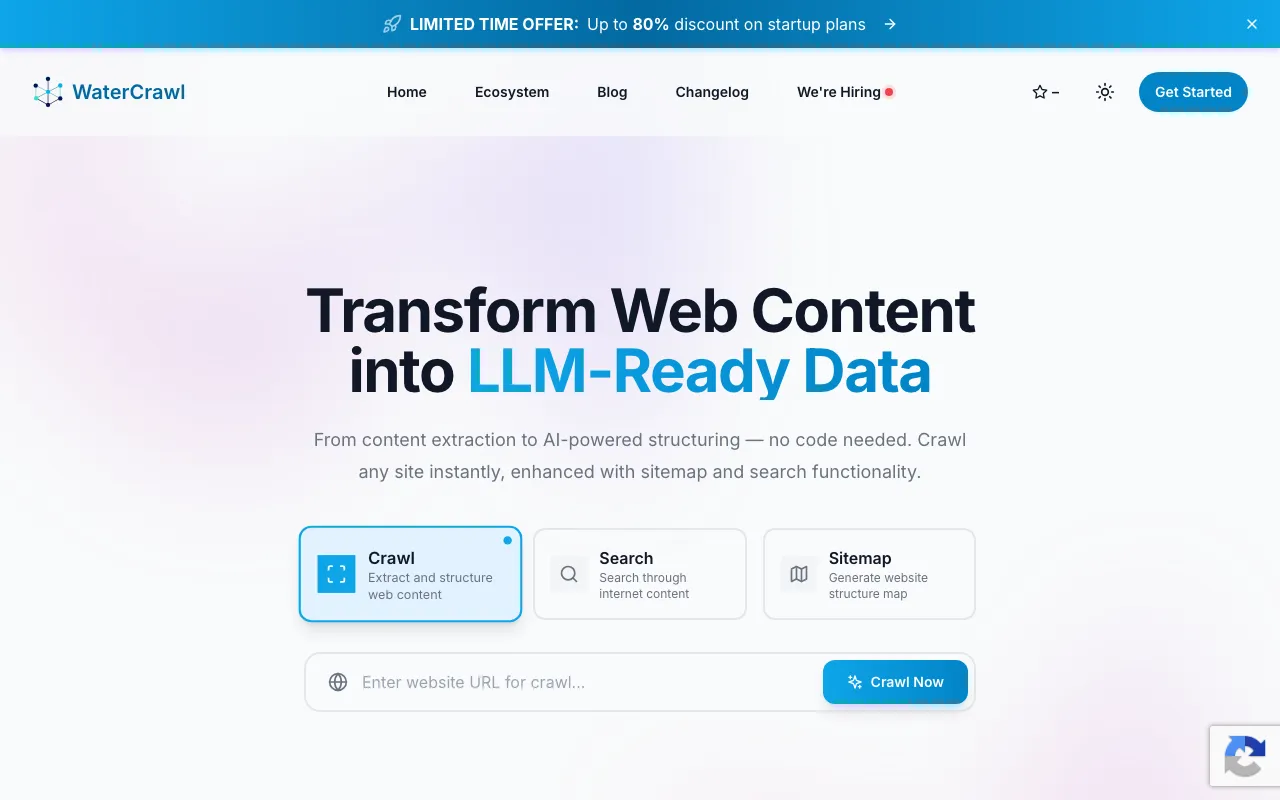
WaterCrawl is a web application stack built with Python, Django, Scrapy, and Celery to crawl pages and extract data suited for downstream AI or automation workflows. It advertises turning web content into structured, LLM-oriented output with crawling, search, and sitemap-related capabilities on the product site.
Operational features described in the project include adjustable crawl depth and targeting, multi-language search, asynchronous jobs with progress via server-sent events, a REST API documented with OpenAPI, client SDKs for Python, Node.js, Go, and PHP, and integrations with tools such as Dify and n8n. Plugins and OpenAI-related processing appear in marketing copy as extensions for content handling.
Self-hosting is documented through Docker: clone the source and build and run the Docker containers locally, with environment configuration for production domains, MinIO, and other backing services noted in deployment guidance. A hosted offering with usage credits also exists on the public website, but the open-source path centers on running your own instance.
WaterCrawl fits teams that want crawl, search, and extraction under their own infrastructure while calling the same API from multiple language clients.
Key features
- Configurable web crawling
- Web search with depth modes
- Asynchronous crawl jobs with SSE
- REST API and OpenAPI docs
- Python, Node, Go, PHP clients
- Docker local deployment
- Dify and n8n integrations
Use cases
- LLM training or RAG data prep
- Targeted site content extraction
- Self-hosted crawl API
- Automation platform ingestion
Does the same job as
WaterCrawl doesn't name these products itself, but its own description shows it does the same job.