qmetrics.net

Hyper-Extract

LLM CLI and SDK for structured knowledge extraction

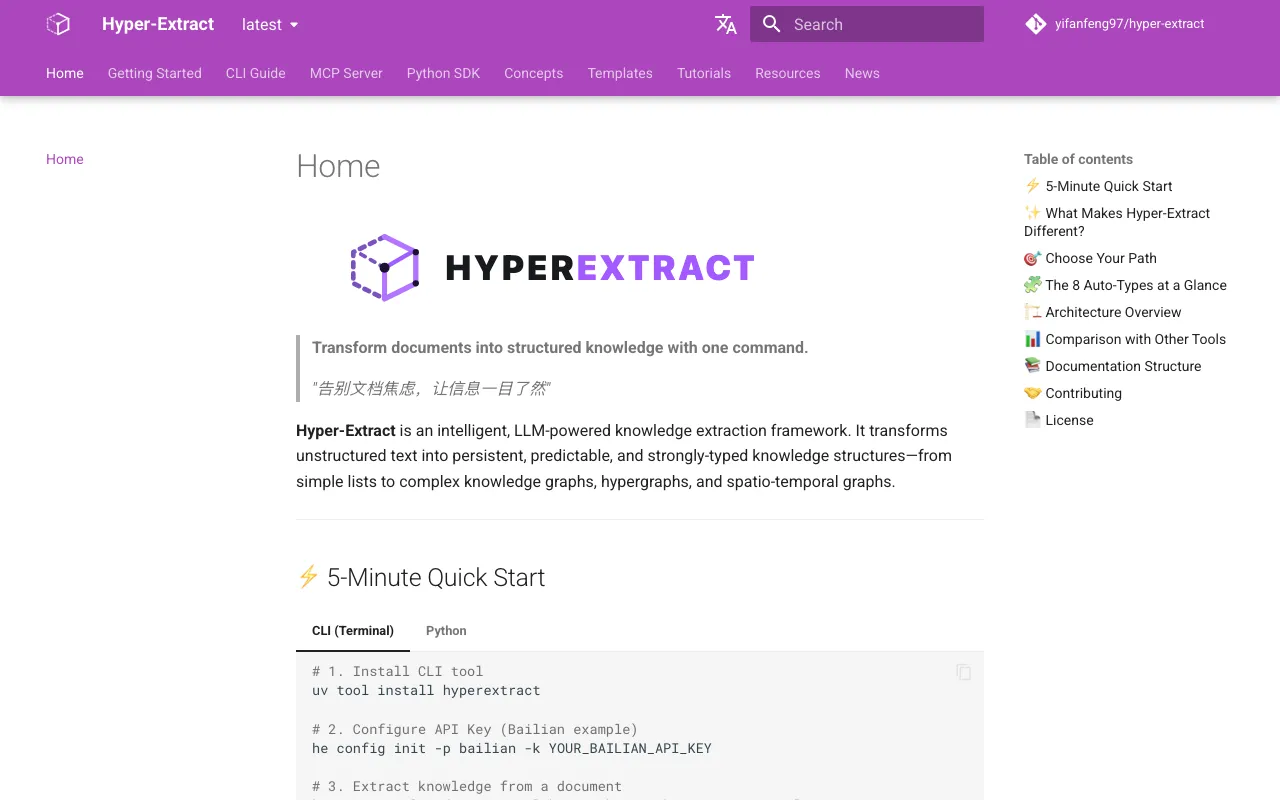
Hyper-Extract screenshot

Hyper-Extract turns unstructured documents into typed knowledge structures via CLI or Python. It supports graphs, hypergraphs, temporal models, templates, and multiple LLM providers.

Overview

Hyper-Extract is a framework for pulling structured knowledge out of text using large language models. Users install a hyperextract CLI or Python package, configure a model provider, then parse documents into outputs such as lists, graphs, hypergraphs, or spatio-temporal graphs.

Ingestion can cover PDF, Word, slides, spreadsheets, HTML, EPUB, and plain text when optional ingest extras are installed. Dozens of YAML domain templates cover finance, legal, medical, and general scenarios without custom code. Multiple extraction engines include chunk-RAG baselines, GraphRAG, LightRAG, Hyper-RAG, and KG-Gen style methods.

Indexes can grow incrementally with per-source provenance, auditing, rollback, and document removal commands. Exports include Obsidian vaults with wikilinks plus graph and tabular formats. An MCP server exposes search, ask, and export tools to desktop assistants.

Providers include OpenAI, Anthropic, Google Gemini, DeepSeek, Alibaba Bailian, and local vLLM deployments for on-premise models. Structured output relies on LangChain function calling, so models must support tool calling APIs.

Key features

  • CLI and Python API
  • Nine knowledge structure types
  • Eighty-plus domain YAML templates
  • Multiple RAG extraction engines
  • Incremental index with provenance
  • Rich document format ingestion
  • Obsidian and graph exports
  • MCP server for assistants

Use cases

  • Paper to concept graphs
  • Earnings report entity extraction
  • On-premise vLLM knowledge bases
  • Auditable evolving document indexes
  • Domain-templated legal or medical mining

Tags

Similar software

Firecrawl

Web scrape crawl and search infrastructure for AI agents

Firecrawl turns websites into LLM-ready markdown and structured data via API, CLI, and MCP. It supports scrape, crawl, map, batch jobs, optional cloud scale, and self-hosted server deployment.

★ 211.5k⟳ todayAGPL-3.0
Open Source Alternative to:TavilyZyte

Crawl4AI

Web crawler and extraction library for AI pipelines

Crawl4AI turns web pages into clean Markdown or structured JSON for RAG and agents. Use the Python library, Docker server, CLI, or the hosted Crawl4AI Cloud API.

★ 88k⟳ 5 days agoApache-2.0

LangExtract

LLM-driven structured extraction with source grounding

LangExtract is a Python library that pulls structured entities from unstructured text using LLMs, with chunking for long documents and HTML review output.

★ 39.4k⟳ yesterdayApache-2.0

ScrapeGraphAI

LLM-driven Python web scraping pipeline library

ScrapeGraphAI builds scraping pipelines with language models and graph logic. You specify what to extract and it processes websites or local HTML, JSON, XML, and Markdown sources.

★ 33k⟳ 1 month agoMIT

WaterCrawl

Self-hosted web crawl and LLM-ready extraction

WaterCrawl crawls sites, searches the web, and structures content for APIs, with Docker-based local deployment.

★ 2.2k⟳ 3 months agoMIT
Open Source Alternative to:Tavily

Reader

Playwright-based scraping library for AI agent web access

Reader scrapes and crawls websites into clean markdown for agents, with browser pooling, anti-bot stealth, proxy tiers, concurrent batches, and optional stealthed Chrome sessions via CDP.

★ 582⟳ 1 month agoApache-2.0