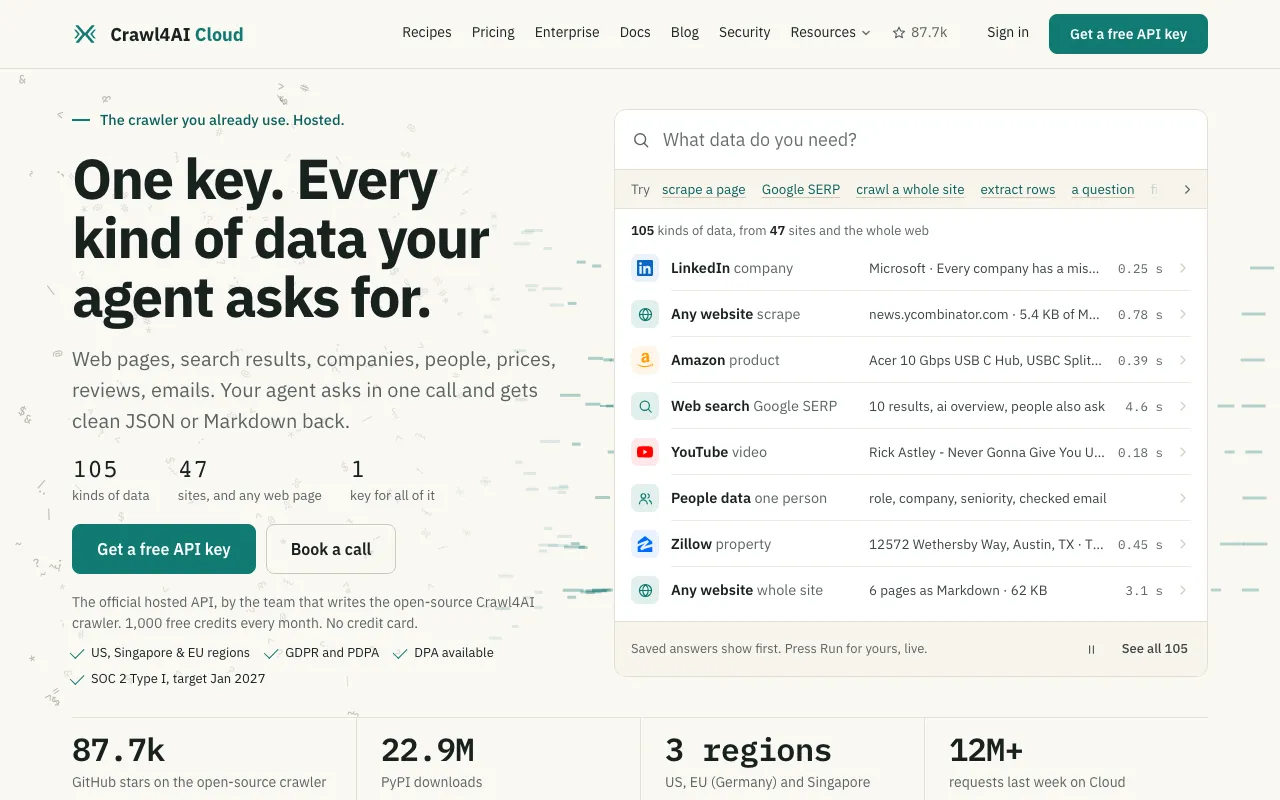
Crawl4AI turns web pages into clean Markdown or structured JSON for RAG and agents. Use the Python library, Docker server, CLI, or the hosted Crawl4AI Cloud API.
Overview
Crawl4AI is a web crawling and extraction stack built for AI agents and data pipelines. It can render JavaScript-heavy pages, produce LLM-oriented Markdown, and extract typed JSON using CSS, XPath, regex, or LLM strategies.
You can run the crawler in your own Python process, ship it as a Docker server with a REST API and MCP endpoint, or call Crawl4AI Cloud for hosted scraping, search, SERP, and answer endpoints with managed browsers and proxies. The cloud offering includes monthly free credits and pay-as-you-go pricing.
Core library features cover deep crawling with BFS, DFS, or best-first strategies, adaptive crawling that stops when enough context is gathered, session and proxy control, stealth browsing, screenshots, PDFs, caching, and batch URL processing. Markdown output can be pruned or filtered for relevance.
Self-hosted Docker deployment exposes routes such as markdown, HTML, crawl, screenshot, and PDF, secured with an API token, plus a monitoring dashboard and playground. The CLI tool crwl wraps common crawl flows for terminal use.
Key features
- LLM-ready Markdown output
- Structured JSON extraction
- Async browser pool
- Docker REST API server
- MCP agent integration
- Deep and adaptive crawling
- Proxy and stealth controls
- Hosted Crawl4AI Cloud API
Use cases
- RAG document ingestion
- AI agent web access
- Batch site scraping jobs
- Structured data from pricing pages
- Self-hosted crawl API behind a token