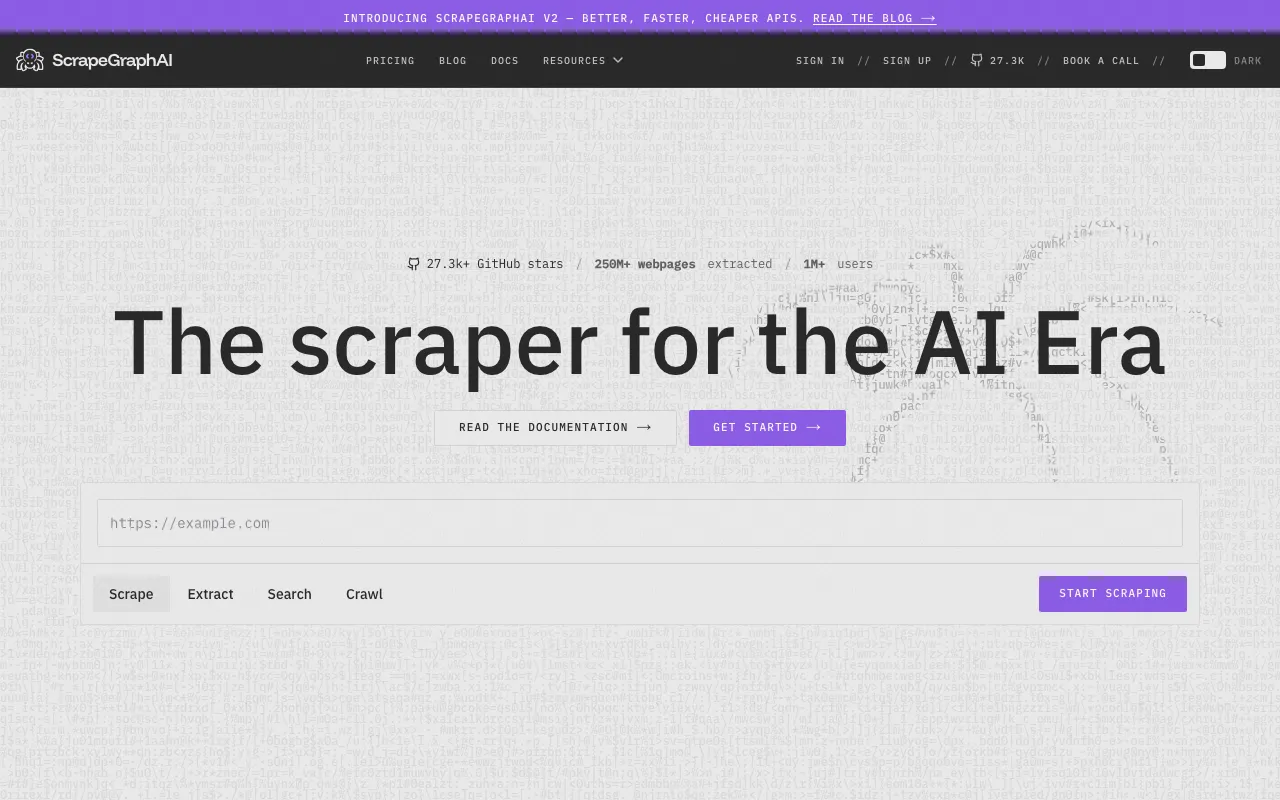
ScrapeGraphAI builds scraping pipelines with language models and graph logic. You specify what to extract and it processes websites or local HTML, JSON, XML, and Markdown sources.
Overview
ScrapeGraphAI is a Python library that wires large language models into predefined graph pipelines for extraction tasks. The SmartScraperGraph reads a single page or file from a URL or path plus a natural-language prompt and returns structured fields without hand-written selectors.
Additional graphs search the web and scrape top results, generate Python scripts from sites, produce audio summaries, or batch many sources in parallel multi-graph variants. Integrations cover multiple LLM APIs including OpenAI, Groq, Azure, Gemini, and local Ollama models, with Playwright available for JavaScript-heavy pages when you configure it.
The open-source edition runs entirely on your machines with your own model keys and infrastructure costs, while a separate hosted API and SDKs offer managed browsers, proxies, and credit-based scaling. Documentation and PyPI packages distribute the library; optional telemetry can be disabled via environment variable.
Pipelines are composable for research, RAG ingestion, and data extraction experiments. The project also publishes paid proxy discount codes and points to managed services for teams that prefer not to operate browsers themselves.
Key features
- Prompt-driven single-page extraction
- Multi-page search and scrape graphs
- Script and audio generation pipelines
- Parallel multi-graph LLM calls
- Multiple LLM and Ollama backends
- Local and remote document inputs
- Python SDK and API integrations
- Optional usage telemetry
Use cases
- Structured data extraction from sites
- Research crawls with LLM parsing
- RAG document ingestion
- Generating scraper scripts automatically
- Self-hosted scraping with own models