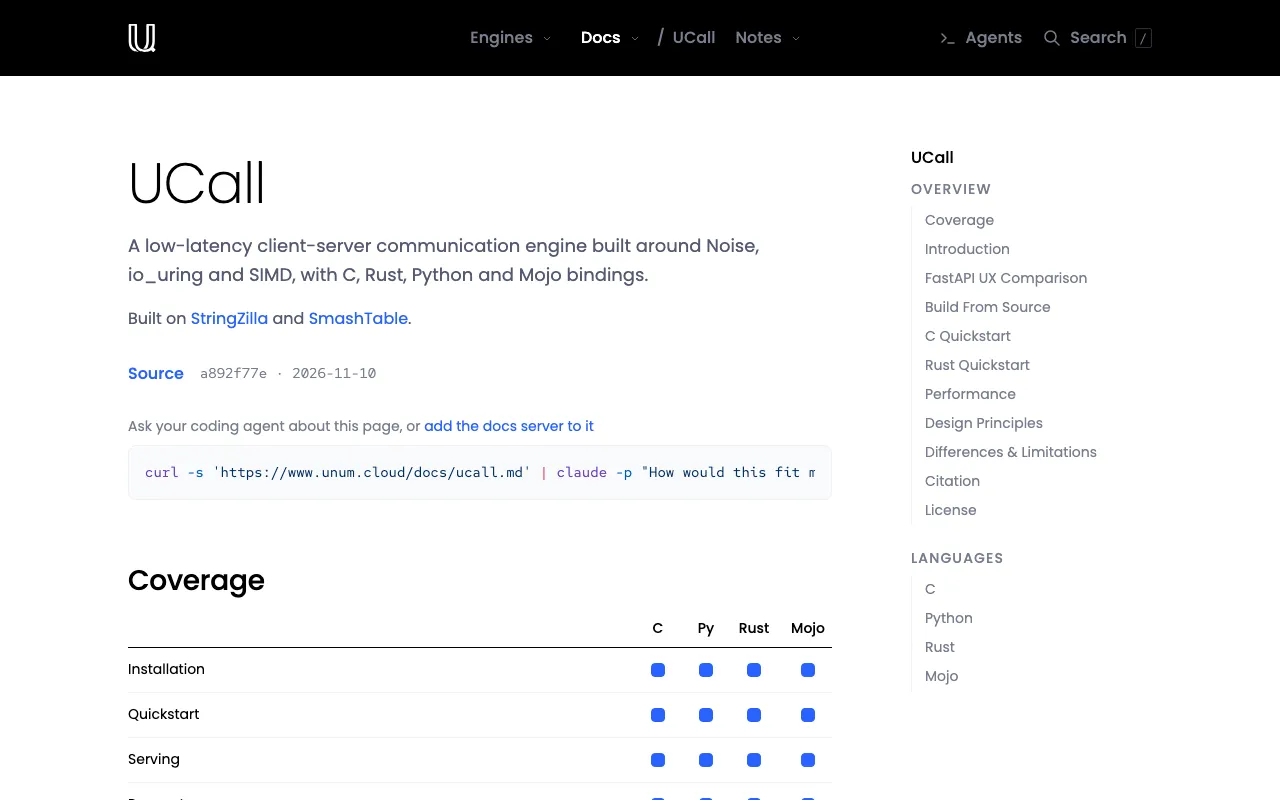
UCall is a compact client-server engine for HTTP APIs with synchronous handlers, optional Noise encryption instead of TLS, and bindings for C, Python, and Rust.
Overview
UCall is a performance-oriented client-server communication engine built around asynchronous I/O backends while exposing synchronous application handlers. HTTP framing, routing, and connection state are implemented in a small native library with a C ABI, wrapped by Python and Rust packages that preserve caller-owned polling threads.
Servers register routes and poll event loops on threads the application controls; clients submit calls and retrieve completions through the same polling model. The design supports pipelined requests, server-side batching for slow endpoints such as inference or analytics queries, and optional Noise handshakes using http+noise:// URLs rather than integrating TLS directly.
Backends include Linux io_uring and epoll, macOS and FreeBSD kqueue, and Windows IOCP, plus a command-line client for single HTTP or Noise requests and key generation. Documentation compares throughput to common Python web stacks and describes happy-eyeballs style dialing, DNS resolution on the client loop, and graceful shutdown semantics.
Developers link installed static or shared libraries from C, install Python bindings with pip from source, or use the Rust crate with closure-based handlers. Examples cover echo services, batched inference routes, and ledger-style operations through the native interface.
Key features
- Synchronous handlers over async I/O
- HTTP routing with C ABI surface
- Python and Rust bindings
- Noise encryption transport option
- Server-side request batching
- Caller-owned polling threads
- Command-line HTTP and Noise client
- Multi-backend POSIX and Windows I/O
Use cases
- High-throughput internal HTTP services
- RPC-style APIs with pipelining
- Batched GPU or OLAP style endpoints
- Embedded native servers with Rust or Python
- Noise-secured service-to-service calls