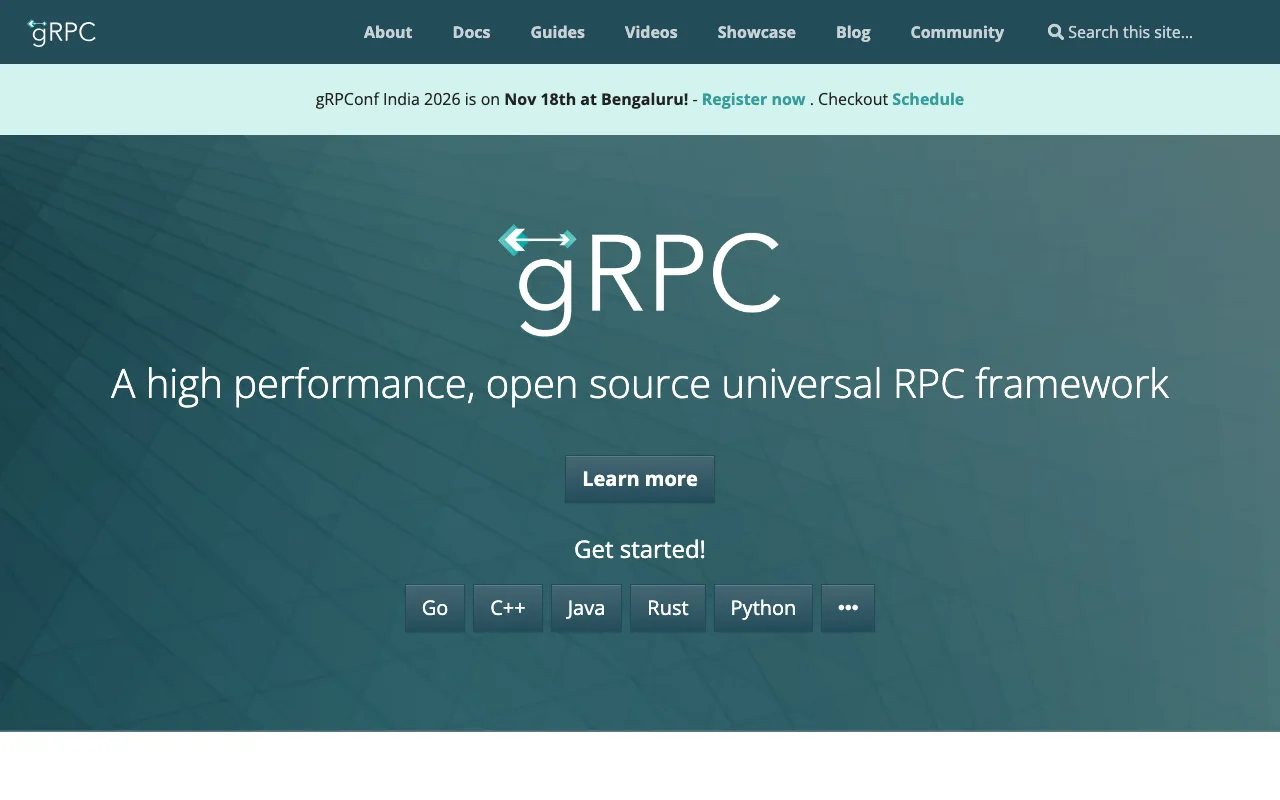
gRPC is an RPC framework that lets client and server programs communicate transparently and supports building connected, multi-language systems.
Overview
gRPC implements high-performance remote procedure calls so distributed services can invoke methods across process and network boundaries. Client and server applications can talk through a common RPC model, which reduces plumbing when linking many components.
Services are defined with Protocol Buffers. Runtimes and tooling generate idiomatic client and server stubs across languages and platforms. The stack supports HTTP/2 transport, bidirectional streaming, and pluggable authentication, load balancing, tracing, and health checking.
Language runtimes install through each ecosystem’s package managers—pip, gem, pecl, NuGet-related packages, and others—while related implementations exist for Java, Go, Node, web, Dart, .NET, Swift, and more. Quickstarts and examples illustrate typical adoption patterns for new projects.
A shared C++ core backs several official language libraries; maturity varies by language. The project positions itself for linking services within and across data centers and for connecting mobile clients, browsers, and devices to backends.
Key features
- Protocol Buffer service definitions
- Multi-language client and server stubs
- HTTP/2-based transport
- Bidirectional streaming
- Pluggable authentication
- Load balancing and health checks
- Package-manager installs per language
Use cases
- Microservice-to-microservice RPC
- Cross-data-center service mesh links
- Mobile and browser backends
- Polyglot distributed systems
- Streaming RPC workloads