
NestJS
Progressive TypeScript framework for Node.js backends
Nest organizes Node server apps with modules, dependency injection, and first-party packages for auth, data, queues, and observability.

Python web framework for building APIs with type hints
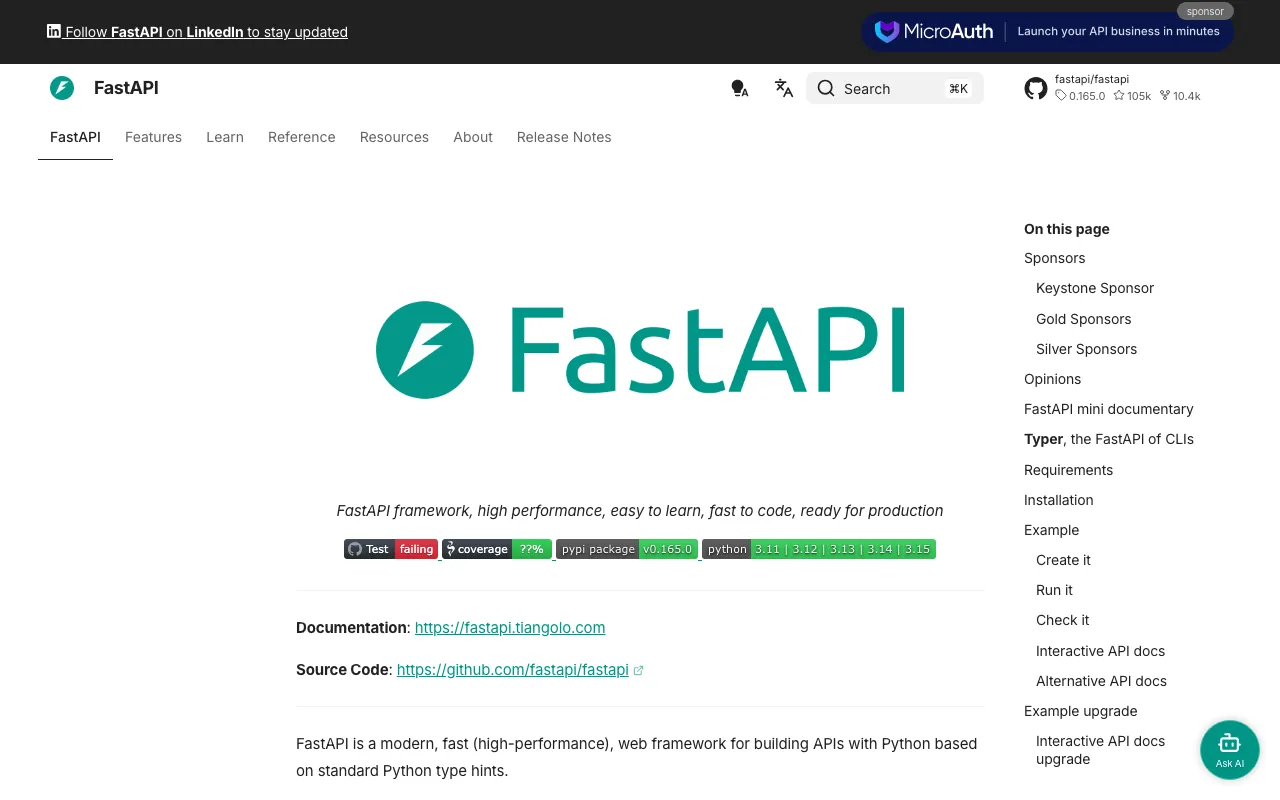
FastAPI is a Python web framework for building APIs using standard type hints. It builds on Starlette and Pydantic and generates interactive OpenAPI documentation for the endpoints you define.
FastAPI is a web framework for building HTTP APIs with Python, centered on standard Python type annotations for paths, queries, headers, bodies, and related inputs. Declaring parameter and response types in ordinary Python function signatures drives validation, conversion, and editor completion without a separate schema language.
The stack relies on Starlette for web handling and Pydantic for data modeling. Automatic OpenAPI output powers built-in interactive documentation through Swagger UI and ReDoc, and supports client generation workflows that consume the same schema.
Development commonly starts with the FastAPI CLI command that reads a main module, detects the application instance, and serves it through Uvicorn, including auto-reload for local work. Documented capabilities include dependency injection, security helpers such as OAuth2 with JWT and HTTP Basic auth, WebSockets, CORS, cookie sessions, and testing patterns built on HTTPX and pytest.
Documentation states that apps built with FastAPI can be deployed to any cloud provider the team chooses, following that provider's guides. A separate optional FastAPI Cloud offering is described for one-command hosted deployment but is not required to use the framework itself.
Progressive TypeScript framework for Node.js backends
Nest organizes Node server apps with modules, dependency injection, and first-party packages for auth, data, queues, and observability.

HTTP client for JVM, Android, and GraalVM
OkHttp is an HTTP client library tuned for efficient networking on Android, Java, and GraalVM native images. It offers synchronous and asynchronous call APIs with a fluent request builder.

Cross-language remote procedure call framework
gRPC is an RPC framework that lets client and server programs communicate transparently and supports building connected, multi-language systems.

End-to-end typesafe TypeScript APIs without code generation
tRPC helps teams define server procedures and call them from clients with full TypeScript types for inputs, outputs, and errors—no schemas or codegen step.
Cloud-native Go microservices and RPC framework
go-zero is a Go web and RPC framework with code generation, built-in resilience middleware, and tooling aimed at stable high-traffic services.

Lightweight web framework on Web Standards
Hono is a small web framework built on Web Standards that runs on Cloudflare Workers, Deno, Bun, Node.js, AWS Lambda, and other JavaScript runtimes with the same application code.