
Chrome DevTools MCP
MCP and CLI bridge from coding agents to Chrome DevTools
Lets coding agents control and inspect a live Chrome session for automation, debugging, performance traces, and Lighthouse-style checks.

Runtime verification for AI-written web applications
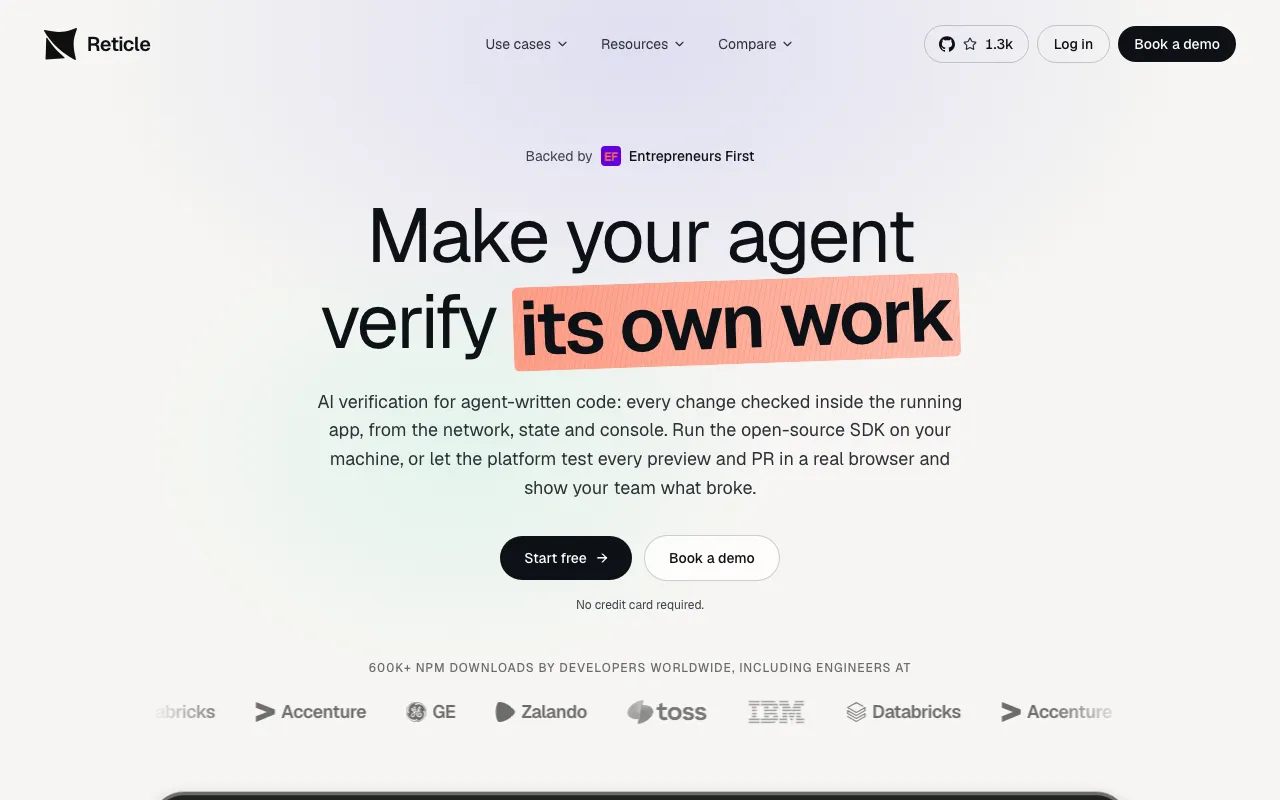
Reticle drives your running app, reads DOM, network, state, and console, and returns pass, fail, or cannot-tell verdicts with file and line hints.
Reticle is tooling for verifying agent-written changes against a real running application. It opens the app in a controlled browser, observes what happened underneath the UI, and returns a verdict of pass, fail, or cannot tell, often pointing to a file and line to fix.
Setup starts with a CLI in the app folder that can find or start the dev server, load pages, check console and network errors, and follow same-origin links. The reticle init command wires dev-only SDK packages and build plugins for frameworks such as Vite and Next.js, writes .reticle.json, and registers MCP tools with coding agents including Claude Code, Cursor, Windsurf, and others. Recorded flows can be replayed later without invoking a model.
Agents use tools such as reticlesession and reticleactandwait to exercise journeys; standalone reticle verify can assert facts from the terminal. An optional app.reticle.sh dashboard links projects for team history while the open-source SDK runs locally in dev mode without sending code or DOM off the machine.
Verification differs from screen-level automation in emphasis, and recorded flow replay supports low-token re-runs suited to frequent checks after each edit.
MCP and CLI bridge from coding agents to Chrome DevTools
Lets coding agents control and inspect a live Chrome session for automation, debugging, performance traces, and Lighthouse-style checks.

MCP server for Playwright browser automation
Playwright MCP exposes browser control to MCP clients using Playwright’s accessibility tree instead of screenshots, so language models can navigate pages through structured snapshots.

Natural-language Android device automation for tests
ARTEMIS turns plain-language instructions into actions on real Android phones or emulators. It combines accessibility, vision, and coordinate fallbacks with Flash or Pro execution profiles.

YAML mobile and web UI end-to-end testing framework
Maestro automates UI and end-to-end tests for Android, iOS, and web using human-readable YAML flows. Tests run on emulators, simulators, browsers, and physical Android devices.
Vision-based natural language E2E testing framework
Midscene.js adds AI vision to end-to-end tests for web, mobile, and desktop. Describe UI steps and expectations in natural language, then a GUI agent acts on screenshots and checks what users see.

Local plan and code review surface for coding agents
Plannotator opens agent plans, specs, and diffs in a local browser UI so you can annotate and send structured feedback back to coding agents.