
Chrome DevTools MCP
MCP and CLI bridge from coding agents to Chrome DevTools
Lets coding agents control and inspect a live Chrome session for automation, debugging, performance traces, and Lighthouse-style checks.

Local plan and code review surface for coding agents
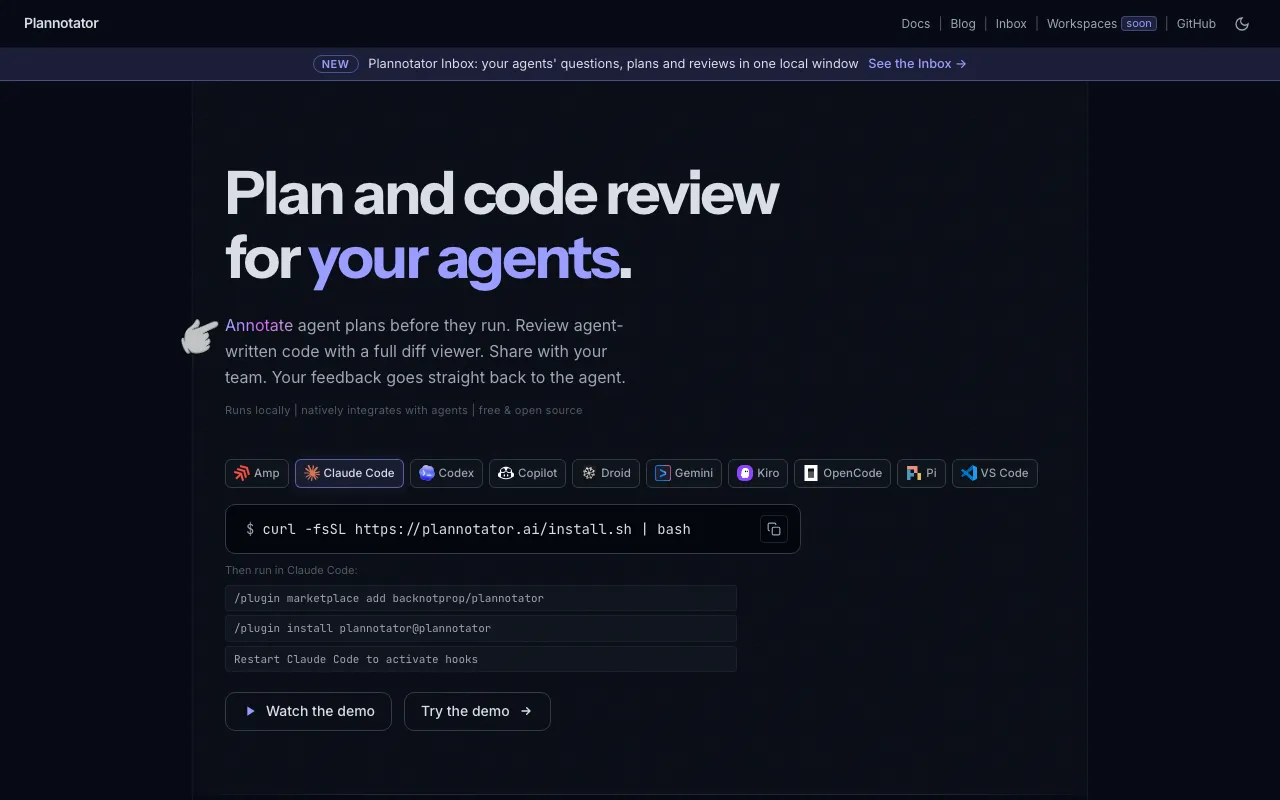
Plannotator opens agent plans, specs, and diffs in a local browser UI so you can annotate and send structured feedback back to coding agents.
Plannotator is review tooling that sits between you and AI coding agents such as Claude Code, Codex, Copilot CLI, Gemini CLI, OpenCode, Kiro, Pi, and others listed in project docs. Plugins, hooks, and slash commands intercept agent plans or finished work and launch a local review workspace where you comment, mark deletions, or suggest replacements before approving or denying the next step.
Plan review can trigger automatically when an agent enters plan mode. Separate flows cover code review on local diffs or remote pull requests from Git hosting URLs, with file trees, unified or side-by-side views, and line-level notes that return to the agent. An Inbox feature aggregates questions and artifacts from multiple agents in one local window, and optional terminal-oriented annotate tooling mirrors the same feedback pattern.
Review data stays on the machine by default. Optional link sharing encodes small payloads in URLs or uploads larger encrypted blobs with expiry. Integrations can save approved plans into Obsidian, Bear, or Notion, open plans in VS Code, and annotate live local web apps through a proxy. A future hosted Workspaces tier is described for teams, while the core plugin remains local-first.
MCP and CLI bridge from coding agents to Chrome DevTools
Lets coding agents control and inspect a live Chrome session for automation, debugging, performance traces, and Lighthouse-style checks.

MCP server for Playwright browser automation
Playwright MCP exposes browser control to MCP clients using Playwright’s accessibility tree instead of screenshots, so language models can navigate pages through structured snapshots.

Natural-language Android device automation for tests
ARTEMIS turns plain-language instructions into actions on real Android phones or emulators. It combines accessibility, vision, and coordinate fallbacks with Flash or Pro execution profiles.

YAML mobile and web UI end-to-end testing framework
Maestro automates UI and end-to-end tests for Android, iOS, and web using human-readable YAML flows. Tests run on emulators, simulators, browsers, and physical Android devices.

Vision-based natural language E2E testing framework
Midscene.js adds AI vision to end-to-end tests for web, mobile, and desktop. Describe UI steps and expectations in natural language, then a GUI agent acts on screenshots and checks what users see.

Runtime verification for AI-written web applications
Reticle drives your running app, reads DOM, network, state, and console, and returns pass, fail, or cannot-tell verdicts with file and line hints.