
Chrome DevTools MCP
MCP and CLI bridge from coding agents to Chrome DevTools
Lets coding agents control and inspect a live Chrome session for automation, debugging, performance traces, and Lighthouse-style checks.

YAML mobile and web UI end-to-end testing framework
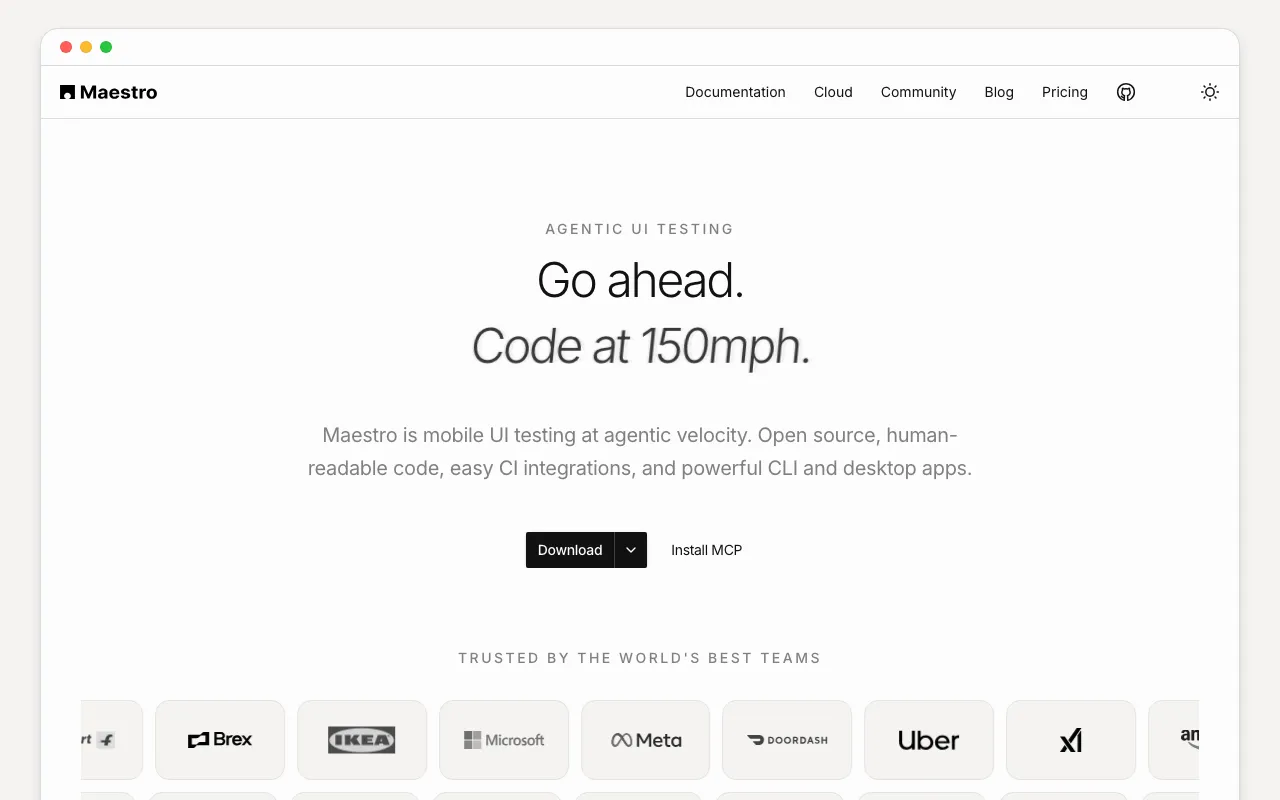
Maestro automates UI and end-to-end tests for Android, iOS, and web using human-readable YAML flows. Tests run on emulators, simulators, browsers, and physical Android devices.
Maestro is a testing framework aimed at making mobile and web UI automation approachable. Interactions are expressed as flat YAML command lists—for example launching an app, tapping elements, entering text, and asserting what is on screen—rather than heavy test code.
It drives applications through each platform’s accessibility layer and ships as a single CLI binary without extra drivers or SDKs. The same command set works across React Native, Flutter, native iOS and Android, Ionic, and hybrid stacks. Flows can run locally on emulators, simulators, browsers, and physical Android hardware; physical iOS devices are not supported yet.
Built-in waiting and tolerance for flaky UIs reduce the need for manual sleep calls. An optional Maestro MCP server inside the CLI lets coding agents inspect the live screen, interact with a device, and author repeatable YAML tests. Maestro Studio is a separate visual IDE for recording and building flows on desktop platforms.
For large suites, Maestro Cloud offers parallel runs on hosted infrastructure, while local CLI execution stays free. Optional MCP integration targets agents such as Claude Code, Cursor, Codex, and other MCP clients.
MCP and CLI bridge from coding agents to Chrome DevTools
Lets coding agents control and inspect a live Chrome session for automation, debugging, performance traces, and Lighthouse-style checks.

MCP server for Playwright browser automation
Playwright MCP exposes browser control to MCP clients using Playwright’s accessibility tree instead of screenshots, so language models can navigate pages through structured snapshots.

Natural-language Android device automation for tests
ARTEMIS turns plain-language instructions into actions on real Android phones or emulators. It combines accessibility, vision, and coordinate fallbacks with Flash or Pro execution profiles.

Vision-based natural language E2E testing framework
Midscene.js adds AI vision to end-to-end tests for web, mobile, and desktop. Describe UI steps and expectations in natural language, then a GUI agent acts on screenshots and checks what users see.

Local plan and code review surface for coding agents
Plannotator opens agent plans, specs, and diffs in a local browser UI so you can annotate and send structured feedback back to coding agents.

Runtime verification for AI-written web applications
Reticle drives your running app, reads DOM, network, state, and console, and returns pass, fail, or cannot-tell verdicts with file and line hints.