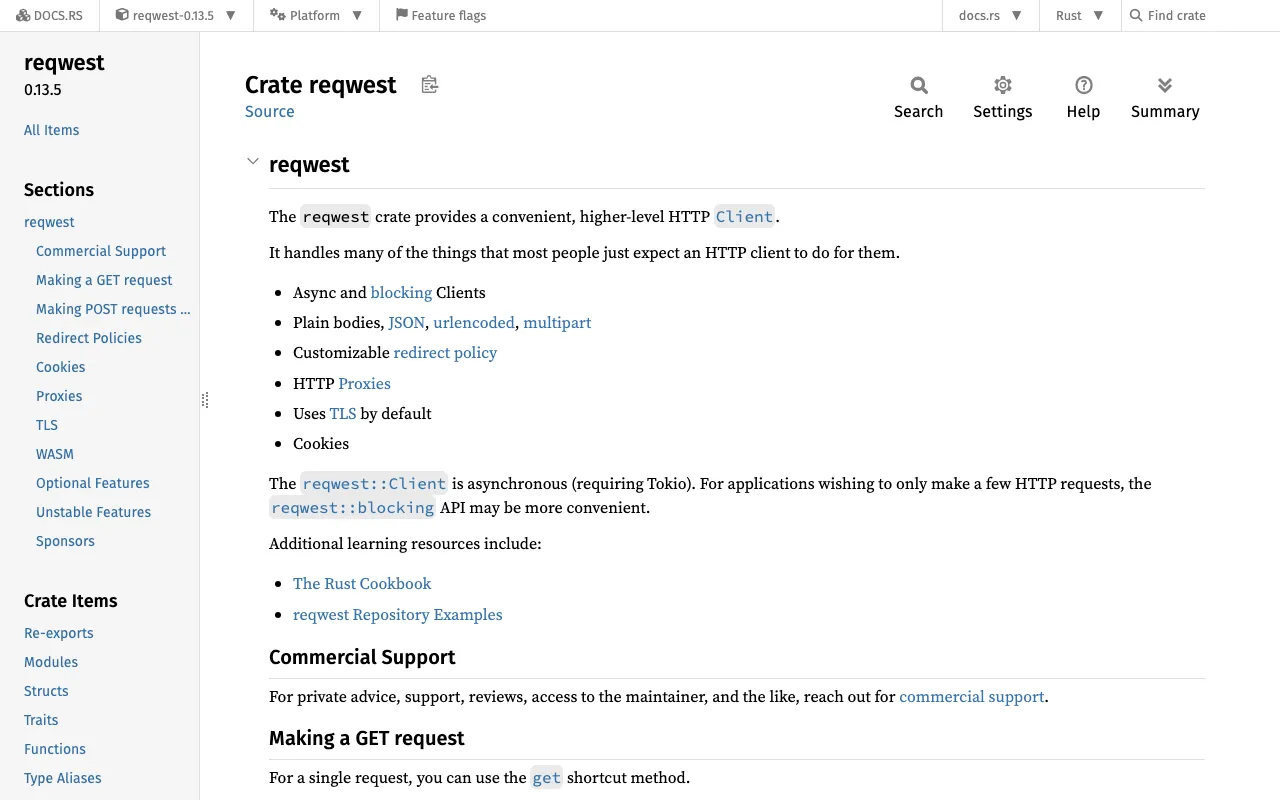
reqwest provides async and blocking HTTP clients for Rust with JSON, forms, multipart bodies, proxies, cookies, and TLS. A WASM target uses the browser’s network stack.
Overview
reqwest is a higher-level HTTP client crate for Rust that wraps connection pooling, TLS, redirects, and common body encodings. The default Client is asynchronous on top of Tokio, while a blocking API exists for simple scripts or low-volume callers.
Request builders support plain text bodies plus JSON, urlencoded forms, and multipart uploads behind optional Cargo features. Clients can follow redirects with a configurable policy, honor system proxy environment variables, store cookies when enabled, and speak HTTP/2 by default.
TLS typically uses rustls, with feature flags to switch to native platform TLS on Windows, macOS, or Linux OpenSSL builds. Compression, SOCKS proxies, custom DNS resolvers, and unstable HTTP/3 require additional features. On wasm32 targets the crate delegates TLS and cookies to the browser environment.
Commercial support from the maintainer is advertised for teams wanting private guidance. Documentation and the Rust Cookbook link to usage patterns and repository examples.
Key features
- Async and blocking clients
- JSON, form, and multipart bodies
- Configurable redirect handling
- System and custom HTTP proxies
- TLS via rustls or native TLS
- Optional cookie jar support
- HTTP/2 enabled by default
- WebAssembly browser client mode
Use cases
- Calling REST APIs from Rust services
- Downloading or uploading HTTP resources
- Scripts needing a blocking client
- Services behind corporate proxies
- Frontend Rust WASM HTTP calls





 Postman