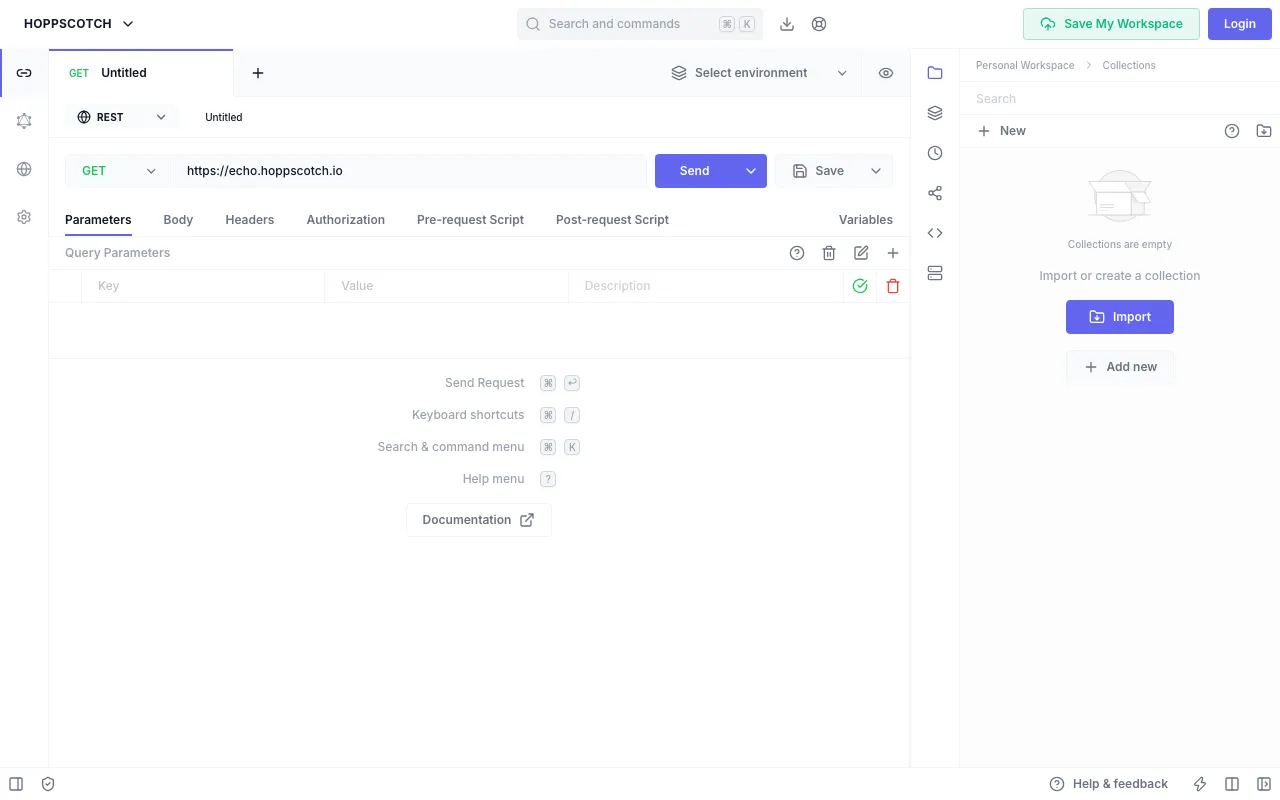
Hoppscotch lets developers send HTTP, WebSocket, GraphQL, and related API requests from a lightweight client. Collections, environments, teams, and sync help organize testing across devices.
Overview
Hoppscotch is an API development ecosystem aimed at building and exercising HTTP and related protocols quickly. Users enter an endpoint, choose a method, attach headers, parameters, and bodies, and inspect responses in real time.
Beyond REST, the client supports WebSocket, Server-Sent Events, Socket.IO, MQTT, and GraphQL workflows with schema exploration and custom headers. Authorization options include basic auth, bearer tokens, OAuth 2.0, and OIDC access tokens.
Requests can be grouped into nested collections and folders, labeled, exported, and imported. Pre-request and post-request scripts, environment variables, history, and keyboard shortcuts support repeatable testing workflows.
Teams can share collections with role-based access, workspaces separate personal and team work, and optional cloud sign-in syncs data across devices. Add-ons include a CLI, browser extensions that address CORS limits, and self-hosting options for organizations that want an on-prem deployment.
The project is available as a web app, progressive web app, desktop builds for major operating systems, and documentation-backed self-hosting for private use.
Key features
- REST and HTTP method support
- GraphQL, WebSocket, and MQTT clients
- Collections with nested folders
- Environment and pre-request scripts
- OAuth 2.0 and bearer authorization
- Team workspaces and shared collections
- PWA and desktop installs
- Hoppscotch CLI add-on
Use cases
- Exploring and debugging REST APIs
- Testing GraphQL queries against a schema
- Collaborating on shared API collections
- Running requests offline as a installed PWA
- Self-hosting an API client for a team
Open-source alternative to

 Postman