qmetrics.net

PyWavelets

Discrete and continuous wavelet transforms in Python

Libraries & SDKsDesktop/CLI app
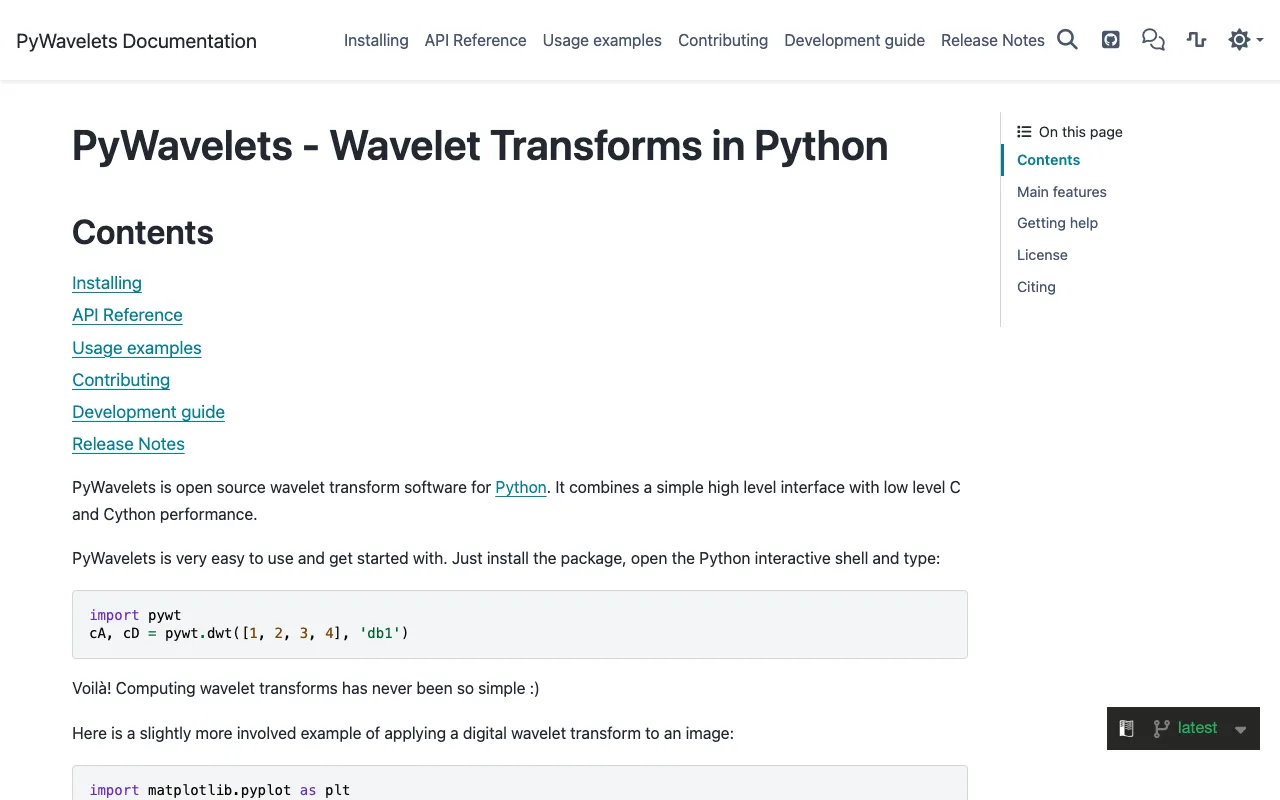
PyWavelets screenshot

PyWavelets (pywt) computes forward and inverse wavelet transforms on 1D, 2D, and nD data with NumPy-friendly APIs.

Overview

PyWavelets is open-source software for wavelet analysis in Python. Wavelets are localized in time and frequency, so transforms help study signals and images beyond what Fourier methods alone provide.

The library implements forward and inverse discrete transforms in multiple dimensions, multilevel decompositions, stationary undecimated transforms, wavelet packets, and continuous transforms. It includes routines to approximate scaling and wavelet functions, ships over a hundred built-in filters, and accepts custom wavelets.

Calculations run in single or double precision on real or complex data, with results aligned to MATLAB's Wavelet Toolbox conventions where applicable. Runtime depends on NumPy; C and Cython code backs the heavy lifting while staying easy to invoke from an interactive shell.

Documentation and examples show transforms on vectors and images, including visualization of approximation and detail bands. PyWavelets suits signal processing, scientific imaging, and any Python workflow needing orthogonal or biorthogonal filter banks.

Key features

  • 1D, 2D, and nD DWT and inverse DWT
  • Multilevel decomposition and reconstruction
  • Stationary undecimated transforms
  • Wavelet packet analysis
  • Continuous wavelet transform
  • 100+ built-in wavelet filters
  • Custom wavelet support
  • Single and double precision

Use cases

  • Image detail and approximation analysis
  • Time-series denoising or feature extraction
  • MATLAB-compatible wavelet experiments
  • Teaching wavelet fundamentals in Python
  • Scientific pipelines with NumPy arrays
Tags

Similar software

ECC

Open-source agent engineering toolkit for coding harnesses

ECC adds planning, verification, review, memory, skills, and security scanning to coding agents such as Claude Code, Codex, and Cursor. It installs as plugins, packages, and managed adapters across multiple harnesses.

★ 311.7k⟳ 8 days agoMIT
AI Assisted CodingDesktop/CLI app

React

JavaScript library for web and native user interfaces

React helps developers build interfaces from reusable components that manage their own state. Views update declaratively when underlying data changes.

★ 253k⟳ 2 days agoMIT
Libraries & SDKsDesktop/CLI app

MarkItDown

Python utility converting office and media files to Markdown

MarkItDown converts many file types into Markdown for LLM and text analysis pipelines. It aims to preserve headings, lists, tables, and links rather than perfect human layout.

★ 198.7k⟳ 21 days agoMIT
Libraries & SDKsDesktop/CLI app

Transformers

Shared model definitions for multimodal ML workloads

Transformers is a Python library that defines pretrained text, vision, audio, and multimodal models once in PyTorch for shared inference and training across the ecosystem.

★ 169.4k⟳ todayApache-2.0

Graphify

Codebase knowledge graph skill for AI coding assistants

Graphify maps a project’s code, docs, and media into a queryable local knowledge graph and installs as a skill for assistants such as Cursor and Claude Code.

★ 154.2k⟳ yesterdayApache-2.0

Taste Skill

Agent skill for designed company sites and browser QA

Taste Skill packages art direction, asset scripts, and headless browser checks so coding agents produce company websites with consistent layout, imagery, and copy rules.

★ 122.3k⟳ yesterdayMIT
AI Assisted CodingDesktop/CLI app