
TensorFlow
End-to-end machine learning platform and tooling ecosystem
TensorFlow is a machine learning platform with Python and C++ APIs, optional GPU packages, and companion libraries for data, training, deployment, and visualization.

Shared model definitions for multimodal ML workloads
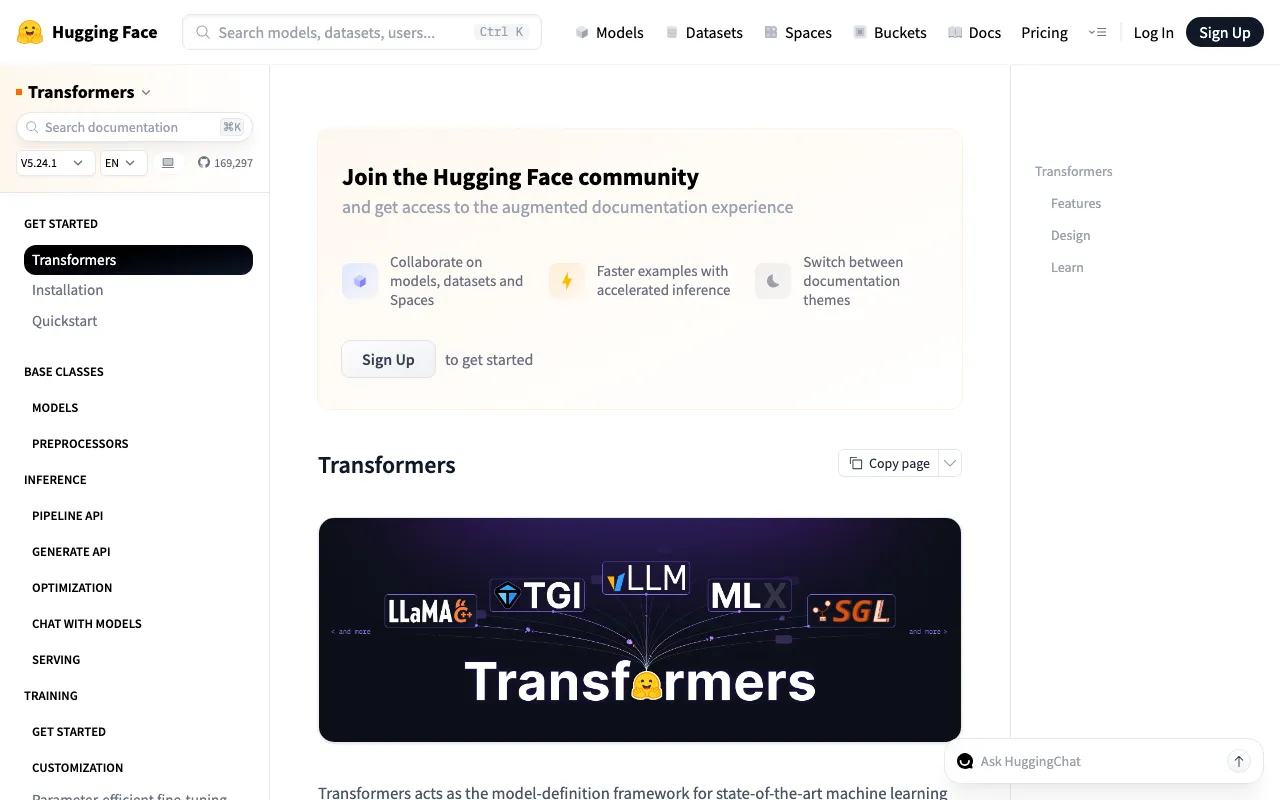
Transformers is a Python library that defines pretrained text, vision, audio, and multimodal models once in PyTorch for shared inference and training across the ecosystem.
Transformers standardizes how hundreds of architectures are expressed so training tools, inference engines, and local runtimes can reuse the same model files. Each implementation follows configuration, model, and preprocessor patterns intended to stay readable while matching original paper results.
Users load checkpoints from the Hugging Face Hub or local paths, then run tasks through Pipeline helpers, chat interfaces, or custom training loops. Generation APIs cover decoding strategies and streaming for large language and vision-language models.
Serving options include a built-in HTTP server for experiments, continuous batching for throughput, and backends that plug into vLLM or SGLang. Training support spans Trainer workflows, parameter-efficient fine-tuning, fully sharded data parallel training, tensor and expert parallelism, quantization, and swappable attention kernels.
Contributors can add architectures via modular inheritance, register custom attention or expert functions, and rely on automated tests that expand from small model-specific suites. Documentation and courses guide installation, task selection, and agent-oriented setup prompts.
End-to-end machine learning platform and tooling ecosystem
TensorFlow is a machine learning platform with Python and C++ APIs, optional GPU packages, and companion libraries for data, training, deployment, and visualization.

Open-source RAG engine and agent context platform
RAGFlow ingests heterogeneous documents, builds retrievable knowledge, and supports agent workflows with citations. It can run on your own hardware with Docker or a from-source server stack.

Local LLM context compression library and proxy
Headroom shrinks tool outputs, logs, JSON, and chat history before LLM calls to cut input tokens while preserving retrievable originals. It offers a Python library, proxy, MCP tools, and agent wrappers.

Local desktop workspace to run and fine-tune AI models
Unsloth is a desktop application to chat with, fine-tune, and serve LLMs, diffusion, audio, and embedding models on your own hardware with optional agent integrations.

TensorFlow reference models and modeling utilities collection
The TensorFlow Model Garden hosts implementations of models and modeling solutions for TensorFlow, installable via pip as tf-models-official.

Unified fine-tuning toolkit for LLMs and multimodal models
LLaMA Factory is a platform to fine-tune large language and vision-language models through CLI or a web board. It bundles many training algorithms, quantization options, and inference backends.