qmetrics.net

React

JavaScript library for web and native user interfaces

Frameworks & PlatformsDesktop/CLI app
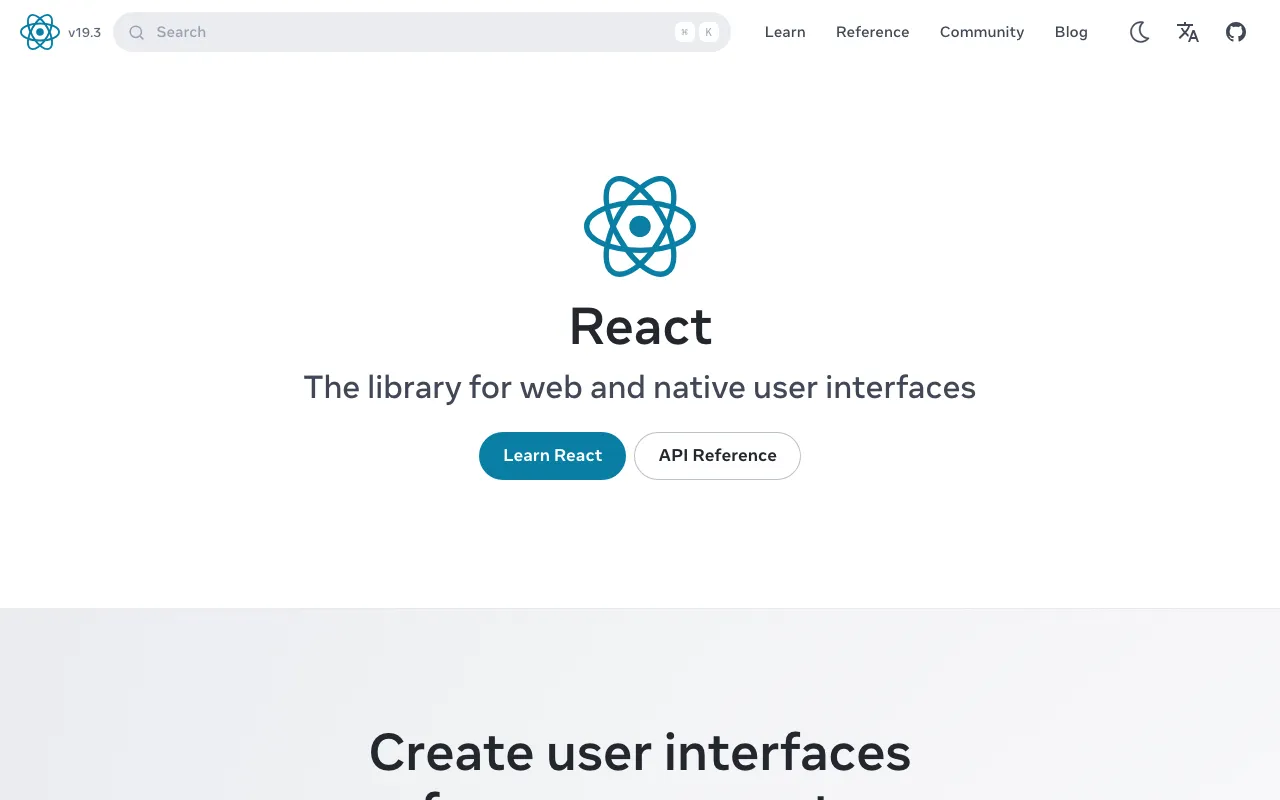
React screenshot

React helps developers build interfaces from reusable components that manage their own state. Views update declaratively when underlying data changes.

Overview

React is a component-oriented JavaScript library aimed at interactive user interfaces for web and native environments. Developers describe each visual state as a function of data, and the runtime reconciles changes to the DOM or native tree efficiently when inputs change.

Components encapsulate markup, behavior, and state in JavaScript functions rather than separate template files. JSX syntax lets authors embed HTML-like structure beside logic, though JSX is optional. Smaller components compose into screens, pages, and larger applications while keeping state out of the raw document when desired.

The project supports gradual adoption: teams can add React to existing pages, start from quick-start examples, or scaffold full toolchains for new apps. Documentation on the website covers quick starts, tutorials, state management, advanced guides, and API references.

Interactivity flows from props and hooks that respond to user events such as typing in inputs. Examples on the site demonstrate conditional rendering, lists, and combined component trees. Community contribution happens through the public issue tracker and documented contribution guide.

Key features

  • Declarative UI rendering
  • Encapsulated stateful components
  • JSX markup beside JavaScript logic
  • Composable component hierarchies
  • Hooks for interactivity and state
  • Gradual adoption in existing sites
  • Web and native UI targets
  • Documented quick start and API guides

Use cases

  • Building interactive single-page web apps
  • Sharing UI logic across web and native stacks
  • Structuring large frontends from small components
  • Incrementally modernizing legacy web pages

Tags

Similar software

ECC

Open-source agent engineering toolkit for coding harnesses

ECC adds planning, verification, review, memory, skills, and security scanning to coding agents such as Claude Code, Codex, and Cursor. It installs as plugins, packages, and managed adapters across multiple harnesses.

★ 311.7k⟳ 8 days agoMIT
Frameworks & PlatformsDesktop/CLI app

Flutter

Open-source UI framework for multi-platform apps from one codebase

Flutter is an SDK for building user experiences for mobile, web, and desktop from a single codebase. It uses the Dart language and compiles to native machine code or web targets.

★ 181.5k⟳ todayBSD-3-Clause
Open Source Alternative to:Ionic Enterprise

Bootstrap

Responsive HTML, CSS, and JavaScript front-end toolkit

Bootstrap supplies CSS, JavaScript, and Sass-based styles for building responsive, mobile-first sites. It ships prebuilt grid layouts, UI components, and optional JavaScript plugins.

★ 175.1k⟳ 2 days agoMIT

Langflow

Visual low-code builder for AI agents and workflows

Langflow is a visual builder for AI agents and workflows. Flows can be customized in Python and deployed as an API or as an MCP server, with support for major LLMs and vector databases.

★ 157k⟳ todayMIT
Open Source Alternative to:Relevance AIVoiceflow

LangChain

Framework for agents and LLM-powered applications

LangChain helps developers chain interoperable components and integrations to build agents and LLM-powered applications. It offers a standard interface for models, embeddings, vector stores, and related pieces.

★ 150.1k⟳ 2 days agoMIT

Next.js

React framework for full-stack web applications

Next.js lets you build full-stack web apps by extending React and integrating Rust-based JavaScript build tooling.

★ 143.8k⟳ todayMIT