
Litestream
Background SQLite WAL replication to files or cloud storage
Standalone process that streams SQLite write-ahead log changes to local paths or remote storage for incremental disaster recovery. Integrates without modifying application code.

Self-hosted centralized backup and restore for many database engines
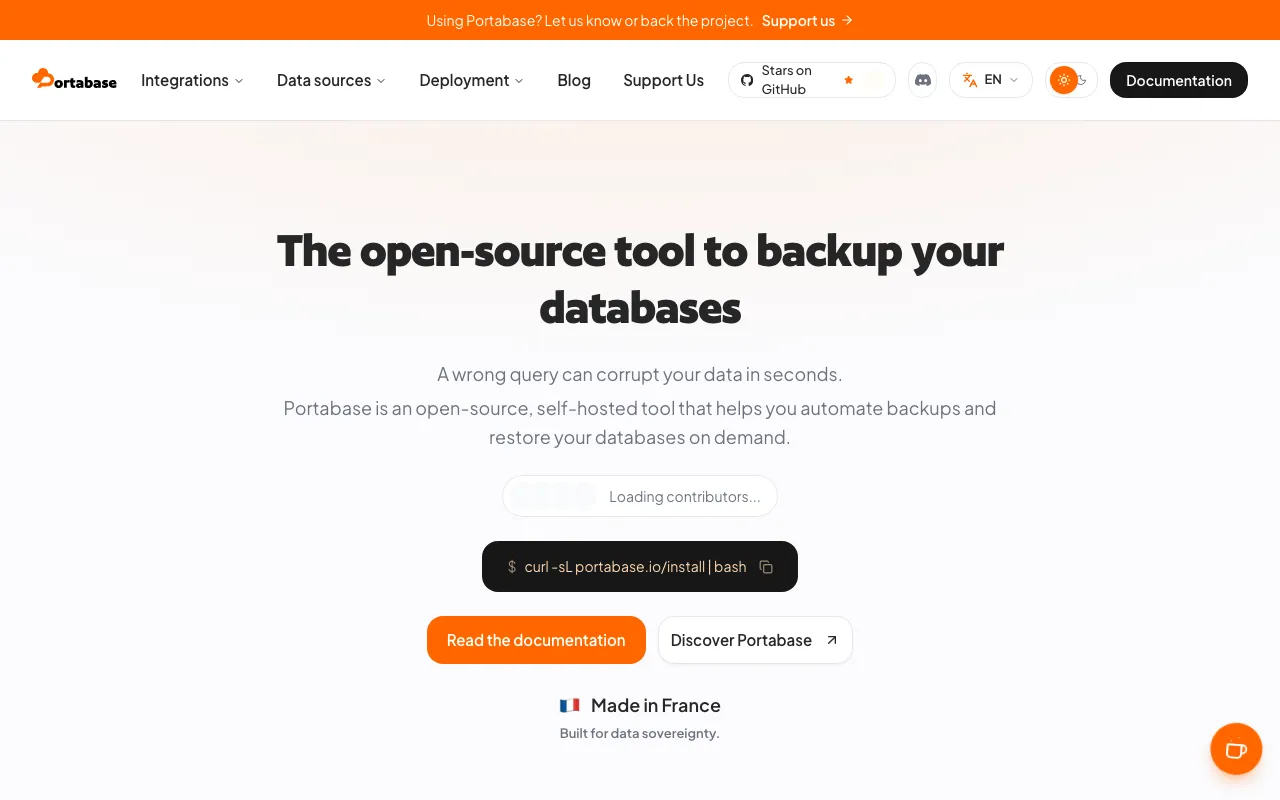
Portabase automates database backups and on-demand restores from a central dashboard. Agents connect to PostgreSQL, MySQL, MongoDB, and other engines plus Docker volumes and files.
Portabase is an open-source, self-hosted tool for backing up, centralizing, and restoring database instances. It uses Portabase agents to run backup and restore work while a dashboard coordinates projects, schedules, storage targets, and notifications without requiring inbound ports on agent hosts.
Supported data sources include PostgreSQL, MySQL, MariaDB, MongoDB, SQLite, Redis, Valkey, Firebird, Microsoft SQL Server, Docker volumes, and file-oriented backup modes. Restore is documented for most engines; Redis and Valkey backups are offered without restore in the compatibility table.
Operators choose storage backends—including S3-compatible providers—and define retention with GFS tiers, keep-last-N, or keep-for-X-days rules per database. Backups can be scheduled with fixed intervals or cron expressions. Backups may use AES-256-GCM encryption, and RBAC organizes teams and permissions on the instance.
Installation options include an automated CLI, Docker run, Docker Compose, and Kubernetes with Helm. A CLI installs agents and manages configuration, and a REST API plus MCP server integrate Portabase into external workflows. OIDC and OAuth2 authenticate users against external identity providers.
Background SQLite WAL replication to files or cloud storage
Standalone process that streams SQLite write-ahead log changes to local paths or remote storage for incremental disaster recovery. Integrates without modifying application code.

Backup and restore utility for ClickHouse databases
Creates and restores ClickHouse table backups locally or in cloud object storage. It must run beside clickhouse-server because it links the same on-disk data paths.
Single-binary scheduled backup for nine database engines
db-backup backs up, restores, verifies, and maintains MySQL, PostgreSQL, MongoDB, and six other engines using one configuration style. It runs as a CLI or built-in scheduler on servers, containers, or CI.

Open-source Postgres platform with auth, APIs, and storage
Supabase bundles a dedicated Postgres database with authentication, auto-generated REST and GraphQL APIs, realtime, functions, file storage, and vector tooling.

Open-source metrics monitoring and time series database
Prometheus collects metrics from configured targets, evaluates rules, and can raise alerts. It stores time series data and exposes a query language called PromQL.
Self-hostable no-code database with spreadsheet interface
NocoDB turns Postgres, MySQL, SQLite, or a hosted database into editable tables with grid, kanban, form, gallery, and calendar views. Teams collaborate with roles, sharing, REST APIs, and workflow integrations.
 Firebase
 Airtable