
Litestream
Background SQLite WAL replication to files or cloud storage
Standalone process that streams SQLite write-ahead log changes to local paths or remote storage for incremental disaster recovery. Integrates without modifying application code.
Single-binary scheduled backup for nine database engines
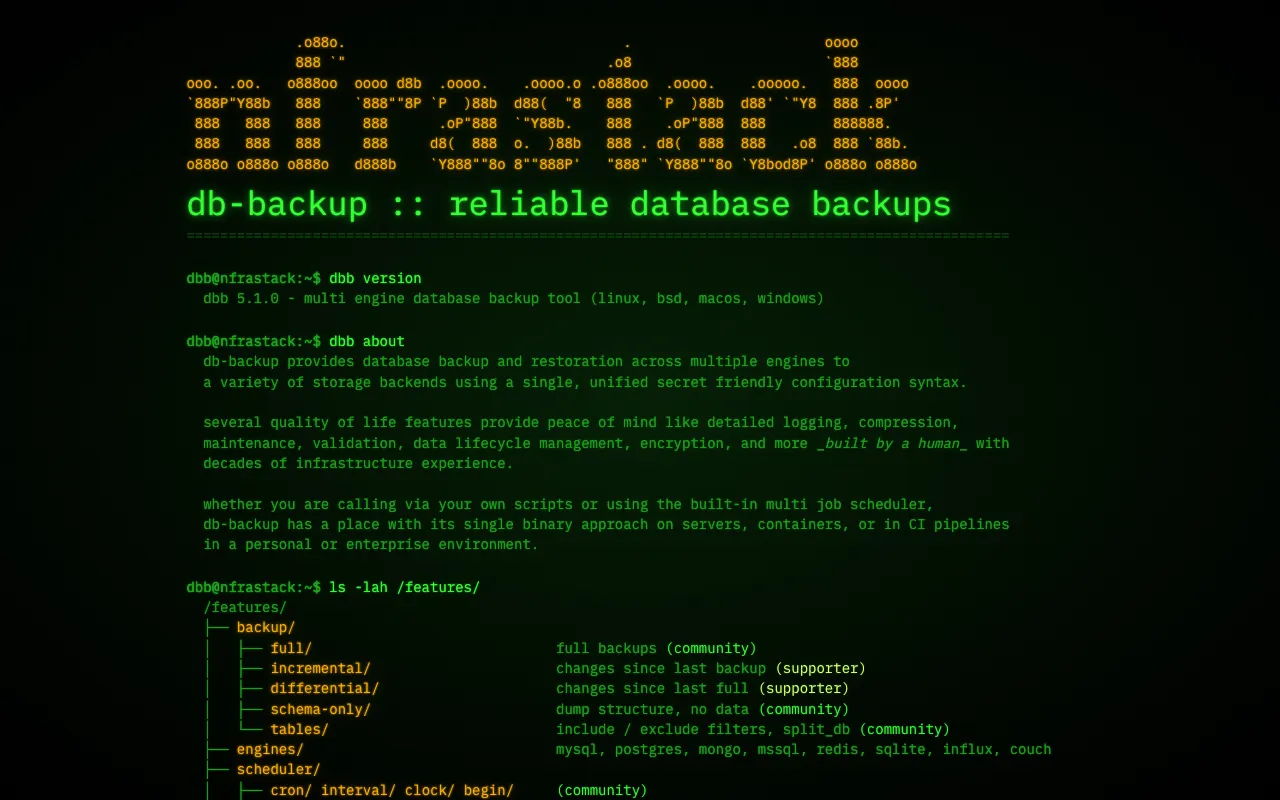
db-backup backs up, restores, verifies, and maintains MySQL, PostgreSQL, MongoDB, and six other engines using one configuration style. It runs as a CLI or built-in scheduler on servers, containers, or CI.
db-backup is a cross-platform tool that unifies backup, restore, verification, and maintenance for multiple database engines behind one secret-friendly configuration syntax. You can invoke it from scripts or let its multi-job scheduler run recurring jobs on servers, in containers, or in pipelines.
Supported engines include MySQL, MariaDB, PostgreSQL, MongoDB, Microsoft SQL Server, Redis, SQLite3, InfluxDB, and CouchDB. Backup modes cover full, incremental, differential, and schema-only dumps, with table include and exclude filters. Output can land on the filesystem or on S3-compatible, WebDAV, Azure Blob, or Google Cloud Storage backends, with optional encryption via AGE, GPG, or OpenSSL AES-256.
Scheduling accepts cron, intervals, clock times, natural language, day filters, and blackout windows. Retention policies support last-N, time windows, and tiered hourly through yearly rules. Compression uses zstd, gzip, bzip2, or xz. Restore works from the CLI, interactive guided mode, or config-driven profiles. Checksums and JSON sidecar metadata accompany backups, and maintenance hooks can analyze, optimize, vacuum, or reindex after successful runs.
Distribution options include a container image, precompiled binaries for Linux, BSD, macOS, and Windows, source builds, and a NixOS module. Documentation is hosted separately; a community edition covers most features, with advanced capabilities in a paid supporter tier.
Background SQLite WAL replication to files or cloud storage
Standalone process that streams SQLite write-ahead log changes to local paths or remote storage for incremental disaster recovery. Integrates without modifying application code.

Self-hosted centralized backup and restore for many database engines
Portabase automates database backups and on-demand restores from a central dashboard. Agents connect to PostgreSQL, MySQL, MongoDB, and other engines plus Docker volumes and files.

Backup and restore utility for ClickHouse databases
Creates and restores ClickHouse table backups locally or in cloud object storage. It must run beside clickhouse-server because it links the same on-disk data paths.

Open-source Postgres platform with auth, APIs, and storage
Supabase bundles a dedicated Postgres database with authentication, auto-generated REST and GraphQL APIs, realtime, functions, file storage, and vector tooling.

Open-source metrics monitoring and time series database
Prometheus collects metrics from configured targets, evaluates rules, and can raise alerts. It stores time series data and exposes a query language called PromQL.
Self-hostable no-code database with spreadsheet interface
NocoDB turns Postgres, MySQL, SQLite, or a hosted database into editable tables with grid, kanban, form, gallery, and calendar views. Teams collaborate with roles, sharing, REST APIs, and workflow integrations.
 Firebase
 Airtable