qmetrics.net

Litestream

Background SQLite WAL replication to files or cloud storage

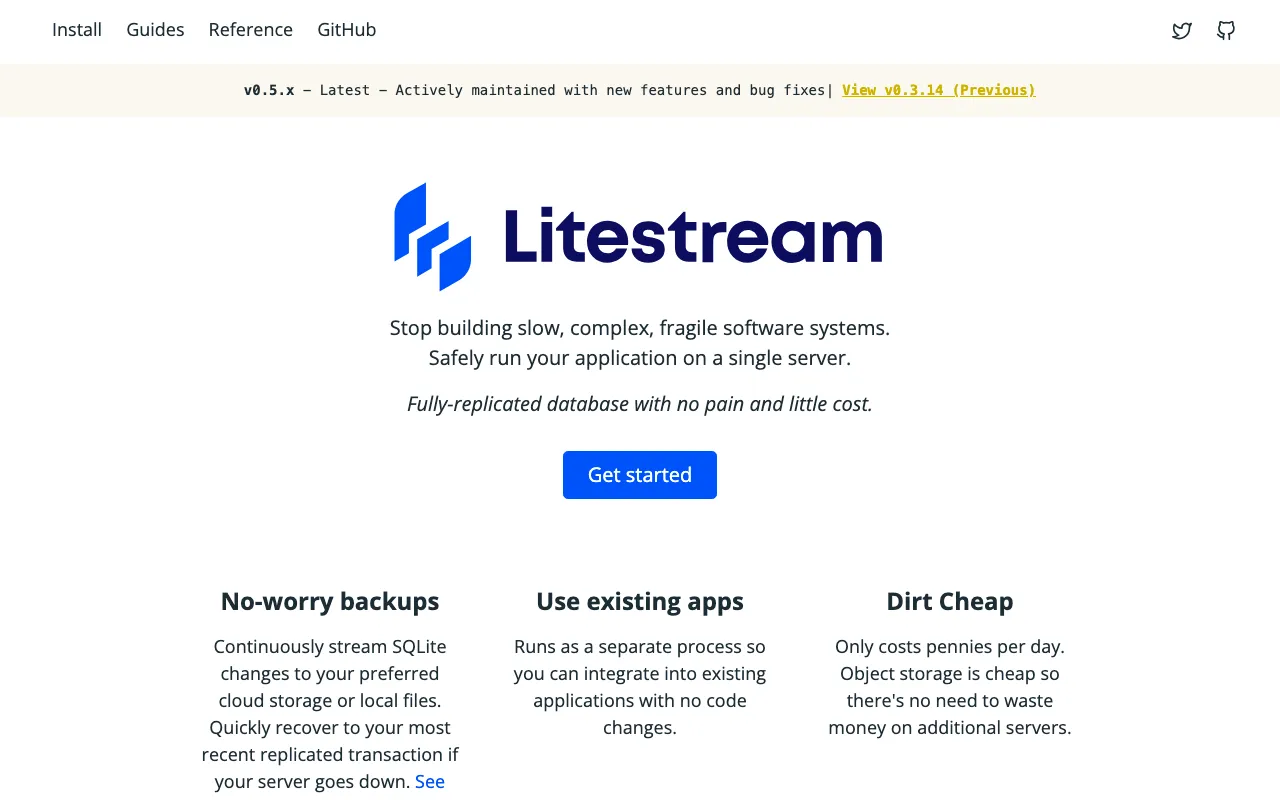
Litestream screenshot

Standalone process that streams SQLite write-ahead log changes to local paths or remote storage for incremental disaster recovery. Integrates without modifying application code.

Overview

Litestream is a disaster recovery companion for SQLite databases. It runs alongside your application as a separate process, watches the database write-ahead log, and replicates changes incrementally to a configured replica destination.

Replicas can target local filesystem paths or supported remote object storage backends, so you can keep off-site copies without running a separate database cluster. The tool is aimed at single-node SQLite deployments that still need continuous backup and a path to restore after server failure.

Because it operates outside the app, existing SQLite programs can adopt it without code changes. Replication introduces a small internal lock table in the source database to coordinate WAL checkpoints; that schema change is expected while Litestream is active. Graceful shutdown attempts to finish syncing on SIGINT or SIGTERM within configurable timeouts.

File replica URLs follow URL path escaping rules, including Unicode paths and percent encoding. The project also offers a Go library interface for embedding replication in other programs, though process-level shutdown behavior differs for library callers.

Key features

  • Incremental SQLite WAL streaming
  • Local file and cloud storage replicas
  • Runs as separate background process
  • No application code changes required
  • Configurable graceful shutdown timeouts
  • Go library for embedded replication
  • URL-escaped file replica paths
  • Restore from latest replicated state

Use cases

  • Continuous backup of production SQLite
  • Cheap object-storage database replicas
  • Single-server apps needing DR copies
  • Recovering after host or disk failure
  • Off-site replication without extra DB servers

Tags

Similar software

Portabase

Self-hosted centralized backup and restore for many database engines

Portabase automates database backups and on-demand restores from a central dashboard. Agents connect to PostgreSQL, MySQL, MongoDB, and other engines plus Docker volumes and files.

★ 1.9k⟳ yesterdayApache-2.0
Backup & RecoverySelf-hostable

ClickHouse Backup

Backup and restore utility for ClickHouse databases

Creates and restores ClickHouse table backups locally or in cloud object storage. It must run beside clickhouse-server because it links the same on-disk data paths.

★ 1.7k⟳ yesterdayMIT
Backup & RecoveryDesktop/CLI app

db-backup

Single-binary scheduled backup for nine database engines

db-backup backs up, restores, verifies, and maintains MySQL, PostgreSQL, MongoDB, and six other engines using one configuration style. It runs as a CLI or built-in scheduler on servers, containers, or CI.

★ 1.6k⟳ todayAGPL-3.0 · open core
Backup & RecoveryDesktop/CLI app

Supabase

Open-source Postgres platform with auth, APIs, and storage

Supabase bundles a dedicated Postgres database with authentication, auto-generated REST and GraphQL APIs, realtime, functions, file storage, and vector tooling.

★ 115.6k⟳ todayApache-2.0
Open Source Alternative to:FirebaseFirebase Realtime Database

Prometheus

Open-source metrics monitoring and time series database

Prometheus collects metrics from configured targets, evaluates rules, and can raise alerts. It stores time series data and exposes a query language called PromQL.

★ 67.9k⟳ yesterdayApache-2.0
Open Source Alternative to:PRTG Network Monitor

NocoDB

Self-hostable no-code database with spreadsheet interface

NocoDB turns Postgres, MySQL, SQLite, or a hosted database into editable tables with grid, kanban, form, gallery, and calendar views. Teams collaborate with roles, sharing, REST APIs, and workflow integrations.

★ 65.6k⟳ todaySource-available
DatabasesSelf-hostable