
MarkItDown
Python utility converting office and media files to Markdown
MarkItDown converts many file types into Markdown for LLM and text analysis pipelines. It aims to preserve headings, lists, tables, and links rather than perfect human layout.

Self-hosted unified API and schema for wearable health device data
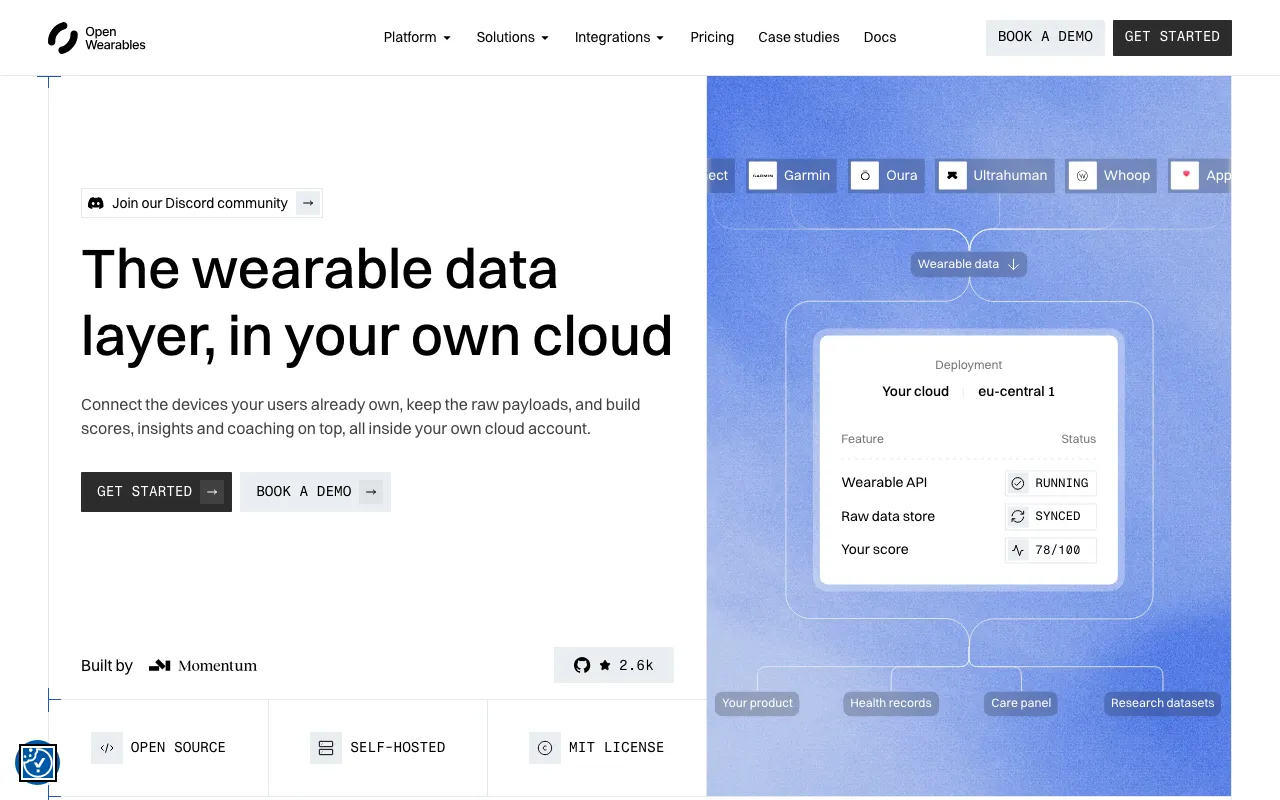
Open Wearables is an open-source platform that connects wearables and health apps, normalizes their data, and exposes sleep, activity, and vitals through one REST API you run in your cloud.
Open Wearables targets teams whose products depend on data from consumer wearables and phone health apps. Instead of maintaining separate integrations per vendor, you deploy one service that handles OAuth to cloud providers, background sync, webhooks, and mobile SDK uploads, then read standardized records from a single API.
Supported cloud providers include Garmin, Oura, Whoop, Polar, Suunto, Strava, Withings, and others, while Apple Health, Google Health Connect, and Samsung Health arrive through on-device SDKs. Records land in PostgreSQL under one unified model, with optional raw payload capture to S3 before parsing. Outgoing webhooks notify your application when new data is available.
A developer portal offers dashboards for users, sync history, webhook debugging, API keys, and provider credentials. A built-in Model Context Protocol server lets MCP clients query user wearable data through the same API. Docker quickstart and production deployment guides describe running official release images with environment flags for secure admin passwords.
The project is MIT licensed and designed for a single organization per deployment, with telemetry that can be disabled. Optional paid tiers add items such as mobile connect apps, health scores, and AI insights, while the core integration layer remains open source.
Python utility converting office and media files to Markdown
MarkItDown converts many file types into Markdown for LLM and text analysis pipelines. It aims to preserve headings, lists, tables, and links rather than perfect human layout.

Promise-based HTTP client for browser and Node.js
Axios is a promise-based HTTP client for JavaScript environments in the browser and Node.js. It supports common request methods, configurable defaults, and interceptors for request and response handling.

Python web framework for building APIs with type hints
FastAPI is a Python web framework for building APIs using standard type hints. It builds on Starlette and Pydantic and generates interactive OpenAPI documentation for the endpoints you define.

OpenAI-compatible AI gateway with provider routing
OmniRoute exposes one endpoint that routes chat requests across many LLM providers with quota-aware fallback and compression.

Web, desktop and CLI API development ecosystem
Hoppscotch lets developers send HTTP, WebSocket, GraphQL, and related API requests from a lightweight client. Collections, environments, teams, and sync help organize testing across devices.
 Postman

Progressive TypeScript framework for Node.js backends
Nest organizes Node server apps with modules, dependency injection, and first-party packages for auth, data, queues, and observability.