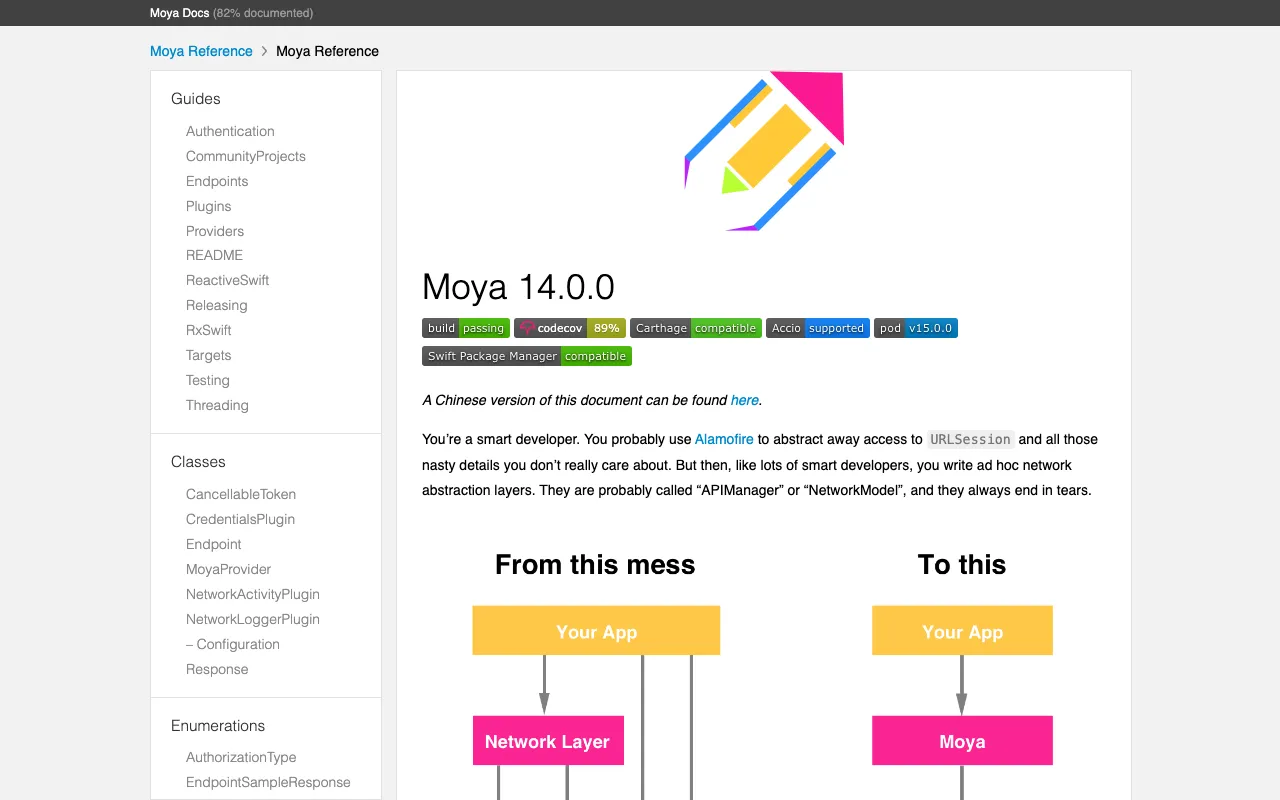
Moya wraps Alamofire with a structured layer for HTTP APIs in Swift. Endpoints are expressed as enums so paths, methods, and parameters are checked at compile time.
Overview
Moya targets iOS and broader Apple-platform developers who want a consistent pattern instead of ad hoc API manager classes. It sits above Alamofire and URLSession, encoding routes, parameters, and task types into type-safe endpoint definitions.
Each API surface is typically modeled as an enum conforming to Moya’s target protocol, which reduces typos in URLs and keeps parameter encoding explicit. Test stubs are treated as first-class citizens so unit tests can return canned responses without hitting the network.
Optional flavors integrate ReactiveSwift, RxSwift, and Combine, exposing requests as signals, singles, observables, or publishers with helpers to map JSON, images, or strings and to react to HTTP status codes. Distribution options include Swift Package Manager, CocoaPods, Carthage, and manual Xcode embedding alongside Alamofire.
The project is used in production settings such as Artsy’s auction application and is positioned as a network abstraction that keeps common calls simple while still supporting richer request definitions.
Key features
- Compile-time endpoint enums
- Alamofire-backed HTTP requests
- Built-in test stubbing
- ReactiveSwift extension
- RxSwift extension
- Combine publisher extension
- Parameter encoding in targets
- Multi-target provider support
Use cases
- iOS app REST client structure
- Unit testing network layers
- Rx or Combine reactive networking
- Replacing ad hoc API managers
- Typed multi-service API clients