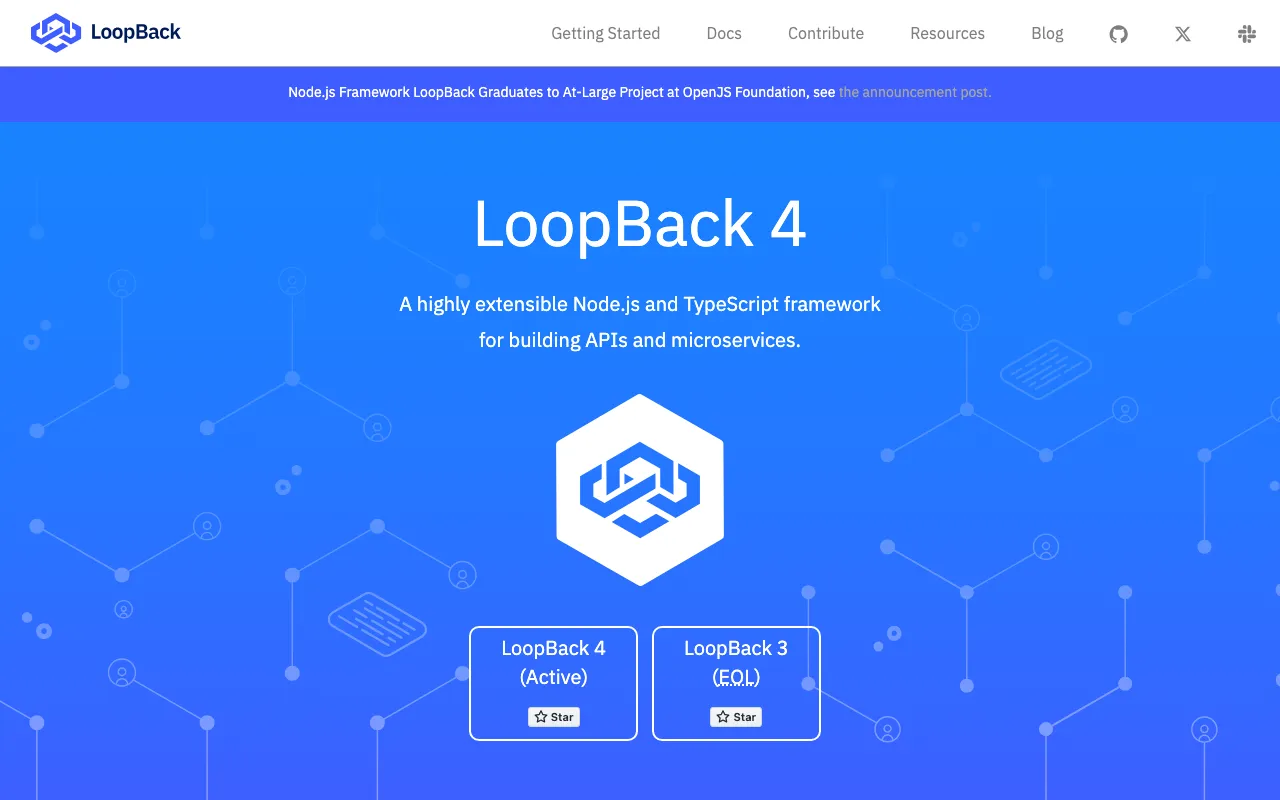
LoopBack is a Node.js and TypeScript framework for building REST APIs and microservices. It centers on OpenAPI for defining data and endpoints.
Overview
LoopBack helps teams create API applications that tie into complex backends and integrations. The stack is aimed at modern Node.js development with a TypeScript-oriented core and an extensible programming model.
You can scaffold APIs from OpenAPI definitions and generate working endpoints without maintaining generated code by hand. Dependency injection, components, mixins, and repositories are part of how you extend behavior. GraphQL interfaces for REST APIs can be produced using OpenAPI-to-GraphQL.
The project is an OpenJS Foundation at-large effort. Documentation covers getting started, package-level API usage, and comparisons between major LoopBack generations. A CLI and application generator are the usual entry points for new work.
It is positioned for developers who want a structured way to expose HTTP APIs with OpenAPI as the contract, rather than ad hoc route wiring alone.
Key features
- OpenAPI-driven REST APIs
- TypeScript and ES2017 core
- CLI project generation
- Dependency injection model
- Components, mixins, repositories
- GraphQL via OpenAPI-to-GraphQL
- No hand-maintained generated code
- Microservice-oriented API design
Use cases
- Building REST microservices
- Exposing complex backend integrations
- OpenAPI-first API development
- Node.js enterprise API layers