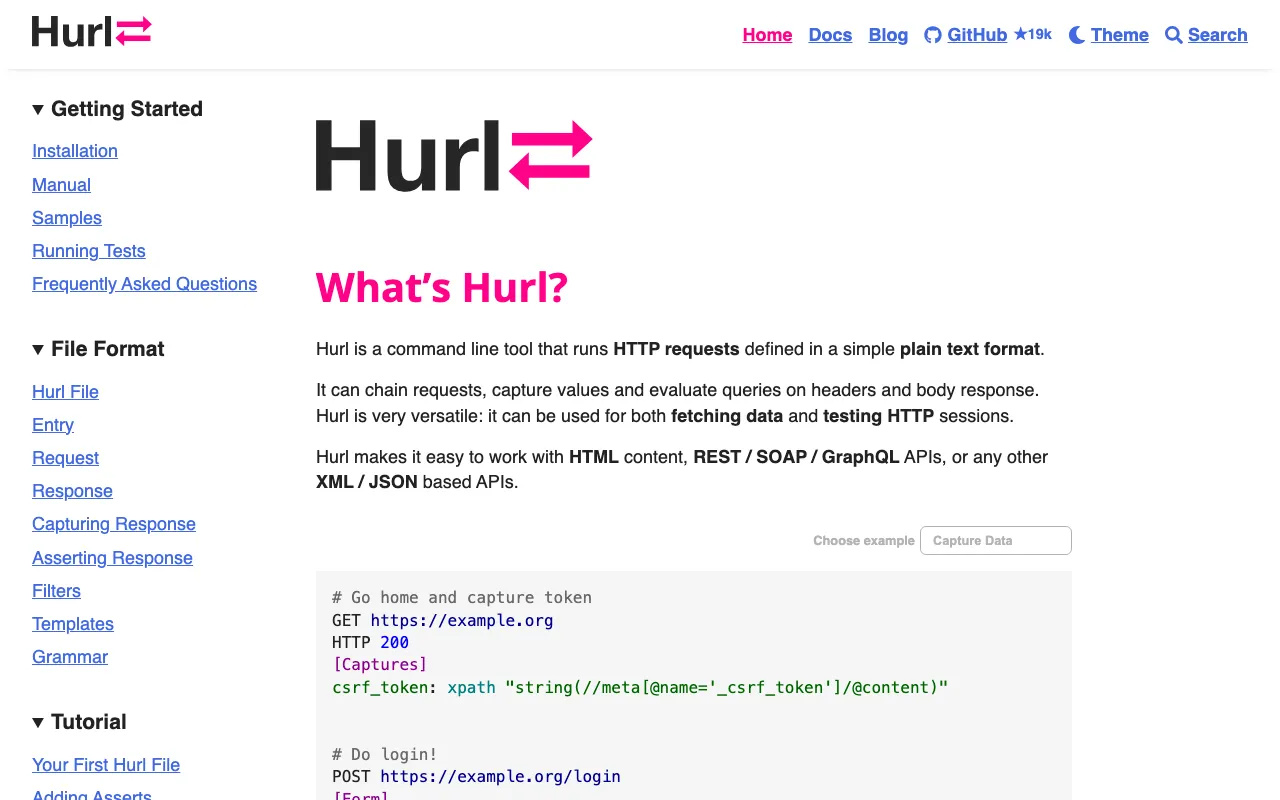
Hurl runs HTTP scenarios written in a readable text format and can assert on status, headers, and body content. It chains calls, captures values, and reports results for CI pipelines.
Overview
Hurl is a command-line client that executes HTTP requests described in plain text files rather than imperative scripts. Each file can list multiple requests in sequence, pass captured fields into later calls, and optionally assert on the responses that come back.
The format supports REST and GraphQL JSON bodies, HTML and XML payloads, multipart and form posts, basic and AWS SigV4 authentication, cookies, proxies, and many curl-compatible options. Queries use XPath, JSONPath, and predicates on headers, status codes, timing, certificates, and binary hashes.
Under the hood the tool is a single Rust binary that delegates transfer work to libcurl, including IPv6 and HTTP/3 capabilities. In default mode it behaves like curl and prints the last response body; a test mode runs assertions and exits with status suited to automation.
JUnit, TAP, HTML, and JSON reports help wire the runner into continuous integration, and directories of .hurl files can be executed recursively for suite-style runs.
Key features
- Plain-text .hurl request files
- Request chaining and response captures
- JSONPath, XPath, and header asserts
- GraphQL, SOAP, and form submissions
- JUnit, TAP, HTML, and JSON reports
- Single static binary powered by libcurl
- Polling, retry, and performance asserts
- curl-compatible CLI options
Use cases
- Integration testing REST and GraphQL APIs
- Smoke testing HTML or SOAP endpoints
- Reproducing multi-step login flows
- CI gates with JUnit or TAP output
- Scripted data fetch with assertions





 Postman
