qmetrics.net

Hugging Face JS libraries

JavaScript libraries for Hugging Face Hub and inference APIs

Libraries & SDKsDesktop/CLI app
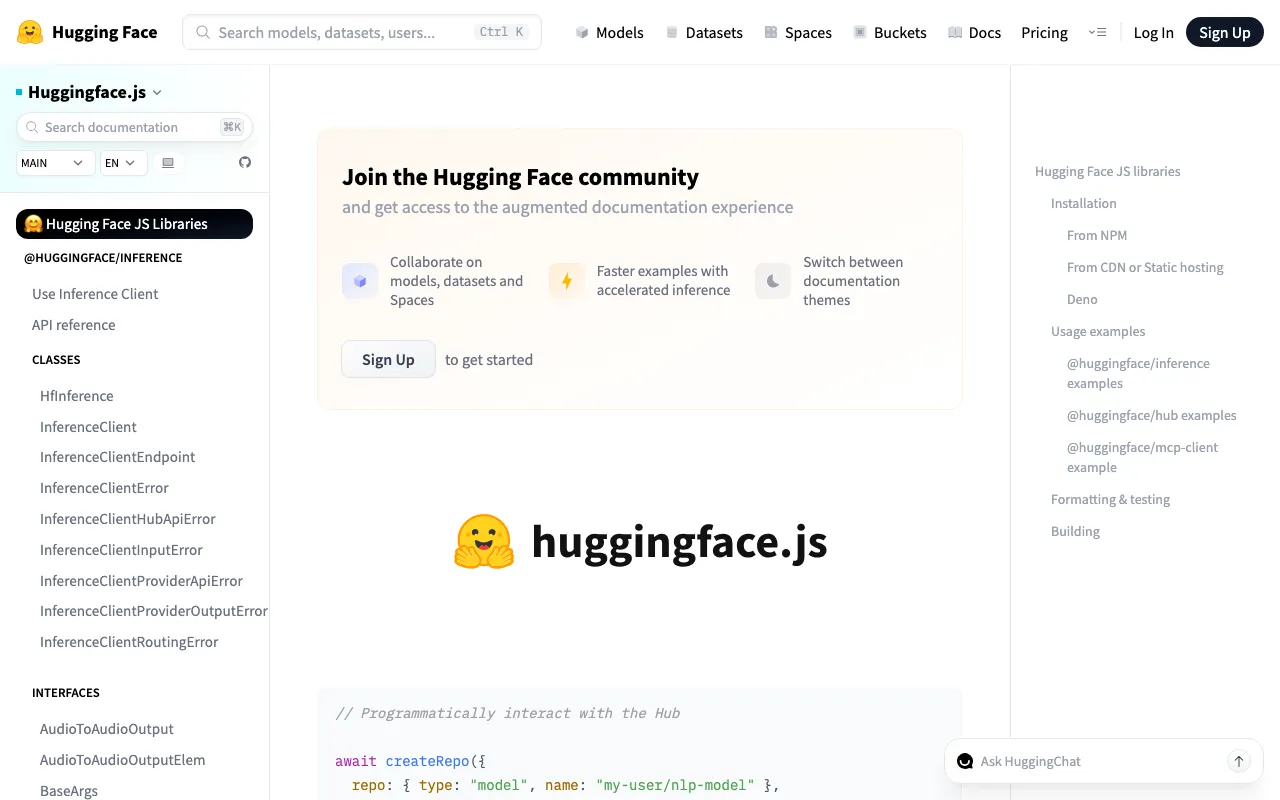
Hugging Face JS libraries screenshot

Hugging Face JS packages let TypeScript and JavaScript apps manage Hub repos, call inference providers, and parse ML file formats from browsers or Node.

Overview

Hugging Face JS libraries are a family of npm packages for working with Hugging Face services from JavaScript or TypeScript, with types included. They target modern browsers and Node.js 18 or newer, plus Bun and Deno, without legacy polyfills.

The @huggingface/hub package creates, updates, and deletes repositories and uploads or downloads files on huggingface.co. @huggingface/inference wraps serverless inference providers and dedicated inference endpoints for chat, image, translation, and related model tasks.

Additional packages cover MCP clients and tiny agents, GGUF and DDUF parsers for remote files, LeRobot dataset layouts, OpenUSD web viewing, Hub task definitions, a minimal Jinja engine for chat templates, Space header embedding, Ollama compatibility helpers, and tool-using agent utilities.

You install only the packages you need from npm, import them in bundled apps, or load them as ES modules from a CDN. Examples in the docs use access tokens from Hugging Face account settings for authenticated Hub and inference calls.

Key features

  • @huggingface/hub repo file operations
  • @huggingface/inference multi-provider calls
  • MCP client and tiny agents package
  • GGUF DDUF and LeRobot parsers
  • USD web viewer with three.js
  • Jinja templates for chat models
  • CDN and npm installation paths
  • TypeScript types included

Use cases

  • Manage Hub models from a web app
  • Call hosted LLMs in Node or browser
  • Build agents with MCP tool servers
  • Parse remote GGUF metadata in JS

Tags

Similar software

ECC

Open-source agent engineering toolkit for coding harnesses

ECC adds planning, verification, review, memory, skills, and security scanning to coding agents such as Claude Code, Codex, and Cursor. It installs as plugins, packages, and managed adapters across multiple harnesses.

★ 311.7k⟳ 8 days agoMIT
AI Assisted CodingDesktop/CLI app

React

JavaScript library for web and native user interfaces

React helps developers build interfaces from reusable components that manage their own state. Views update declaratively when underlying data changes.

★ 253k⟳ 2 days agoMIT
Libraries & SDKsDesktop/CLI app

MarkItDown

Python utility converting office and media files to Markdown

MarkItDown converts many file types into Markdown for LLM and text analysis pipelines. It aims to preserve headings, lists, tables, and links rather than perfect human layout.

★ 198.7k⟳ 21 days agoMIT
Libraries & SDKsDesktop/CLI app

Transformers

Shared model definitions for multimodal ML workloads

Transformers is a Python library that defines pretrained text, vision, audio, and multimodal models once in PyTorch for shared inference and training across the ecosystem.

★ 169.4k⟳ todayApache-2.0

Graphify

Codebase knowledge graph skill for AI coding assistants

Graphify maps a project’s code, docs, and media into a queryable local knowledge graph and installs as a skill for assistants such as Cursor and Claude Code.

★ 154.2k⟳ yesterdayApache-2.0

Taste Skill

Agent skill for designed company sites and browser QA

Taste Skill packages art direction, asset scripts, and headless browser checks so coding agents produce company websites with consistent layout, imagery, and copy rules.

★ 122.3k⟳ yesterdayMIT
AI Assisted CodingDesktop/CLI app