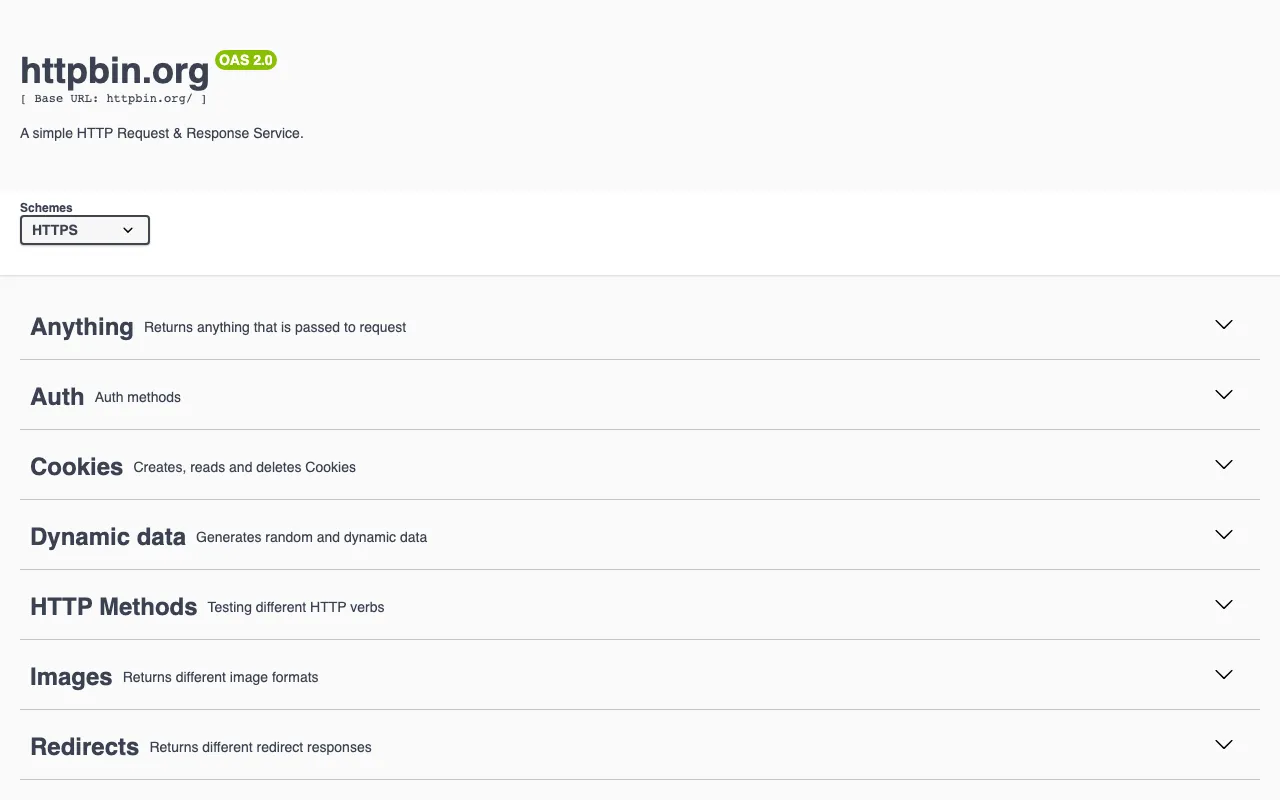
httpbin is a small Flask web service that reflects requests and returns configurable HTTP responses so you can exercise client libraries and tools.
Overview
httpbin helps developers verify how HTTP clients handle real protocol behavior. Endpoints echo headers, query strings, bodies, uploaded files, cookies, and client IP data, or respond with chosen status codes, delays, redirects, compression, authentication challenges, and other patterns described in its documentation.
A public deployment at httpbin.org provides shared access with documented rate limits per IP, smaller body size caps on echo routes, and optional visibility into proxy-added headers when callers pass showenv query flags. Operators who need a private instance can build and run the project from source, including Docker runs with environment variables that restrict redirect targets.
The service is implemented in Python with Flask and is widely used as a stable target for tutorials, integration tests, and manual curl experiments. Test suites can aim at any base URL so CI jobs hit a self-hosted copy instead of the shared site when required.
Because responses are deterministic and introspective, httpbin suits debugging serializers, middleware, and networking stacks without standing up a custom application backend.
Key features
- Request echo for headers and body
- Configurable status and delay responses
- Redirect and compression behaviors
- Cookie and auth challenge endpoints
- Docker deployment from source build
- Redirect domain allow list env var
- Proxy header visibility via showenv
- Public hosted instance with rate limits
Use cases
- HTTP client library testing
- Integration test fixtures
- Manual API debugging
- Teaching HTTP semantics
- Proxy and header behavior checks





 Postman
