GoFr is a Go framework aimed at microservices with Kubernetes in mind. It bundles REST defaults, configuration, observability, databases, messaging, and optional AI integrations.
Overview
GoFr helps teams stand up HTTP and gRPC services with conventional REST behavior, middleware, swagger rendering, websockets, cron jobs, and health checks across configured datasources. Configuration follows twelve-factor style environment variables for plugging in SQL, Kafka, Pub/Sub, NATS, and similar backends.
Observability is wired by default: structured logs, traces to OpenTelemetry-compatible exporters, and Prometheus-style metrics. HTTP outbound calls can use a circuit breaker, and database migrations are supported in the workflow.
AI-related APIs register OpenAI-compatible LLM endpoints with tracing, token metrics, and streaming. An optional MCP server exposes read-only handlers as tools for agent clients on a loopback port, while in-process tool access supports custom agent loops.
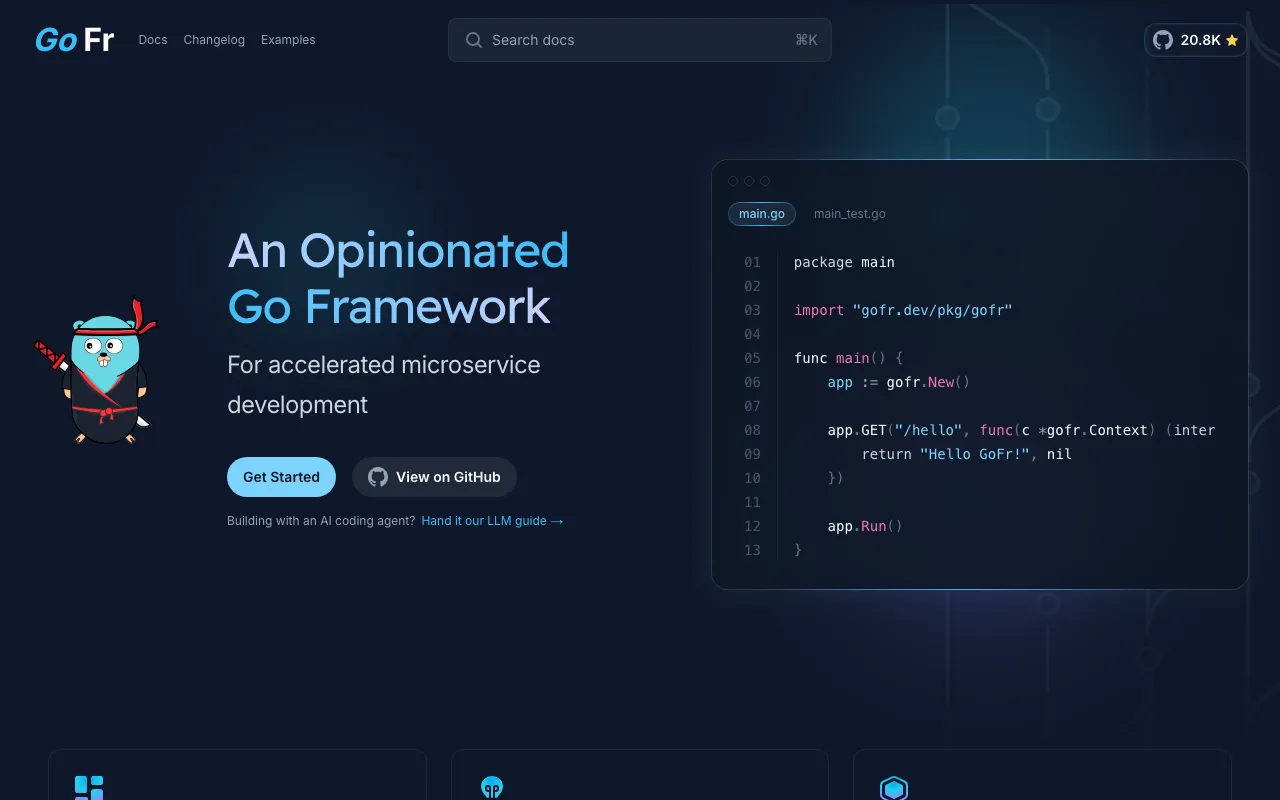
Applications start with a small bootstrap that registers routes and runs a local server on a default port. Documentation covers LLM setup, MCP, and examples for common patterns. The project is listed in the CNCF landscape under app definition and development.
Key features
- REST and gRPC handlers
- Built-in logs, traces, metrics
- Env-based datasource config
- Auth and custom middleware
- Pub/sub and cron support
- Database migrations
- LLM and MCP integrations
- Swagger and health checks
Use cases
- Kubernetes-oriented microservices
- Internal REST APIs in Go
- Services needing default observability
- Agent-callable read APIs via MCP