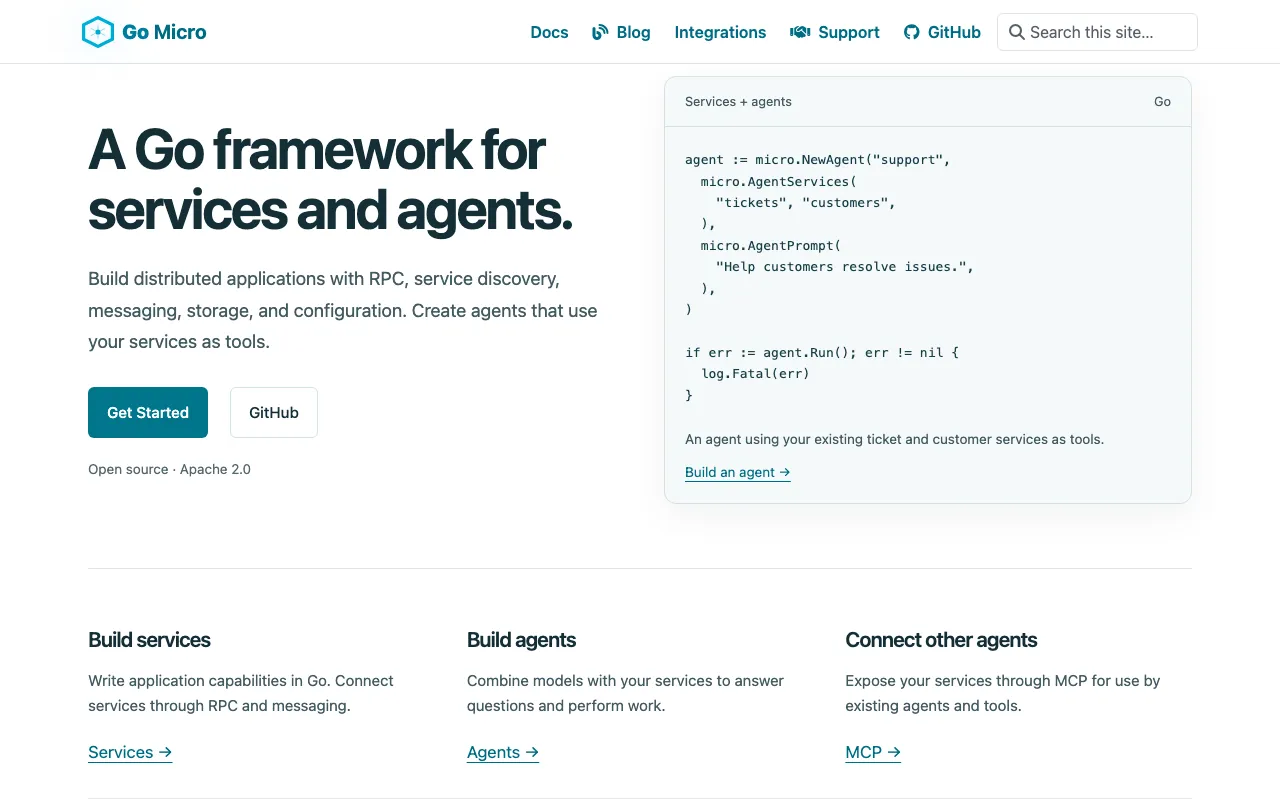
Go Micro is a Go framework for building distributed systems with RPC, discovery, messaging, storage, and configuration. Agents can call your services as tools and expose them over HTTP or MCP.
Overview
Go Micro targets teams building networked Go applications that need standard plumbing for communication and runtime concerns. It centers on services that speak RPC with streaming and encoding, plus discovery, messaging, storage, and configuration hooks.
On top of services, it adds an agent layer with models, conversation history, tools, background tasks, and recovery. Agents are wired to existing services so automated workflows can invoke real application capabilities instead of isolated prompts.
A gateway can expose services through HTTP and MCP so other applications or external agents can reach them. Documentation paths cover running plain RPC services, connecting outside agents via MCP, scaffolding services that embed agents, and chatting with services from the terminal.
Each major piece is defined as a Go interface with a default implementation that you can swap. The intended split is: implement capabilities as services, orchestrate them with agents, and optionally publish them through the gateway when other clients need access.
Key features
- RPC services with streaming and encoding
- Service discovery and messaging
- Storage and configuration abstractions
- Agent runtime with tools and history
- HTTP and MCP service gateway
- Pluggable Go interfaces per component
- Terminal chat against running services
- Background tasks and recovery for agents
Use cases
- Building Go microservices with shared infrastructure
- Letting agents call internal APIs as tools
- Exposing services to external agents via MCP
- Prototyping support bots over ticket services
- Standardizing discovery and messaging in Go fleets