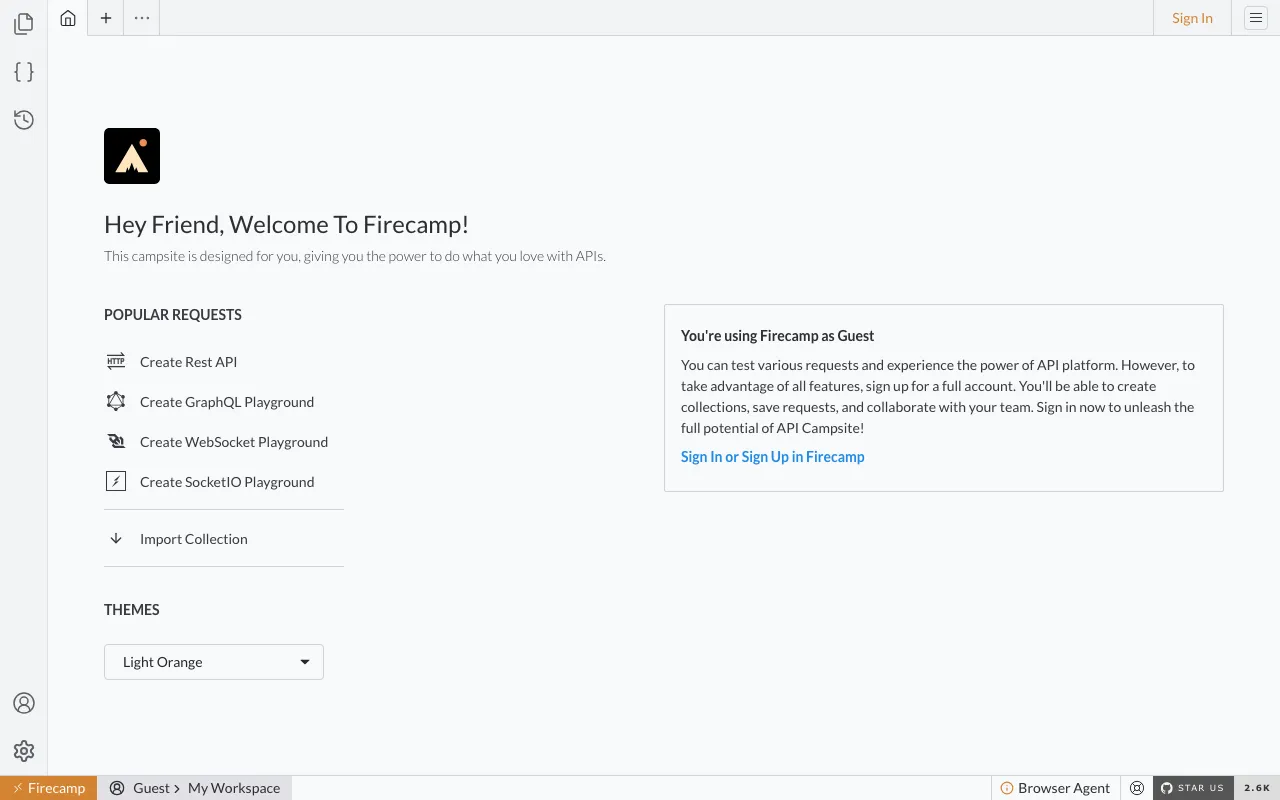
Firecamp helps teams design, test, and document REST, GraphQL, WebSocket, and Socket.IO APIs from a shared workspace. It offers protocol-specific playgrounds, collections, and optional desktop or web access.
Overview
Firecamp is an API development platform focused on designing, exercising, and documenting interfaces without juggling separate single-protocol tools. It supports REST, GraphQL, WebSocket, and Socket.IO with dedicated GUI playgrounds intended for collaborative team use.
Collections organize related requests for shared workspaces. Authentication helpers exercise common auth patterns, while pre-request and test scripts and dynamic variables support repeatable calls across the environment. A web client provides quick access; a downloadable desktop application is also offered for local use.
Team features center on a centralized workspace where members collaborate on API definitions and test runs. Planned roadmap items mentioned in project materials include self-hosted deployment, CLI and CI/CD runners, visual collection test runs, published API documentation, proxies, custom SSL, and history tracking.
The product positions itself around reducing context switching between documentation, clients, and automation by keeping protocol testing, scripting, and collaboration in one camp-style environment inspired by editor-centric developer workflows.
Key features
- REST GraphQL WebSocket Socket.IO playgrounds
- Shared API collections and workspaces
- Pre-request and test scripts
- Dynamic variables across requests
- Authentication testing helpers
- Web and desktop clients
- GraphQL query collection sharing
- Visual WebSocket and Socket.IO debugging
Use cases
- Team API design and regression testing
- Debugging event-driven Socket.IO services
- Collaborative GraphQL query development
- Centralized workspace for backend and mobile teams
- Exercising authenticated REST endpoints
Open-source alternative to

 Postman