REA
MCP and CLI reverse-engineering toolkit for agents
REA connects coding agents and terminals to local analysis tools for binaries, Electron apps, websites, .NET, and Android targets. Setup registers MCP access and investigation skills via npm.
LLVM and MLIR plugin for automatic differentiation
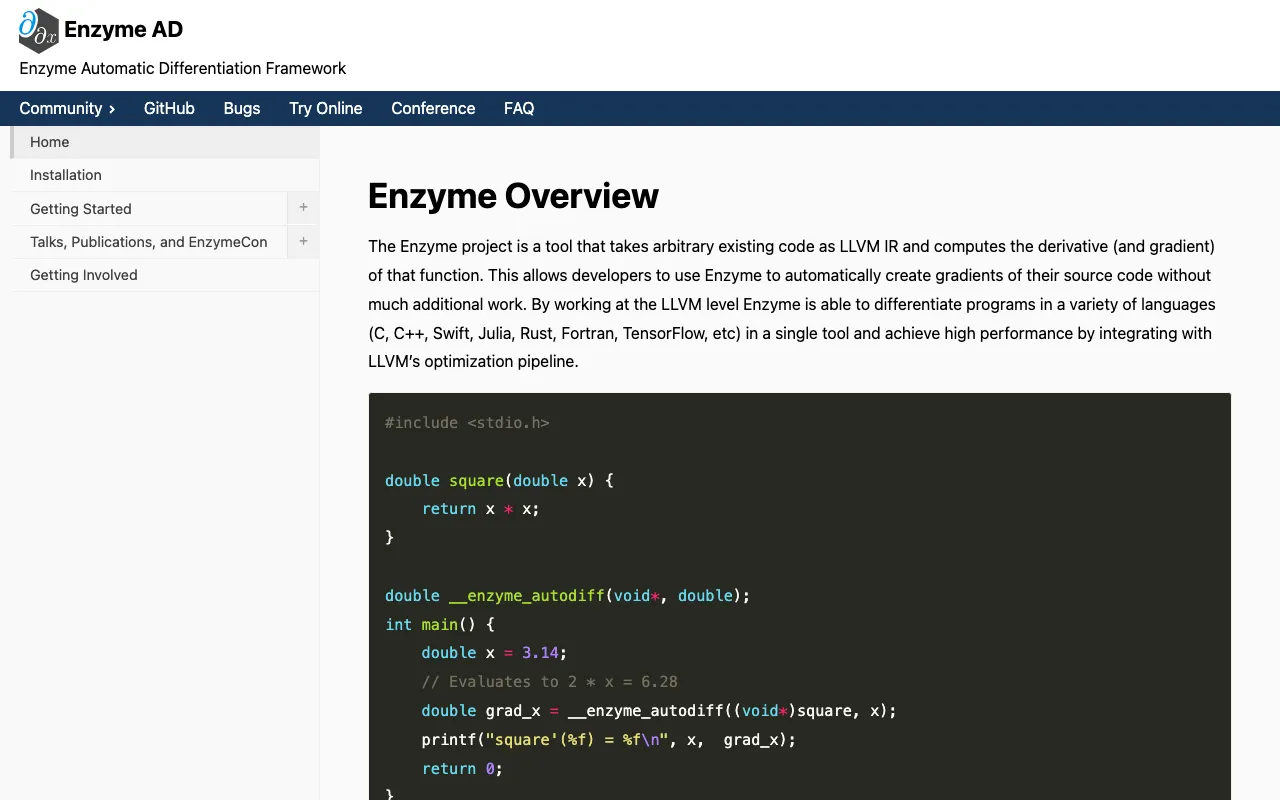
Enzyme is a compiler plugin that differentiates LLVM and MLIR code automatically. Developers call enzymeautodiff on functions to obtain gradients without hand-written derivative code.
Enzyme performs automatic differentiation on statically analyzable LLVM and MLIR. It takes existing optimized intermediate representation, runs analyses to determine which values affect derivatives, and replaces calls to enzymeautodiff with generated gradient functions.
Because differentiation happens after optimization in the LLVM pipeline, Enzyme is designed to produce efficient derivatives for code already tuned by the compiler. It can target programs originating from C, C++, Swift, Julia, Rust, Fortran, TensorFlow, and other front ends that lower to LLVM, using one toolchain rather than per-language AD rewrites.
The implementation includes optional preprocessing, interprocedural type analysis for memory, activity analysis, and an optimization pass that synthesizes derivative functions. Julia, Rust, and Fortran bindings are available. Installation paths mentioned in project materials include package managers such as Homebrew, Spack, and Nix, plus documentation on the project website and a Compiler Explorer instance for experiments.
MCP and CLI reverse-engineering toolkit for agents
REA connects coding agents and terminals to local analysis tools for binaries, Electron apps, websites, .NET, and Android targets. Setup registers MCP access and investigation skills via npm.

End-to-end machine learning platform and tooling ecosystem
TensorFlow is a machine learning platform with Python and C++ APIs, optional GPU packages, and companion libraries for data, training, deployment, and visualization.

Run open AI models locally or in the cloud
Ollama runs open language models such as Gemma, Qwen, DeepSeek and gpt-oss on macOS, Windows and Linux, locally or in the cloud. It offers a CLI, a REST API, and Python and JavaScript libraries.

Shared model definitions for multimodal ML workloads
Transformers is a Python library that defines pretrained text, vision, audio, and multimodal models once in PyTorch for shared inference and training across the ecosystem.

Codebase knowledge graph skill for AI coding assistants
Graphify maps a project’s code, docs, and media into a queryable local knowledge graph and installs as a skill for assistants such as Cursor and Claude Code.

LLM inference engine in C/C++ for local and cloud hardware
llama.cpp runs large language models and multimodal models locally or in the cloud with minimal setup. It includes a CLI, an OpenAI-compatible server with a built-in chat app, and a C library API.