
CyberChef
Browser-based toolkit for encoding and crypto operations
CyberChef runs in the browser and chains many data operations into recipes. Processing stays on your machine, with optional local Docker or Node.js builds.

MCP and CLI reverse-engineering toolkit for agents
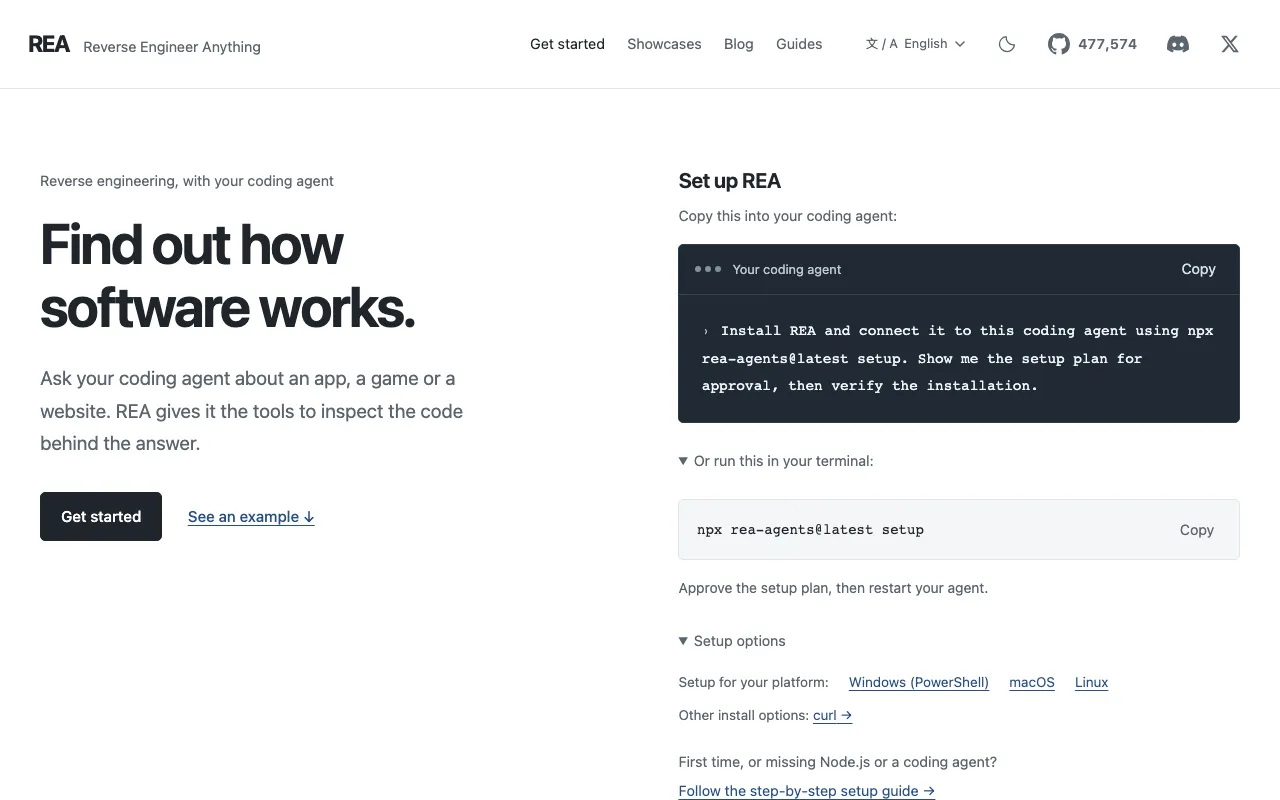
REA connects coding agents and terminals to local analysis tools for binaries, Electron apps, websites, .NET, and Android targets. Setup registers MCP access and investigation skills via npm.
REA helps investigate how software features work when source code is unavailable. Through MCP, an agent can call inspection tools, collect evidence, explain behavior, and optionally draft implementations grounded in what was observed. The same workflows are available from a command-line interface for scripted use.
Setup is run with a published npm package command from outside the project under study. It backs up existing agent configuration, registers the MCP server, and installs matching investigation instructions. Several agent clients are supported, with manual registration paths for others.
Native binary work can integrate Hopper, Ghidra, IDA, or Kuna where licensed and installed; static JavaScript and .NET inspection does not require those engines. Analysis runs locally, with results documenting evidence limits. Showcases walk through cases such as Electron clipboard bridges, DOS game math recovery, and sound-pan reconstruction.
Supported targets include native binaries, JavaScript and Electron directories, websites, .NET assemblies, Android apps, firmware, and recorded runtime or network captures. Operators can build reinforcement-learning practice environments from recorded sessions or desktop apps. Provider selection, snapshots, updates, and troubleshooting guidance are available per operating system.
Browser-based toolkit for encoding and crypto operations
CyberChef runs in the browser and chains many data operations into recipes. Processing stays on your machine, with optional local Docker or Node.js builds.
CLI for disassembling and rebuilding Android APK packages
Apktool reverse engineers third-party Android APK binaries, decodes resources and smali, supports edits, and rebuilds installable packages from a project-like tree.

Pattern-based static analysis for many languages
Semgrep scans source code with rules that resemble real code to find bugs and enforce standards. It runs locally in the CLI, IDE hooks, pre-commit, or CI.

JavaScript and Node.js source code obfuscator
A package that rewrites JavaScript to hinder reverse engineering, with local transforms, CLI batching, and optional cloud VM obfuscation.
Java and Android bytecode reverse engineering workbench
Bytecode Viewer is a Java desktop suite to open JARs, APKs, DEX, and related formats, decompile or disassemble them, search code, and edit with plugins.

Automated open-source project security health checks
OpenSSF Scorecard runs automated checks on open-source repositories and scores security-related practices from 0 to 10. It helps maintainers and consumers assess dependency risk.