
Argo Workflows
Kubernetes-native container workflow engine
Argo Workflows orchestrates parallel container jobs on Kubernetes using custom resources. Each step is a container, arranged as sequential tasks or DAG dependencies.
Unified orchestration layer for AI compute across GPU clouds and clusters
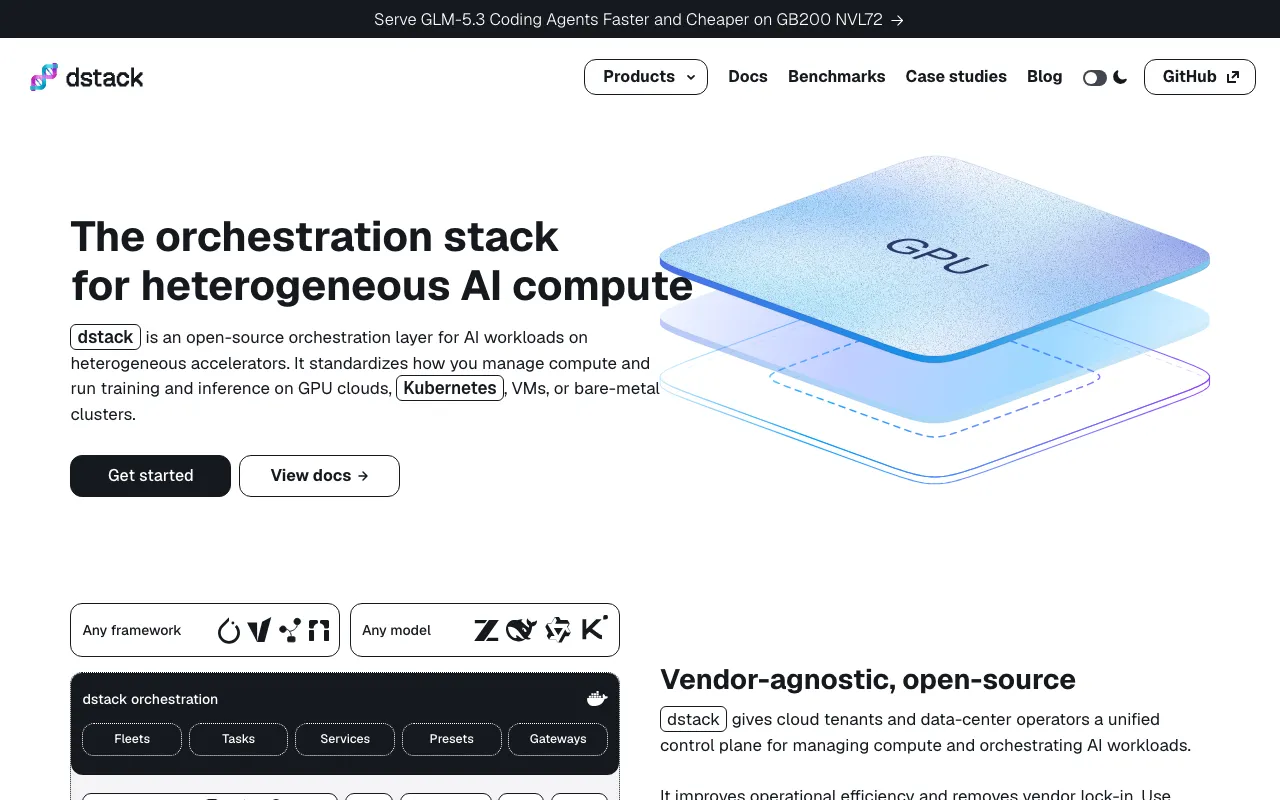
Open-source control plane for provisioning GPU compute and running training and inference on GPU clouds, Kubernetes, Slurm, VMs, or bare-metal clusters. Supports NVIDIA, AMD, Google TPU, and Tenstorrent accelerators.
dstack is an open-source orchestration layer for AI workloads on heterogeneous accelerators. It gives one interface for managing compute and running development, training, and inference across GPU clouds, Kubernetes clusters, Slurm clusters, VMs, and bare-metal servers. NVIDIA, AMD, Google TPU, and Tenstorrent accelerators are supported out of the box.
Work is described with a small set of configuration types written as YAML files in a repository. Fleets provision and manage clusters. Dev environments can be reached from an IDE or by agents. Tasks cover training and batch jobs on one node or many. Services expose model inference endpoints. Presets handle agent-driven inference optimization, and volumes hold persistent data. Configurations are applied with the dstack apply CLI command, a programmatic API, or AI agent skills. dstack handles provisioning, job queuing, auto-scaling, networking, volumes, run failures, out-of-capacity errors, and port-forwarding.
Compute can be brought in several ways. For clouds, you configure backends with your own credentials and dstack provisions fleets in your account. For on-prem machines with SSH access, you create SSH fleets and need no backend setup. Existing Kubernetes clusters connect through the Kubernetes backend, and existing Slurm clusters through an experimental Slurm backend. Those systems still handle scheduling inside the cluster. Gateways add HTTPS, auto-scaling, domains, and rate limits for services.
The server runs on Linux, macOS, and Windows through WSL 2. The CLI is available on Linux, macOS, and Windows. Besides the self-hosted open-source edition, the project offers dstack Factory, a multi-tenant stack for AI labs and data centers, and dstack Sky, a hosted service run by the vendor.
Kubernetes-native container workflow engine
Argo Workflows orchestrates parallel container jobs on Kubernetes using custom resources. Each step is a container, arranged as sequential tasks or DAG dependencies.
Open-source datacenter-scale distributed generative AI inference stack
Dynamo coordinates vLLM, SGLang, and TensorRT-LLM across many GPUs and nodes. It adds routing, disaggregated prefill and decode, KV cache management, and autoscaling without replacing those engines.

End-to-end machine learning platform and tooling ecosystem
TensorFlow is a machine learning platform with Python and C++ APIs, optional GPU packages, and companion libraries for data, training, deployment, and visualization.

Run open AI models locally or in the cloud
Ollama runs open language models such as Gemma, Qwen, DeepSeek and gpt-oss on macOS, Windows and Linux, locally or in the cloud. It offers a CLI, a REST API, and Python and JavaScript libraries.

Shared model definitions for multimodal ML workloads
Transformers is a Python library that defines pretrained text, vision, audio, and multimodal models once in PyTorch for shared inference and training across the ecosystem.

LLM inference engine in C/C++ for local and cloud hardware
llama.cpp runs large language models and multimodal models locally or in the cloud with minimal setup. It includes a CLI, an OpenAI-compatible server with a built-in chat app, and a C library API.