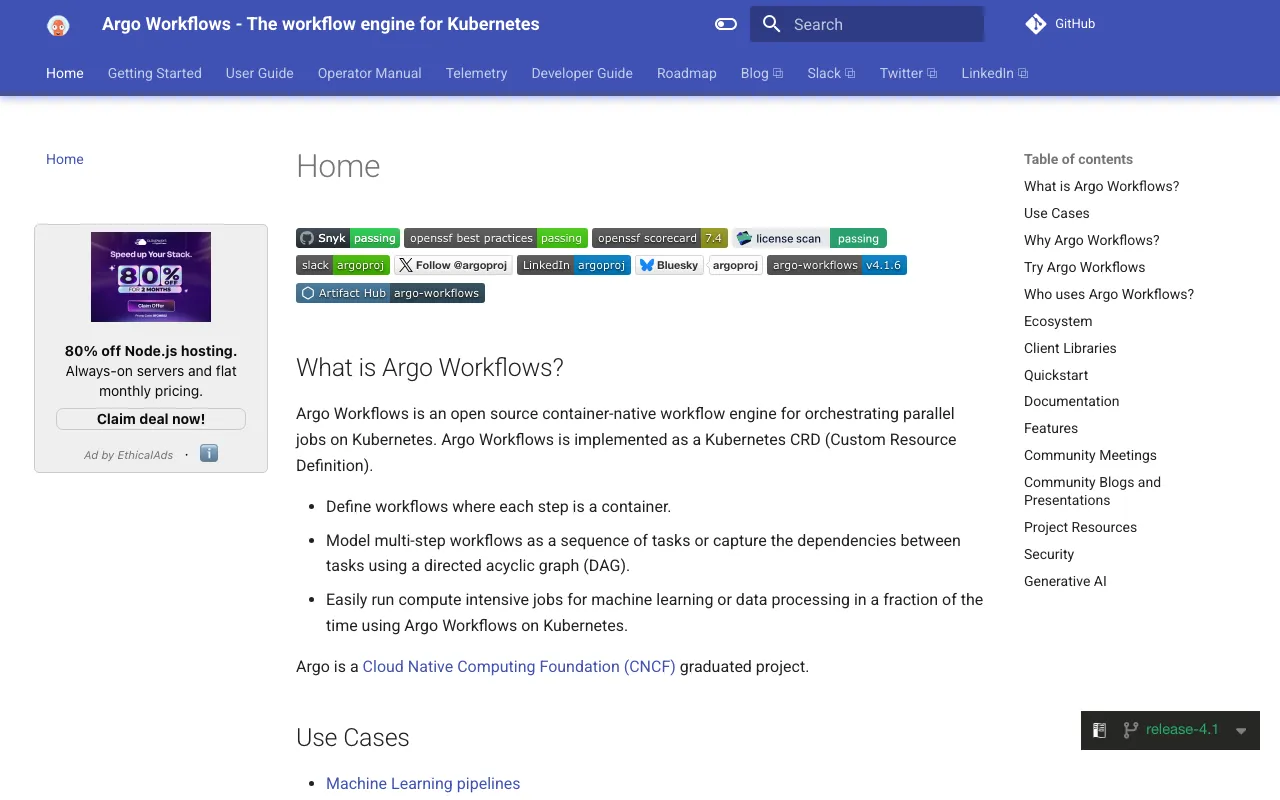
Argo Workflows orchestrates parallel container jobs on Kubernetes using custom resources. Each step is a container, arranged as sequential tasks or DAG dependencies.
Overview
Argo Workflows targets teams that want batch and pipeline logic inside Kubernetes instead of separate VM schedulers. Workflows are declared as cluster resources where every step runs as a pod, which keeps compute intensive machine learning and data jobs colocated with cluster tooling.
Operators can model flows as linear steps or directed acyclic graphs, pass artifacts and parameters between steps, and reuse workflow templates stored in the cluster. Cron schedules, retries, timeouts, suspend and resume, conditional branches, loops, and exit hooks cover long-running automation patterns.
A web UI visualizes runs, while a server component exposes HTTP and gRPC APIs. Artifacts can land in object stores and other backends, and completed runs can be archived for later inspection. Client libraries exist for Java, Go, Python via Hera, and TypeScript via Juno.
The controller is designed to run on any Kubernetes cluster, with scheduling knobs such as affinity, tolerations, node selectors, parallelism limits, and Prometheus metrics. SSO via OAuth2 or OIDC and webhook triggers support shared multi-tenant installations.
Key features
- Container steps as workflow units
- DAG and sequential workflows
- Web UI for workflow management
- Cron-scheduled workflows
- S3 and multi-backend artifacts
- REST and gRPC server API
- Workflow templates in cluster
- Python Hera SDK support
Use cases
- Machine learning training pipelines
- Data and batch processing jobs
- Kubernetes CI/CD workflows
- Infrastructure automation on K8s