qmetrics.net

Django OAuth Toolkit

OAuth 2.0 authorization server for Django projects

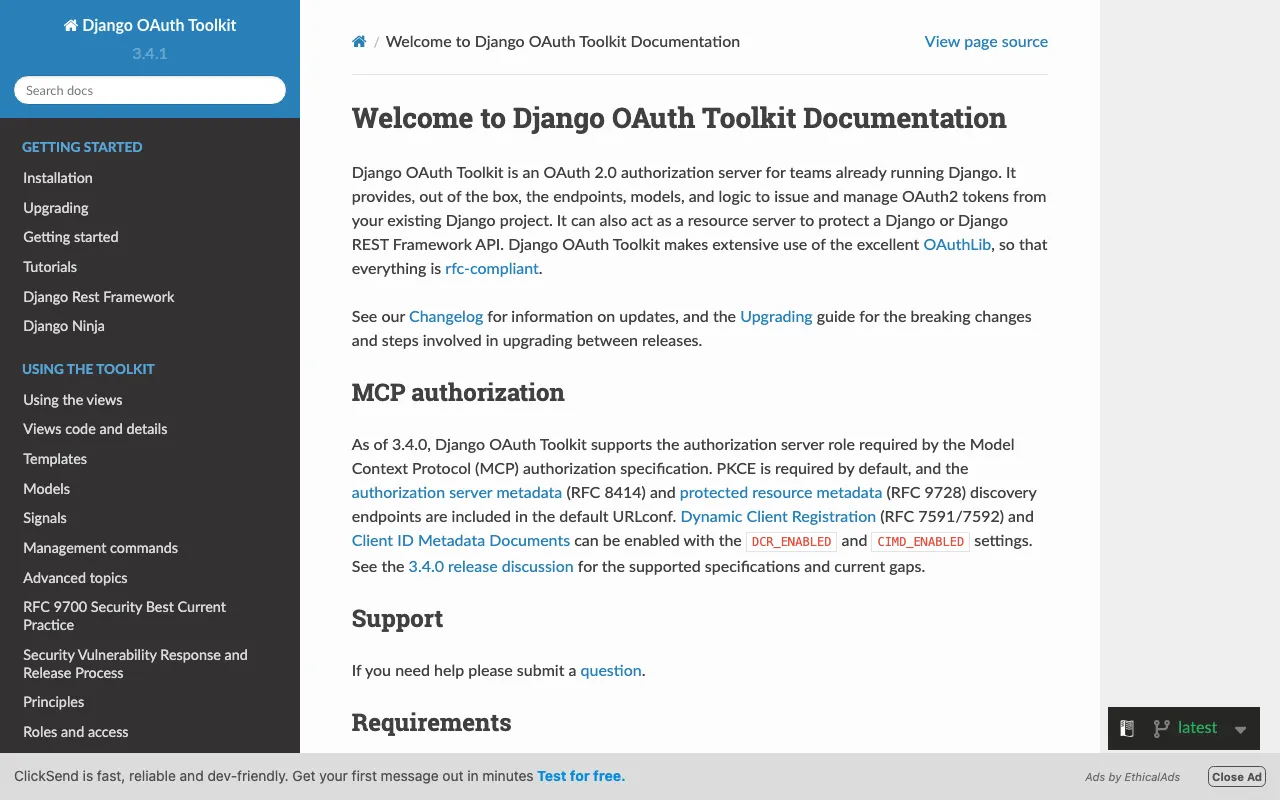
Django OAuth Toolkit screenshot

Issues and manages OAuth2 tokens inside an existing Django site. Can protect Django or Django REST Framework APIs as a resource server using OAuthLib.

Overview

Django OAuth Toolkit is an OAuth 2.0 authorization server for teams already running Django. It exposes endpoints, models, and logic to grant and maintain tokens from the same project instead of operating a separate auth service.

As an authorization server it wires into Django URL configuration under a conventional path prefix after adding the oauth2 provider app. It can also act as a resource server to guard APIs with OAuth2 access tokens. Behavior leans on OAuthLib for RFC-aligned flows.

Recent releases add Model Context Protocol authorization server expectations by default, including required PKCE, authorization server metadata (RFC 8414), and protected resource metadata (RFC 9728) discovery endpoints in the default URL set. Dynamic Client Registration and Client ID Metadata Documents are optional via settings.

Documentation covers grants such as authorization code and client credentials, Django REST Framework and Django Ninja integration, OpenID Connect, pushed authorization requests, device flows, admin management of applications and tokens, and separation of authorization and resource servers when APIs run on another Django instance.

Key features

  • OAuth 2.0 authorization server
  • API resource server mode
  • OAuthLib RFC compliance
  • PKCE by default
  • MCP authorization support
  • Metadata discovery endpoints
  • Optional dynamic client registration
  • Django REST Framework integration

Use cases

  • OAuth for Django APIs
  • Single-project token issuance
  • MCP authorization backends
  • Third-party app access control

Tags

Similar software

axios

Promise-based HTTP client for browser and Node.js

Axios is a promise-based HTTP client for JavaScript environments in the browser and Node.js. It supports common request methods, configurable defaults, and interceptors for request and response handling.

★ 109.5k⟳ 2 days agoMIT

FastAPI

Python web framework for building APIs with type hints

FastAPI is a Python web framework for building APIs using standard type hints. It builds on Starlette and Pydantic and generates interactive OpenAPI documentation for the endpoints you define.

★ 105.1k⟳ 9 days agoMIT

OmniRoute

OpenAI-compatible AI gateway with provider routing

OmniRoute exposes one endpoint that routes chat requests across many LLM providers with quota-aware fallback and compression.

★ 90.7k⟳ todayMIT

Hoppscotch

Web, desktop and CLI API development ecosystem

Hoppscotch lets developers send HTTP, WebSocket, GraphQL, and related API requests from a lightweight client. Collections, environments, teams, and sync help organize testing across devices.

★ 81k⟳ 5 days agoMIT
Open Source Alternative to:Postman

NestJS

Progressive TypeScript framework for Node.js backends

Nest organizes Node server apps with modules, dependency injection, and first-party packages for auth, data, queues, and observability.

★ 77.2k⟳ todayMIT

JSON Server

Zero-code mock REST API from JSON data files

JSON Server turns a JSON or JSON5 database file into a REST API for local prototyping. It supports filtering, sorting, pagination, embedding relations, and static assets.

★ 75.7k⟳ 8 months agoMIT