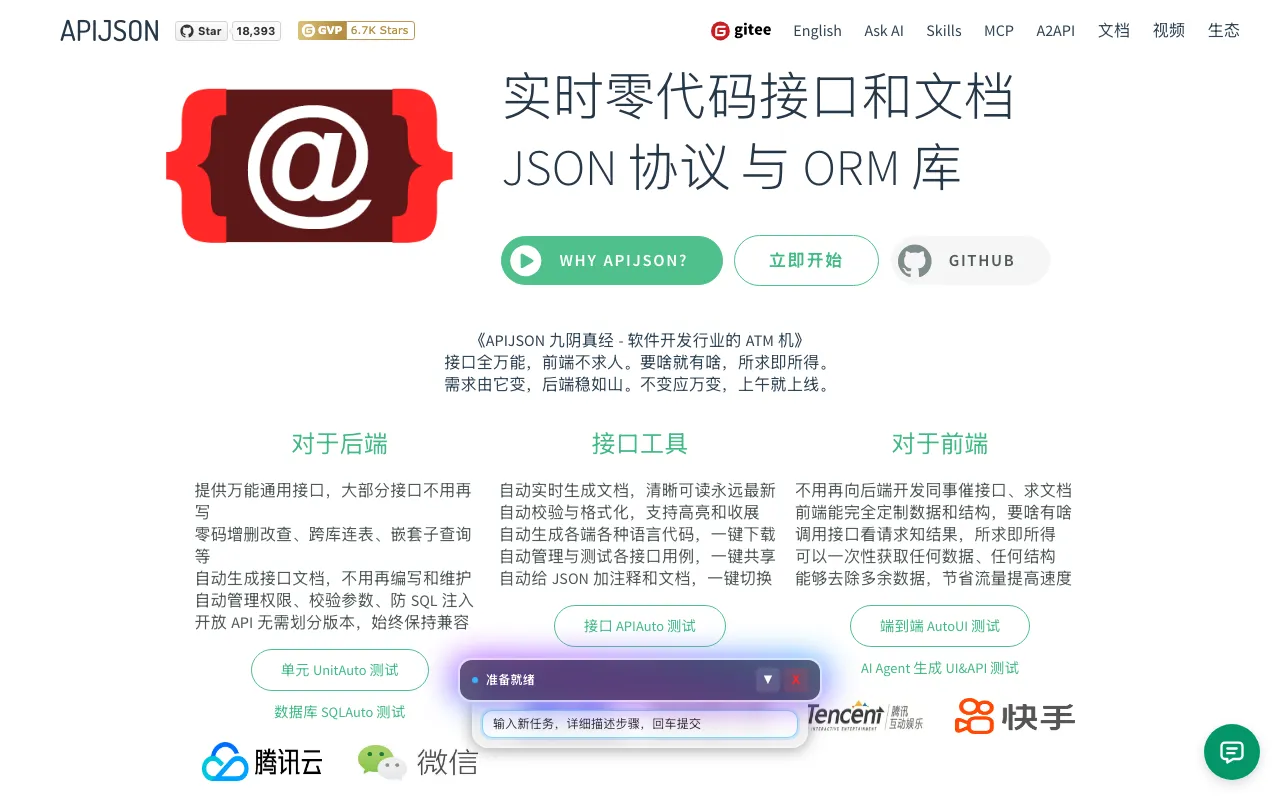
APIJSON is a JSON-based communication protocol and ORM library that lets backends expose CRUD-style HTTP APIs from client-shaped JSON requests. Frontends can tailor response JSON structure without separate endpoint sprawl.
Overview
APIJSON combines a JSON-based internet communication protocol with an ORM library aimed at back-end API work. Clients send JSON that names the data and shape they want; the server interprets it for reads, writes, joins, and related operations instead of requiring many hand-written REST endpoints per table or view.
Capabilities include CRUD, fuzzy search, remote function calls, and fetching varied data types in one request. Server-side API design and documentation effort can be reduced, with clients relying less on static API docs.
Backends integrate via Maven or Gradle dependencies; ecosystem projects cover multiple languages and databases. Companion tooling such as APIAuto supports HTTP API testing, code generation, and regression workflows. Demo Android APKs exist for simple and more complex client scenarios.
Compared with traditional CRUD and documentation-heavy API styles, APIJSON highlights multi-table queries, flexible JSON structures, auto-generated documentation, and permission or parameter checks on the server.
Key features
- Client-defined JSON query and response shape
- CRUD and fuzzy search over databases
- Remote function calls from JSON requests
- Multi-table joins and nested queries
- Auto-generated API documentation
- Role access and argument validation
- SQL injection protections
- Ecosystem ORM and router plugins
Use cases
- Reducing hand-written REST CRUD endpoints
- Mobile and web clients with flexible data fetches
- Multi-database and multi-language API backends
- Low-code or rapid internal API delivery
- HTTP API testing with APIAuto