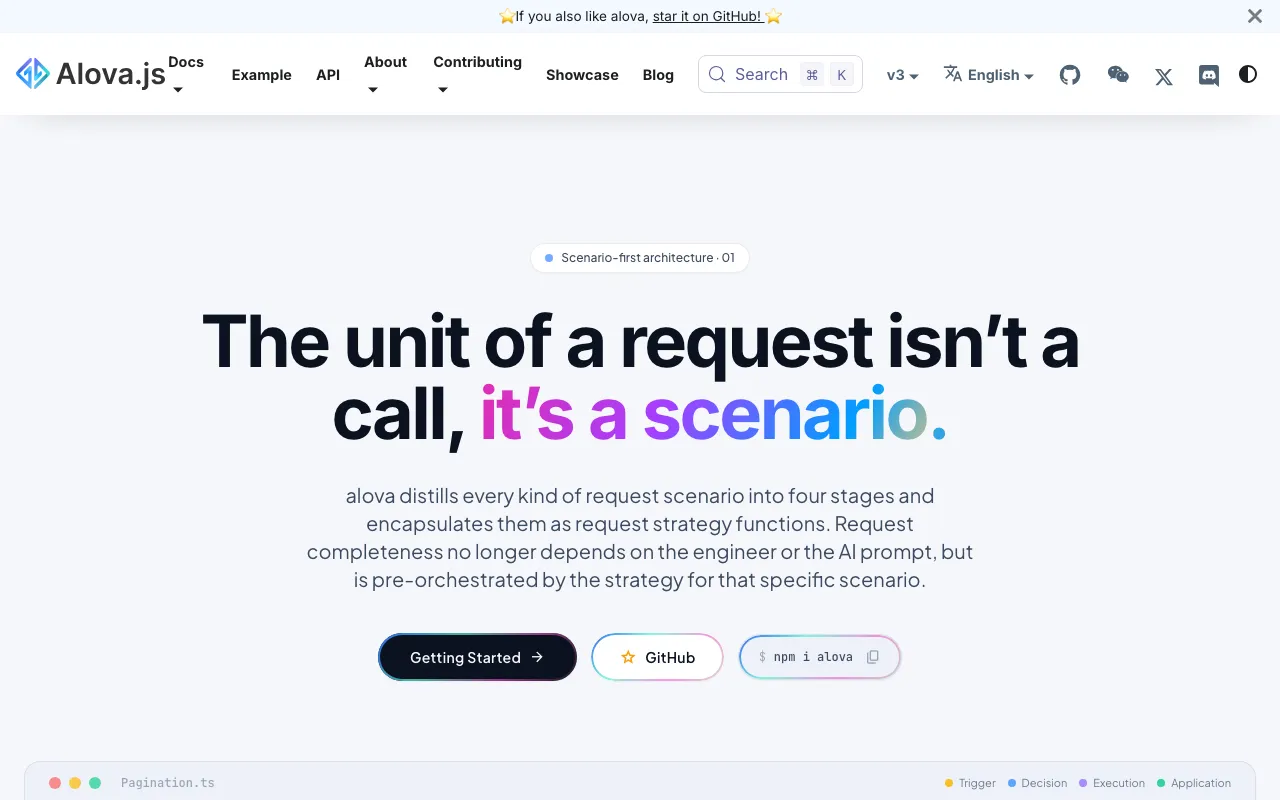
alova models HTTP work as reusable scenarios with trigger, cache, retry, and UI hooks. One API spans React, Vue, Svelte, Solid, mini-programs, and server runtimes atop axios or fetch.
Overview
alova is a request-strategy library that treats each HTTP interaction as a lifecycle scenario instead of a one-off call. Pagination, forms, uploads, authentication, retries, and server-side rate limiting are packaged as declarative strategies rather than repeated hand-written glue.
It sits above familiar clients such as axios or fetch and supplies hooks like usePagination, useForm, useUploader, useWatcher, useFetcher, and server-side atomize and retry helpers. The Request Scenario Model splits work into trigger, decision, execution, and data-application stages with defaults for debouncing, caching, stale-response guards, retries, and prefetch.
The same interfaces are intended to run across React, Vue, Svelte, Solid, mini-program targets, and Node.js, Deno, or Bun on the server, with request sharing, multi-level cache, and end-to-end typing. An OpenAPI-oriented companion generates typed clients, docs, and AI-assistant knowledge from specifications.
Documentation contrasts alova with query-centric libraries by emphasizing scenario completeness for UX-heavy features such as pagination sync and silent token refresh interceptors.
Key features
- Request Scenario Model lifecycle
- Pagination and form strategy hooks
- Built-in debounce cache and retry
- Cross-framework client hooks
- Server-side retry and rate limits
- Shared in-flight request deduplication
- Token refresh authentication helper
- OpenAPI codegen companion worma
Use cases
- Declarative list and form fetching
- Unified HTTP logic across frameworks
- Reducing hand-written request boilerplate
- SSR and mini-program API layers