
Octelium
Self-hosted zero-trust secure access and tunnel platform
Octelium unifies VPN, ZTNA, secure tunnels, API and AI gateways, and PaaS-style deployments on Kubernetes you host yourself.

Open-source zero-trust overlay networking platform
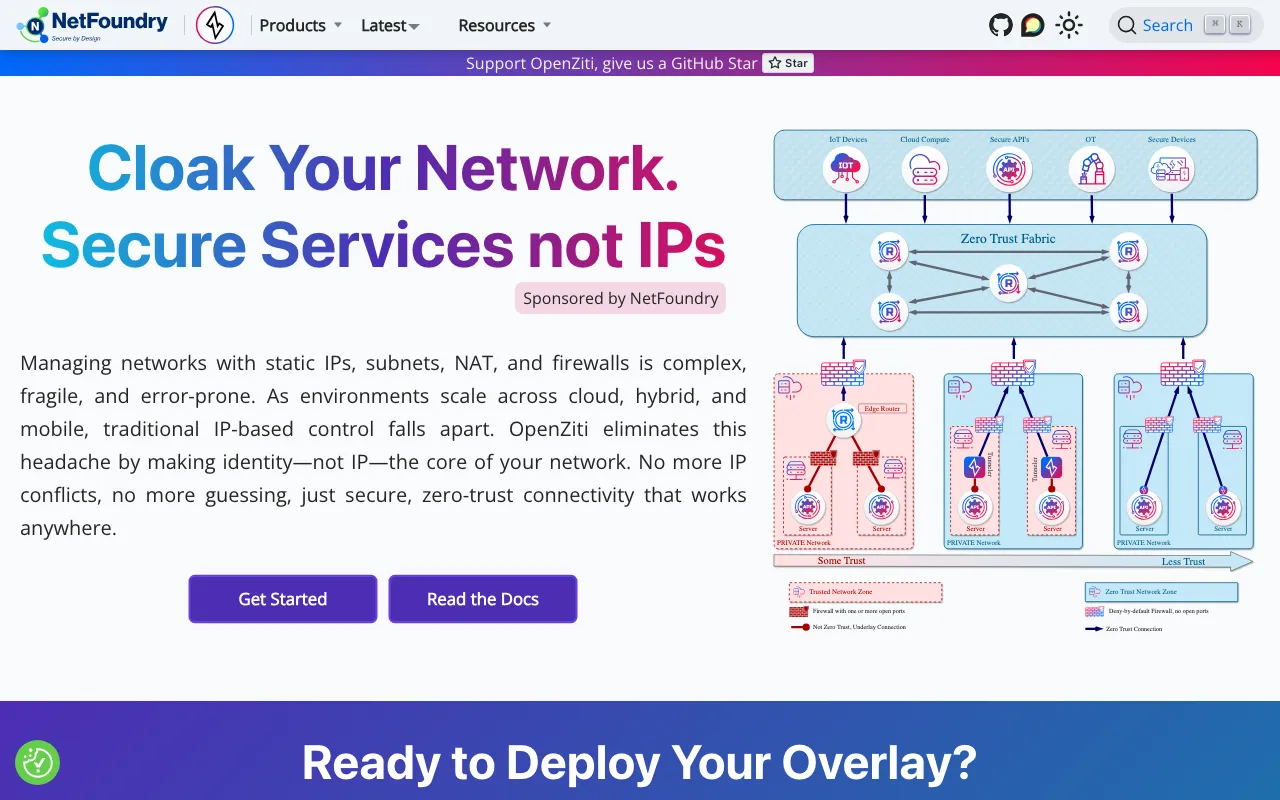
OpenZiti hides services behind cryptographic identity, policy, and end-to-end encryption. It supports tunnelers for existing apps and SDKs for embedded zero trust.
OpenZiti is an open-source zero-trust networking platform that makes services unreachable to unauthorized parties. Each user, service, device, or workload receives a cryptographic identity; connections are authorized by policy and encrypted end to end, using identity rather than IP location as the basis for access.
A controller manages identities, policies, and topology while edge routers form an encrypted mesh fabric for data traffic. Services can stay dark with no listening ports, registering outbound to the overlay so port scans and public endpoints are avoided. Management is available through REST APIs and a web-based admin console.
Teams can adopt three models in one network: edge routers at a trusted zone boundary, host tunnelers beside unmodified applications, or SDKs compiled into clients and servers for in-process encryption. Tunnelers exist for common desktop and mobile operating systems; SDKs cover several programming languages.
Typical goals include replacing broad VPN access with per-service authorization, securing machine-to-machine and IoT identity, linking multi-cloud and hybrid sites on one overlay, and reaching self-hosted resources without opening home router ports. The stack is intended to be fully operable on your own infrastructure.
Ziti doesn't name these products itself, but its own description shows it does the same job.
Self-hosted zero-trust secure access and tunnel platform
Octelium unifies VPN, ZTNA, secure tunnels, API and AI gateways, and PaaS-style deployments on Kubernetes you host yourself.

Self-hosted WireGuard VPN with MFA and IAM
Defguard combines WireGuard VPN, identity and access management, multi-factor authentication, and network access control in one platform you can run on your own infrastructure.

Self-hosted access gateway with SSO and session recording
Werbot is an open-source access gateway that authorizes commands to servers and databases, records sessions, and shares access without handing out passwords. It supports Docker Compose and binary installs.

Multi-platform Clash Meta proxy client without ads
FlClash is a proxy client built on the mihomo (Clash.Meta) core for Android, Windows, macOS, and Linux. It supports rule routing, TUN mode, and subscription-based profiles.
Network-wide DNS sinkhole for ads and unwanted content
Pi-hole is a DNS sinkhole that blocks ads and unwanted content for every device on your network without client-side software on each device.

Web control panel for Xray-core proxy servers
3X-UI is a web panel for deploying, configuring, and monitoring Xray-core servers and many proxy or VPN protocols from one VPS or multi-node setup.