
Ziti
Open-source zero-trust overlay networking platform
OpenZiti hides services behind cryptographic identity, policy, and end-to-end encryption. It supports tunnelers for existing apps and SDKs for embedded zero trust.

Self-hosted zero-trust secure access and tunnel platform
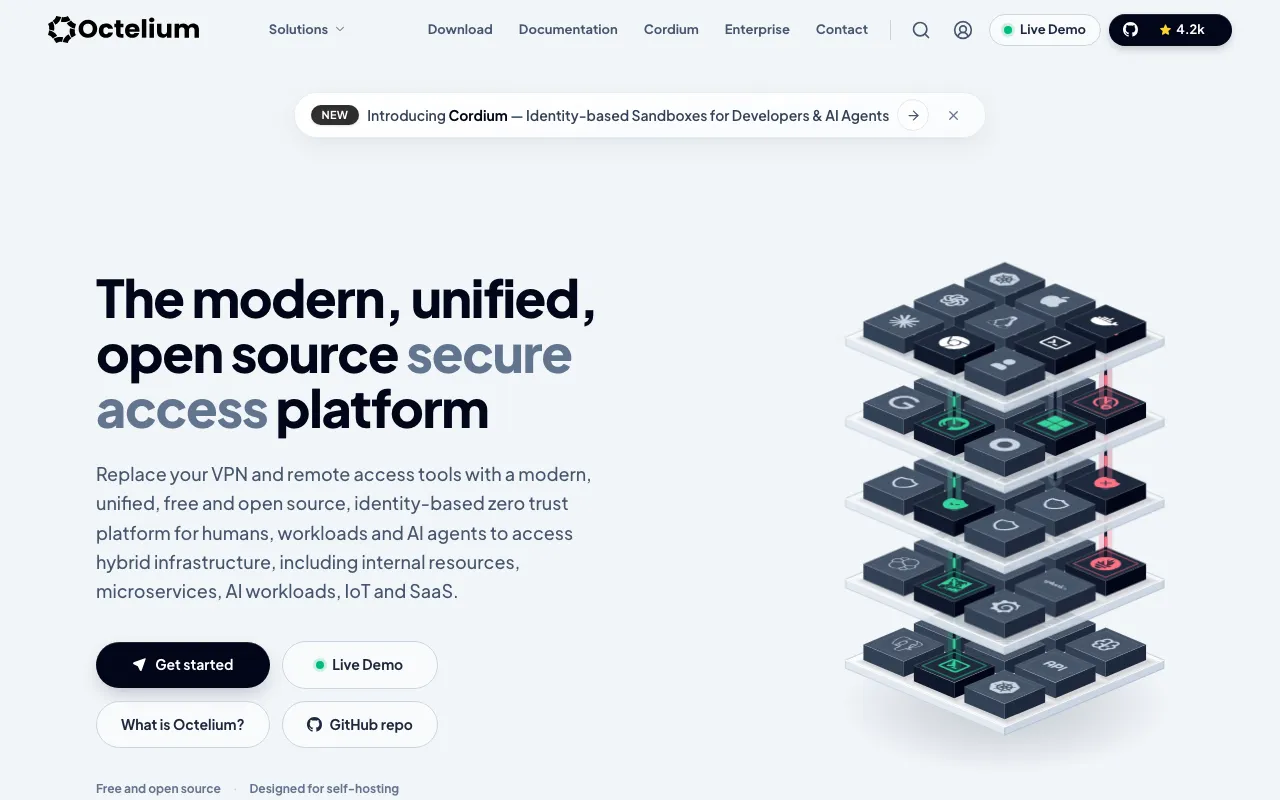
Octelium unifies VPN, ZTNA, secure tunnels, API and AI gateways, and PaaS-style deployments on Kubernetes you host yourself.
Octelium is a free, open-source platform for zero-trust secure access that you install on your own infrastructure. It can act as a remote access VPN, a ZTNA or BeyondCorp layer, a self-hosted tunnel and reverse proxy, an API or AI gateway, a deployment surface for containerized apps, or homelab connectivity.
Access can be client-based over WireGuard or QUIC tunnels or clientless through identity-aware HTTP proxies. Policies use CEL and OPA for per-request routing, secretless access to protected APIs and databases, and continuous authentication with common IdPs and MFA options.
Management is declarative through octeliumctl, similar to Kubernetes workflows, with OpenTelemetry-native auditing. Upstream services do not need to be Octelium-aware and can sit behind NAT or on localhost.
Cluster components are AGPLv3 while client tools use Apache 2.0. A single-node install on a small Linux VM is documented for personal or light production use.
“API Gateway: A self-hosted, scalable, and secure API gateway for microservices, providing a robust alternative to Kong Gateway or Apigee.” source
“Self-Hosted Secure Tunnels: A programmable infrastructure for secure tunnels and reverse proxies for both secure identity-based as well as anonymous clientless access, offering a powerful, self-hosted alternative to ngrok or Cloudflare Tunnel.” source
“Self-Hosted Secure Tunnels: A programmable infrastructure for secure tunnels and reverse proxies for both secure identity-based as well as anonymous clientless access, offering a powerful, self-hosted alternative to ngrok or Cloudflare Tunnel.” source
“Modern Remote Access VPN: A zero-trust, layer-7 aware alternative to commercial remote access/corporate VPNs like OpenVPN Access Server, Twingate, and Tailscale, providing both zero-config client access over WireGuard/QUIC and client-less access via dynamic, identity-based, context-aware Policies.” source
“Modern Remote Access VPN: A zero-trust, layer-7 aware alternative to commercial remote access/corporate VPNs like OpenVPN Access Server, Twingate, and Tailscale, providing both zero-config client access over WireGuard/QUIC and client-less access via dynamic, identity-based, context-aware Policies.” source
Open-source zero-trust overlay networking platform
OpenZiti hides services behind cryptographic identity, policy, and end-to-end encryption. It supports tunnelers for existing apps and SDKs for embedded zero trust.

Self-hosted WireGuard VPN with MFA and IAM
Defguard combines WireGuard VPN, identity and access management, multi-factor authentication, and network access control in one platform you can run on your own infrastructure.

Self-hosted access gateway with SSO and session recording
Werbot is an open-source access gateway that authorizes commands to servers and databases, records sessions, and shares access without handing out passwords. It supports Docker Compose and binary installs.

Multi-platform Clash Meta proxy client without ads
FlClash is a proxy client built on the mihomo (Clash.Meta) core for Android, Windows, macOS, and Linux. It supports rule routing, TUN mode, and subscription-based profiles.

Network-wide DNS sinkhole for ads and unwanted content
Pi-hole is a DNS sinkhole that blocks ads and unwanted content for every device on your network without client-side software on each device.

Web control panel for Xray-core proxy servers
3X-UI is a web panel for deploying, configuring, and monitoring Xray-core servers and many proxy or VPN protocols from one VPS or multi-node setup.