qmetrics.net

Yargs

Node.js command-line argument parsing library

Frameworks & PlatformsDesktop/CLI app
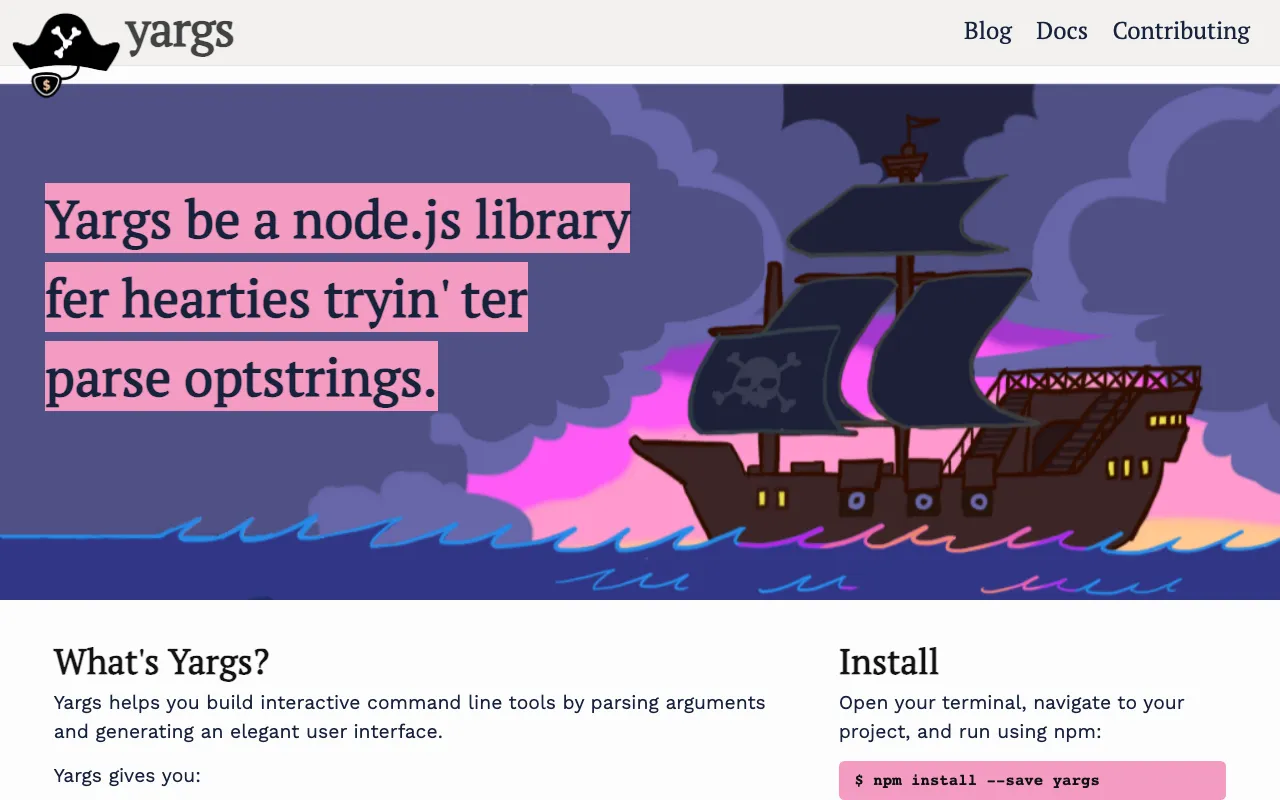
Yargs screenshot

Yargs is a Node.js library that parses CLI options and commands and builds help text for interactive command-line programs.

Overview

Yargs is a Node.js library for parsing option strings and structuring command-line applications. It succeeds optimist and helps authors define commands, grouped options, and generated help output rather than hand-writing argument parsing.

Applications can declare subcommands, positional arguments, defaults, and boolean or typed options. Yargs produces a help menu from those definitions and can generate Bash and Zsh completion scripts. Guides cover parsing tricks such as stopping the parser, negated booleans, arrays, objects, and quoted values, plus patterns for multi-command CLIs and custom parser configuration.

TypeScript users can rely on the separate @types/yargs definitions, and examples cover browser environments as well as Node. Installation is via npm as a project dependency, with hideBin recommended to strip the node binary path from process.argv before parsing.

Releases align with Node.js long-term support versions. The current major version requires at least Node v20.19.0, with older majors receiving security updates for a documented period.

Key features

  • Commands and grouped CLI options
  • Auto-generated help from definitions
  • Bash and Zsh completion scripts
  • Positional arguments and defaults
  • Configurable parser behavior
  • TypeScript type definitions via @types
  • Browser usage examples in docs
  • hideBin helper for process.argv

Use cases

  • Building multi-command Node.js CLIs
  • Generating --help without manual copy
  • Adding shell tab completion to tools
  • Parsing complex flags, arrays, and objects
  • Standardizing argv handling across scripts

Similar software

ECC

Open-source agent engineering toolkit for coding harnesses

ECC adds planning, verification, review, memory, skills, and security scanning to coding agents such as Claude Code, Codex, and Cursor. It installs as plugins, packages, and managed adapters across multiple harnesses.

★ 311.7k⟳ 8 days agoMIT
Frameworks & PlatformsDesktop/CLI app

React

JavaScript library for web and native user interfaces

React helps developers build interfaces from reusable components that manage their own state. Views update declaratively when underlying data changes.

★ 253k⟳ 2 days agoMIT
Frameworks & PlatformsDesktop/CLI app

Flutter

Open-source UI framework for multi-platform apps from one codebase

Flutter is an SDK for building user experiences for mobile, web, and desktop from a single codebase. It uses the Dart language and compiles to native machine code or web targets.

★ 181.5k⟳ todayBSD-3-Clause
Open Source Alternative to:Ionic Enterprise

Bootstrap

Responsive HTML, CSS, and JavaScript front-end toolkit

Bootstrap supplies CSS, JavaScript, and Sass-based styles for building responsive, mobile-first sites. It ships prebuilt grid layouts, UI components, and optional JavaScript plugins.

★ 175.1k⟳ 2 days agoMIT

Langflow

Visual low-code builder for AI agents and workflows

Langflow is a visual builder for AI agents and workflows. Flows can be customized in Python and deployed as an API or as an MCP server, with support for major LLMs and vector databases.

★ 157k⟳ todayMIT
Open Source Alternative to:Relevance AIVoiceflow

LangChain

Framework for agents and LLM-powered applications

LangChain helps developers chain interoperable components and integrations to build agents and LLM-powered applications. It offers a standard interface for models, embeddings, vector stores, and related pieces.

★ 150.1k⟳ 2 days agoMIT






